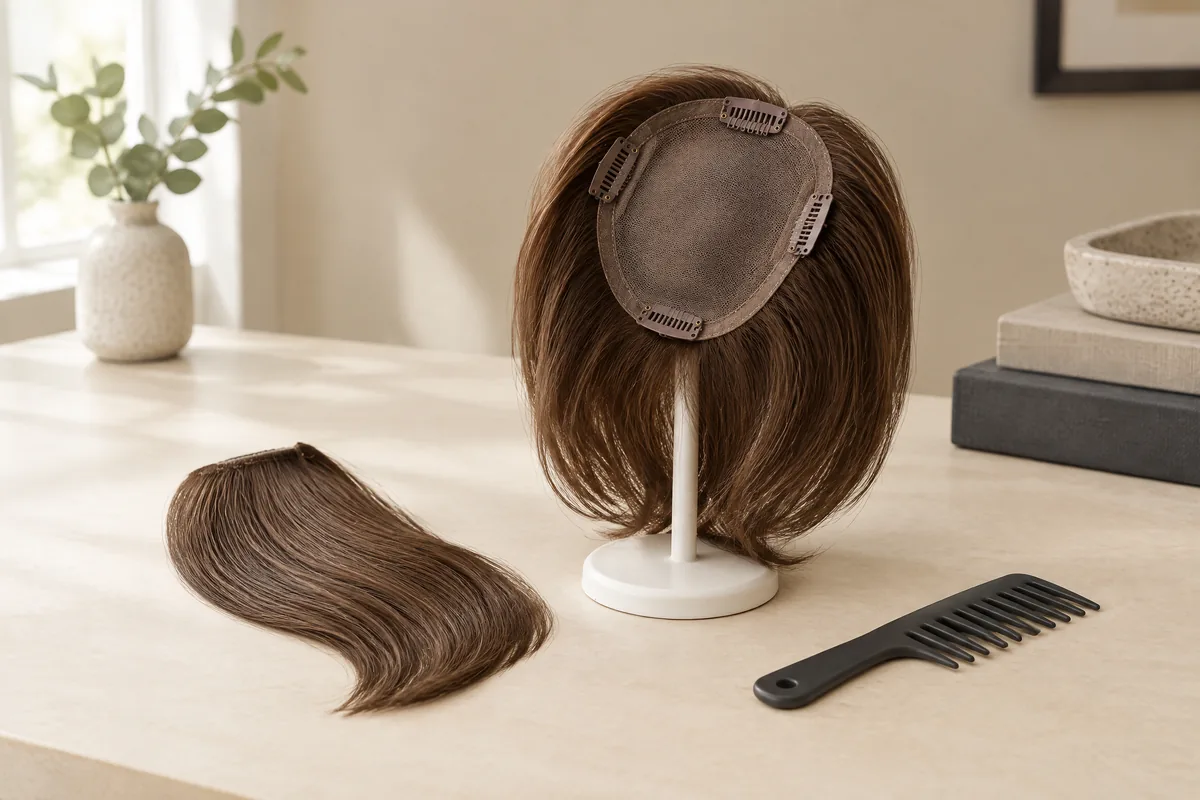
A topper choice becomes easier when you map the visible area first: a short widening part usually calls for focused coverage, while a broader crown concern may need a larger base or a full wig. Then compare placement, colour, texture and the amount of your own hair you want to keep visible—not just the style photograph.
Start with the appearance goal, not the label
A hair topper is a partial piece placed over a selected area, while a full wig is designed to cover the whole head. The distinction is cosmetic: it helps you choose the silhouette and amount of coverage you want, but it does not diagnose why hair has changed. The American Cancer Society makes the same practical distinction between a topper that adds coverage and volume on top and a full wig that covers the entire head 1.
A useful first question is: “What do I want someone to notice less?” It may be a visible part line, a flatter crown, or a general change in density across the top. A second question is: “What do I want to remain mine?” Some wearers want their sides, fringe or lengths to frame the piece. Others prefer a complete, consistent shape. Neither preference is more correct.
For a wider menu of whole-head silhouettes, compare women's wigs by coverage and fit. A category name cannot tell you whether a particular cap, fibre or size will suit your routine, so treat it as a route to comparison rather than a result.
Cosmetic rule of thumb: choose the smallest coverage that softens the visible area you care about while leaving enough surrounding hair to make the transition look intentional.
Map the visible area in your usual parting
Before looking at colours or fibres, part your hair as you normally do. Note where the visible line begins, where it ends, and whether the exposed area continues towards the crown. This map is more useful than a label such as “small topper” or “natural volume”.
A short line near the front may be visually improved by a compact part-covering base. If the line continues backwards, a base that ends at its centre can leave the uncovered ends obvious. An oversized base can ask more of the surrounding hair: its perimeter may need concealing, and added density can change the outline more than intended.
Part coverage and crown coverage are different jobs
A part-focused choice aims to soften a line. A crown-focused choice aims to make a wider zone look fuller or more lifted. Consider the view from the front, sides and above. For a focused comparison, read the hair topper for widening part guidance alongside your own parting map. A piece that looks right in a top-down image may feel too full at the temples; one that looks subtle from the front may not reach the back of the crown.
| Visible goal | Coverage question | Blending question | Main trade-off |
|---|---|---|---|
| Soften a short part line | Does the base cover the full visible length? | Can nearby hair meet both sides? | Less coverage may leave ends exposed |
| Soften a longer part | Does the base extend beyond the line? | Can front and crown textures agree? | More coverage can alter density |
| Add crown fullness | Does the footprint reach the flat area? | Is there enough perimeter hair? | A larger silhouette may feel unfamiliar |
| Change the whole outline | Would full-head coverage be clearer? | Does it frame your face as intended? | Less of your own hair remains visible |
The goal is not to hide every strand. It is to create a controlled transition between the piece and the hair you have chosen to show.
Choose the base by placement and edge behaviour
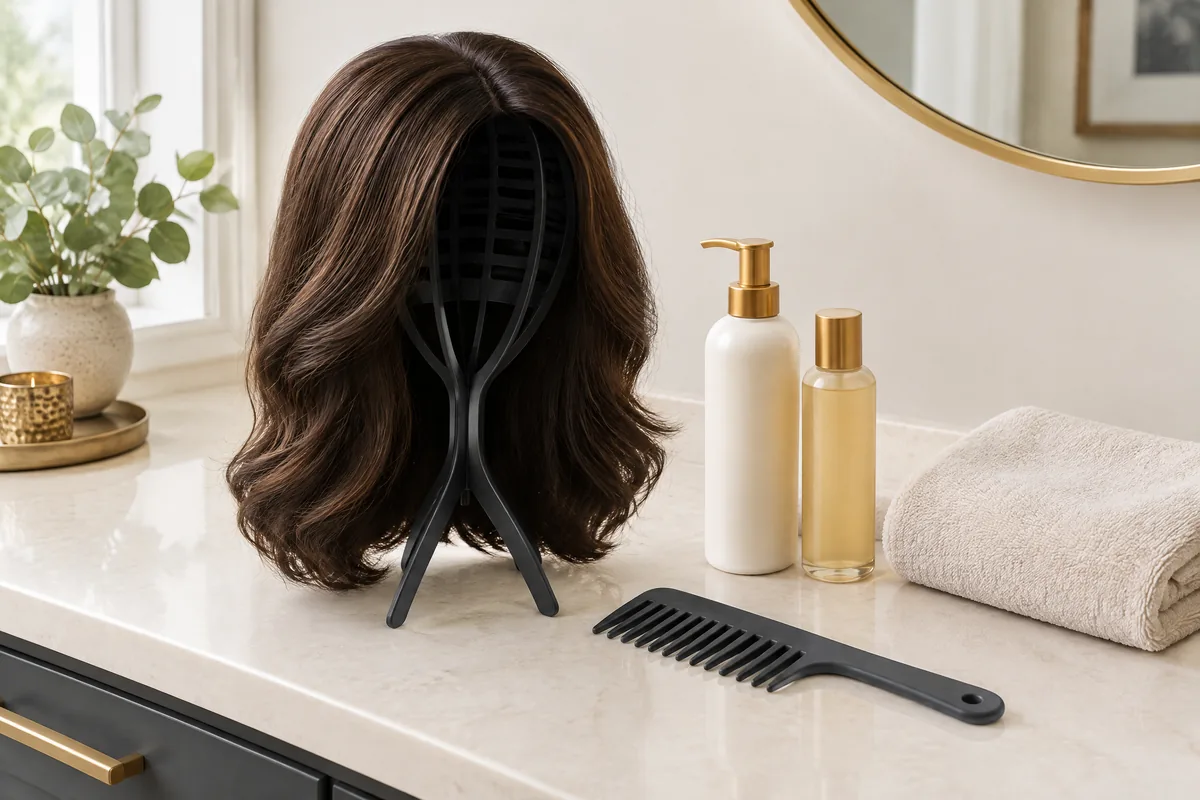
Once you know the area, check the exact base dimensions. A topper’s footprint is a coverage specification, not a promise of fit. Ask where attachment points sit, which edges meet your hair, and whether the construction leaves your preferred part visible. Do not infer those details from an image or another model.
Placement matters because the same piece can read differently when shifted forward, back or to one side. Mark your normal part, then imagine the base centred over the visible zone. If the front edge sits too far forward, it may compete with your fringe. If it sits too far back, the original concern can remain visible. If the sides land where there is little hair to blend, the perimeter can become the focus.
Monofilament, silk-top and other construction names describe base features; they do not automatically state size, attachment method or suitability for your crown. Ask for exact measurements and construction instead of translating a term into a guaranteed appearance.
Compare hair, colour and texture as one blend
A convincing blend is rarely just a shade match. Compare the topper with hair around the intended placement, including root-to-length variation, grey strands, wave pattern and finish. A dark brown piece beside black hair may look close indoors but separate in daylight. A smooth topper over waved lengths may create a boundary even when colour is near-perfect.
Use the three-neighbouring-zones check
Look at front, side and back transitions separately. The front tells you whether the part feels deliberate. The sides reveal abrupt density changes. The back shows whether length and movement continue. If one zone fails, changing colour alone may not solve it; base size, length or texture may need reconsideration.
| Detail | What to compare | Why it changes appearance | Question to ask |
|---|---|---|---|
| Root and lengths | Tone near part versus mid-lengths | One shade can look flat beside dimensional hair | Can the colour be viewed in suitable light? |
| Texture | Straight, wave, curl and finish | Mismatch makes the join visible | Can the piece match the texture? |
| Density | Topper fullness versus sides and ends | Contrast changes the silhouette | Is the aim subtle or visibly fuller? |
| Length | End point relative to your hair | A sharp break draws attention | Would styling be needed, subject to instructions? |
| Grey or mixed tones | Distribution, not average colour | Grey may be scattered rather than uniform | How are mixed tones shown on the model? |
A reference image communicates style mood, not proof of identical colour or finish. If a specification is missing, record it as unknown rather than assuming.
Decide how much change you actually want
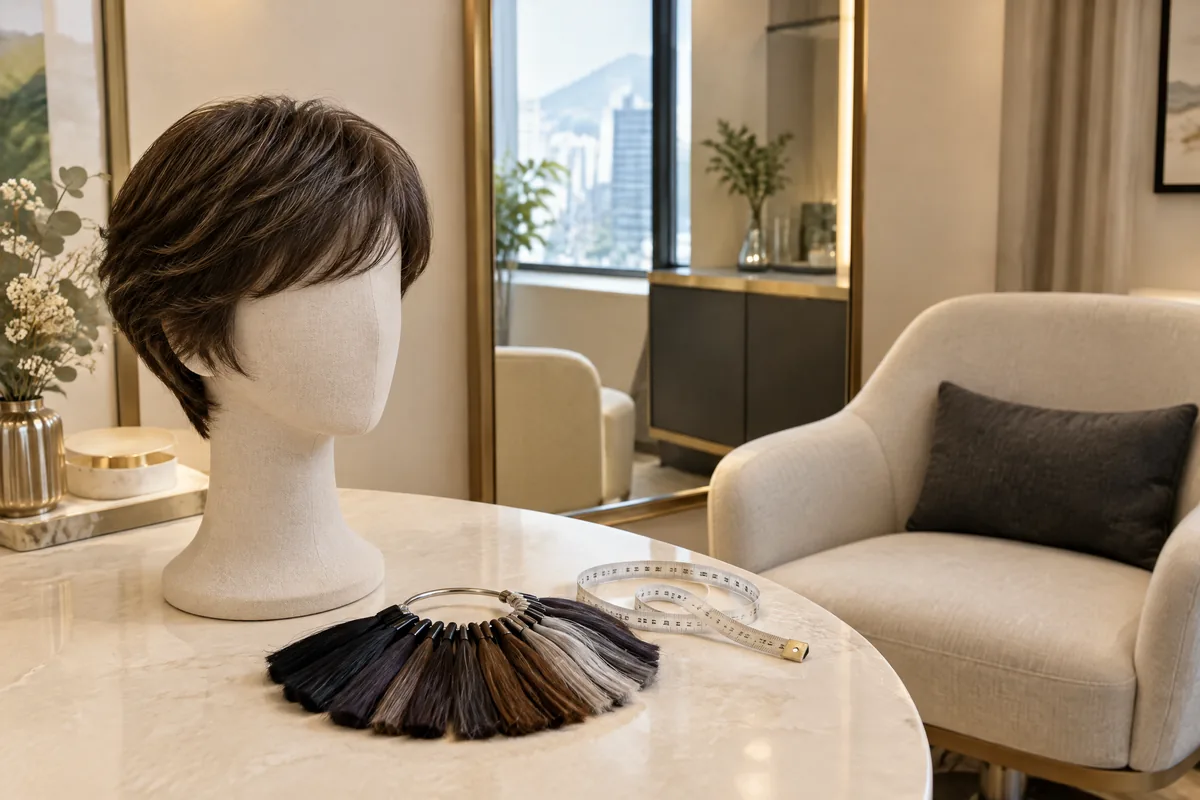
Two toppers with similar footprints can create different effects because density, length and part placement alter the silhouette. Decide whether your aim is quiet continuity or a noticeable style refresh. “Natural-looking” can mean that proportions, movement and placement look purposeful, not that the piece is invisible.
A focused piece may preserve more of your own hair and stay close to a familiar hairstyle. The trade-off is greater dependence on accurate placement and blending. A larger topper can simplify coverage over a broad crown, but may require more adjustment at the perimeter. A full wig can create the most consistent outline, while showing less of your own hair.
Consider normal settings too. An office parting, windy commute and tied-back style expose different edges. Select for the moments you care about, not only the best mirror angle.
Ask for facts before comparing prices
Before an enquiry, prepare a short specification list:
- The visible area: front part, mid-part, crown or wider top zone.
- The approximate length of the visible line or crown area.
- Base footprint and attachment details for the exact model.
- Fibre, length, colour options and care instructions.
- Where your own hair will remain visible and blend.
- Return or exchange terms for a ready-described item.
- Confirmed price and supply, rather than assuming a catalogue listing is inventory.
hair toppers are easiest to compare when these details stay model-specific. Separate coverage, attachment, fibre, base construction, length and colour; one attractive feature cannot stand in for all the others.
If you prefer a consultation, describe the area and desired silhouette in appearance terms. You need not disclose personal medical details to discuss a style. Ask what is confirmed and what still needs checking.
Keep comfort and health questions separate
A topper is an appearance choice. It may help someone feel more comfortable with how hair looks, but it is not a treatment or a way to make hair regrow. The American Academy of Dermatology says wigs and concealers can offer immediate cosmetic results and may support self-esteem, while they cannot slow hair loss or regrow hair 2.
If hair change is sudden, painful, associated with scalp symptoms, or connected with chemotherapy or another treatment, ask a qualified healthcare professional what is appropriate to wear. The NHS advises speaking with a GP or dermatologist before starting or stopping hair-loss treatment, and notes that people may choose wigs—or choose not to cover up—as part of coping 3. A product description cannot assess sensitive skin, attachment tolerance or medical suitability.
Follow the exact maker’s instructions. Do not use heat on synthetic fibre unless product information permits it, and do not assume a base term tells you the correct cleaning routine. Comfort is part of appearance because repeated adjustment can change where a piece sits.
A practical five-minute decision sequence
Use this order when two styles seem equally attractive:
- Circle the visible zone. Mark the full part or crown area you want softened.
- Choose coverage level. Decide whether focused, broader partial or full-head coverage matches the silhouette.
- Check the perimeter. Identify where your own hair meets the base.
- Compare three zones. Review front, sides and back for colour, texture, density and length.
- Confirm unknowns. Ask for dimensions, attachment, fibre, care, price and supply.
This prevents choosing a beautiful style first and then asking it to solve a different visual problem. Start with the visible map, and style becomes a comparison rather than a guess.
Questions & answers
Can a hair topper cover a widening part?
It can provide cosmetic coverage over a parting area when the base extends across the visible length and surrounding hair can blend around its edges. Compare the full line, not only its centre, and confirm the footprint and attachment.
Should I choose a crown topper or a part-covering topper?
Choose by the area you want to soften. A part-covering piece suits a focused line; a crown topper is considered when the broader top looks flat or lacks visual fullness. Compare the perimeter and silhouette from several angles.
Is a larger topper always more natural?
No. A larger base may cover more, but it also changes density and asks more of the surrounding hair at the edges. The better size reaches the visible zone while supporting a proportionate transition.
How do I match a topper to highlighted or grey hair?
Compare root tone, lengths, texture and the distribution of lighter strands in suitable light. Shade names and screen images are starting points only. Ask how the exact model’s colour can be checked.
Can I wear a topper if my scalp is sensitive or I am having chemotherapy?
Ask your healthcare team first about what is appropriate for your scalp and treatment. Attachment, friction and materials vary. This guide cannot diagnose irritation or confirm medical suitability; follow clinical advice and maker instructions.
Put the next step into practice
For a structured introduction to cutting and styling, explore the learning options at Canvas. Hong Kong hair styling courses。
Read more practical notes on hairstyles and preparation for everyday routines. Canvas beauty journal。
Tell the team about your learning goal or styling request. Contact Canvas Academy。
Sources & further reading
- American Cancer Society: Choosing and Wearing a Wig
Supports topper versus full-wig coverage and checking fibre, fit, colour and care.
- American Academy of Dermatology: Hair Loss—Diagnosis and Treatment
Supports immediate cosmetic results from wigs and their limits: they do not slow loss or regrow hair.
- NHS: Women and Hair Loss—Coping Tips
Supports wigs as an optional covering choice and medical advice before treatment changes.