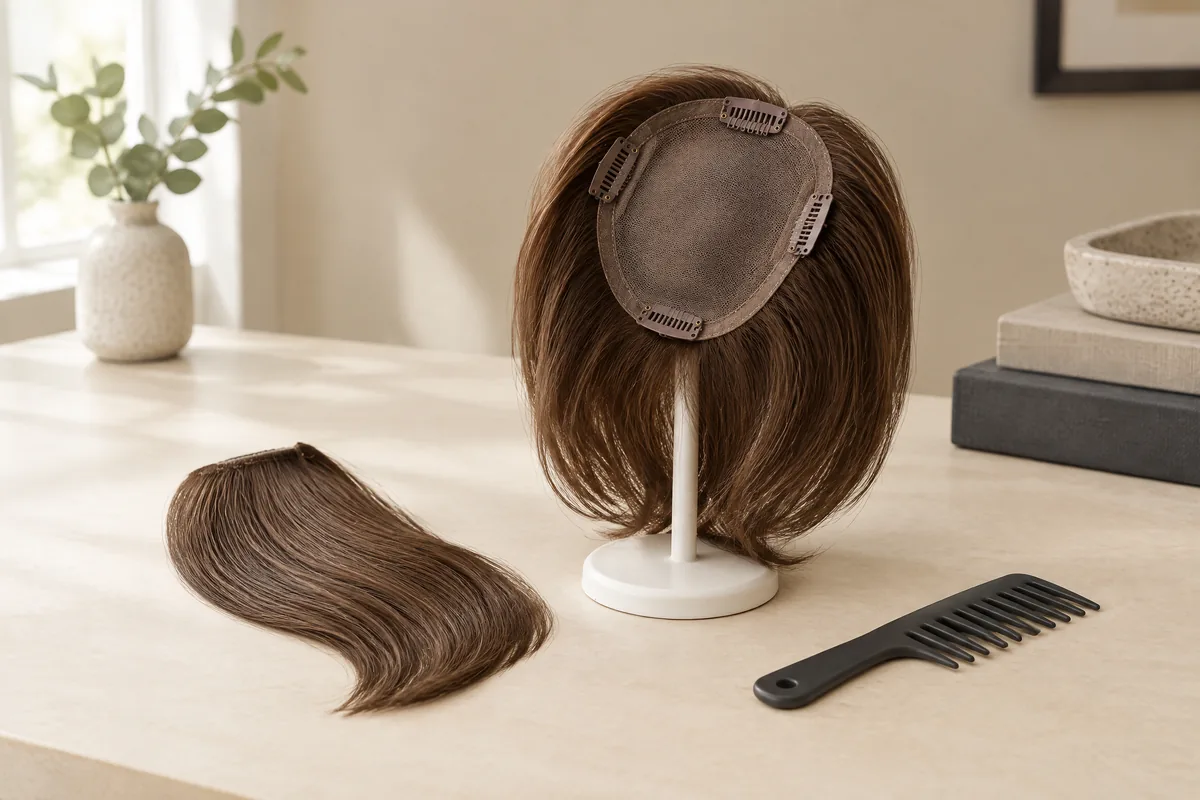
Why “average” is only a starting point
Wig cap sizes are useful categories, not a universal measuring system. Petite, average and large can differ between makers. Two caps with the same label may also sit differently because their depth, shape, ear tabs and construction are not identical. The American Cancer Society advises checking the individual brand chart because wig sizing can vary slightly between brands. 1
A tape reading is therefore a selection input, not a guarantee. A cap may feel comfortable at the nape but press at the temples, or feel roomy at the crown while the front looks right. Ask: which measurements does this cap use, and how will I wear it?
Keep three layers separate:
- Size: the space the base provides around and across your head.
- Tension: the limited change made by a strap, tab or fastening.
- Securing feature: an attachment such as a comb, clip or separate grip.
Tightening a strap cannot make a small base larger. Adding a clip cannot correct a cap that already presses. A wig can contain all three features and still be the wrong shape.
Measure your head in a repeatable way
Use a flexible, non-stretch tape. Arrange your hair, braid, wrap or liner as you normally intend to wear it under the wig. If your hair will be flatter on ordering day than on a later wearing day, record both situations. The point is to measure the wearing setup, not an imaginary one.
A four-step home measurement
- Place the tape at the front hairline.
- Guide it above the ears and around the fullest part of the back of the head, including the nape.
- Keep it level and comfortably snug; do not compress the skin.
- Record the number and unit, then repeat the route without changing the start point.
The American Cancer Society also describes front-to-back and ear-to-ear measurements, alongside circumference, and says to compare the largest measurement when a result does not match a chart exactly. 1 These dimensions matter when a cap feels tight in one direction but not another. Ask someone to check that the tape has not slipped upwards behind your ears.
| Measurement | What it tells you | How to make it useful |
|---|---|---|
| Circumference | Route around the head | Keep the tape level above ears and around the nape |
| Front to back | Cap depth requirement | Follow the centre line from front hairline to nape |
| Ear to ear | Width across the top | Use the route specified by the maker’s chart |
| Wearing setup | Space needed on the day | Note hair, liner and flattening method |
Do not round a borderline result before checking whether the chart uses centimetres or inches. If two readings differ, reposition the tape and repeat. Averaging visibly different routes can create a neat number that describes neither fit.
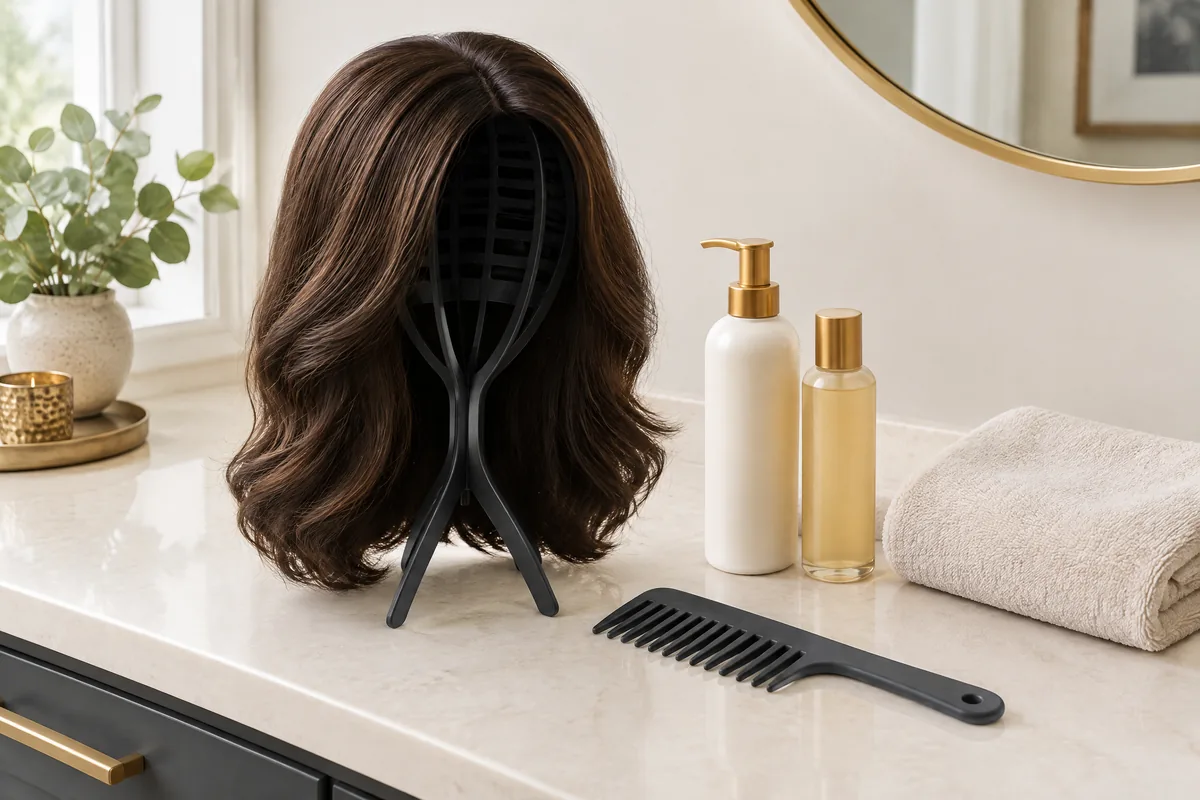
Compare the chart with the exact cap
Open the sizing information for the selected item, not a generic chart copied from another style. Check whether it gives circumference only or also front-to-back, ear-to-ear, cap depth and an adjustment range. Construction may matter as much as the label.
The wig cap sizes guide uses the same practical principle: measure along the hairline, above the ears and around the nape, then compare with the exact style’s information rather than assuming “average” means the same everywhere.
| Before ordering | What to confirm | Why it matters |
|---|---|---|
| Your measurements | Circumference and other available dimensions | One number may hide a shape mismatch |
| Cap label | Petite, average, large or another system | Labels are not shared standards |
| Construction | Lace front, wefted, monofilament or hand-tied details | Base shape affects how it sits |
| Adjustment | Tabs, strap, elastic or none stated | Tension has a limited range |
| Exchange terms | Window, exclusions and possible fees | Photos cannot confirm personal fit |
If a measurement sits on a boundary, ask for actual dimensions and how the cap is intended to sit. For an online purchase, check the return or exchange policy before opening or altering the item; the American Cancer Society recommends doing this in advance. 1 For an in-person fitting, bring the liner or hair arrangement you expect to use. A cap that fits bare hair may feel different over a liner.
Use adjustable tension as a finishing tool
An adjustable strap, hook, tab or similar fastener usually changes tension near the nape or sides. It can help a correctly chosen cap sit closer, but it cannot enlarge the base, reshape the crown or promise that the wig will not move. Treat it as a small finishing control.
Use this sequence:
- Put the cap on in its intended position, with front and ear tabs aligned.
- Identify the actual fastener instead of pulling a seam or decorative elastic.
- Make one small change.
- Recheck the front, both sides and the nape.
- Stop if pressure, pinching or uneven tension increases.
The adjustable wig straps guide makes the same distinction: a nape adjustment may fine-tune local fit, while widespread tightness or looseness calls for checking size and shape. Designs have different ranges, so never infer one strap’s action from another wig.
A strap can create false security. If the nape becomes closer but the temples lift, one symptom was changed while another mismatch appeared. Return to the last comfortable setting and describe the issue precisely: loose at the nape, pressure around the perimeter, a crown gap or movement after turning your head.

Decide whether clips or combs suit the anchor
Clips and combs are not tension adjusters. A comb has teeth intended to engage with suitable hair; a clip opens around a section. Both depend on placement and enough comfortable hair to anchor them. With little or no hair at that point, the feature may not provide the support expected.
Turn the cap inside out and inspect it gently before wearing or altering it. Look for attachments at the front, sides or back. Check that they lie flat when closed and that stitching appears intact. Do not tug seams, repeatedly bend a fastener or sew a new one into an unfamiliar base without checking the maker’s instructions.
The wig clips and combs guide explains why attachment features should be assessed with the cap and your own hair together. A clip that catches comfortably may still be a poor answer to an overall size problem; pulling it tighter can create a pressure point.
If there is suitable hair at the attachment points, clips may be convenient for everyday positioning. With little hair, a separate grip or another cap design may be more relevant. Neither is automatically better. Test one arrangement at a time so you know what changed comfort or movement.
Make comfort part of the fit test
Check the pressure map, not just whether it stays on
A fit is not confirmed merely because the wig stays on for a minute. Check the front hairline, ear tabs, temples, crown and nape. Walk around, turn your head gently and sit down. Aim for balanced contact without headache, pinching, sharp pressure or a constant need to readjust. Check the front hairline, ear tabs, temples, crown and nape. Walk around, turn your head gently and sit down. Aim for balanced contact without headache, pinching, sharp pressure or a constant need to readjust.
A liner changes the required space, so include it in the test. Cancer Research UK notes that some people experience scalp sensitivity during treatment and may choose soft fabric products or liners; it also advises asking a wig fitter when choosing and fitting a wig. 2 If chemotherapy, a skin condition, rash, broken skin or unusual tenderness is involved, let your oncology or medical team guide what is appropriate. A wig is an appearance option, not a diagnosis or treatment.
In Hong Kong’s warm, humid weather, wearing time, ventilation and sweat are separate comfort questions. A loose nape, a sweaty liner and a tight temple need different responses. Record when discomfort starts and where it occurs.
Comfort rule: if stopping movement requires pain, the fit is not confirmed. Return to the last comfortable setting and reassess size, shape and securing method.
A practical order-to-fitting checklist
Use this process for the selected item:
- Measure twice with the intended hair or liner arrangement.
- Save the exact chart, cap dimensions and adjustment details.
- Mark whether the issue is size, local tension, attachment or comfort.
- Try the cap in position before changing a fastener.
- Make one small adjustment, then check all sides again.
- Inspect clips or combs and use them only where the anchor is suitable.
- Move gently while checking pressure and shifting.
- Confirm the final fit for that specific item and record the setting.
This order prevents a securing feature from hiding a size mismatch. It also makes a later discussion clearer: you can state measurements, chart details, fastener position and the exact place that feels wrong.
If buying online, keep packaging intact until you have checked the policy and confirmed that trying on is allowed. If buying in person, ask what is included, where the cap adjusts and whether the style has another size or construction. A photo or general category cannot establish personal fit; the selected item must be checked.
When to pause and ask for help
Pause rather than forcing a fastener if you notice persistent pain, numbness, broken skin, rash, marked itching or headache. Remove the wig and seek clinical advice for ongoing scalp symptoms, especially during cancer treatment. Do not use adhesive, clips or a tight band to cover a medical concern.
For ordinary fit questions, ask a wig fitter or seller: Which measurement does this size represent? Where is the adjustment range? Will this liner add bulk? Are the clips intended for hair at these locations? The answer should relate to the exact style, not a broad label.
A sound decision is a documented match: measured head, selected cap, limited tension adjustment, suitable securing feature and comfort check. That method is more reliable than choosing by “average” or tightening until the wig feels immovable.
Questions & answers
Is an average wig cap size the same across all brands?
No. Petite, average and large are broad labels, and measurements and shape differ by maker and style. Compare your measurements with the exact item’s chart.
Can an adjustable strap fix a wig that is too small?
Usually not. A strap fine-tunes local tension within its range. Widespread pressure means reassessing cap size, shape or construction.
Do wig clips and combs work without natural hair?
They depend on a suitable anchor, so they may not provide expected support when little or no hair is available. Check cap, hair and comfort together.
How tight should a wig feel when first fitted?
It should feel balanced and comfortable, not painful or compressive. Check all sides and move gently; persistent pressure means reassess the cap.
What should I do if my scalp becomes sore under a wig?
Remove the wig and pause straps, clips or adhesives. For persistent symptoms, broken skin, rash or treatment-related sensitivity, seek advice from your medical team.
Put the next step into practice
For a structured introduction to cutting and styling, explore the learning options at Canvas. Hong Kong hair styling courses。
Read more practical notes on hairstyles and preparation for everyday routines. Canvas beauty journal。
Tell the team about your learning goal or styling request. Contact Canvas Academy。
Sources & further reading
- American Cancer Society: Wigs for Hair Loss
Explains circumference, front-to-back and ear-to-ear measurements; warns that charts vary by brand; describes adjustable tabs and return-policy checks.
- Cancer Research UK: Wigs, hats and scarves
Supports wig-fitter advice, allowance for changing hair volume, and soft fabrics or liners for sensitive scalps.