
A natural-looking wig is judged by the whole finish: the front outline, parting, fullness, colour, movement and fit must agree with your everyday styling. Start by comparing the exact piece in the way you plan to wear it, then ask the supplier to confirm fibre, construction, care limits and any alteration terms before you commit.
What “natural” means at the mirror
“Natural-looking” is not a single cap type or a promise attached to one label. It is the visual result of several small relationships: where the front begins, how the part meets it, whether the density suits the cut, and whether the colour sits comfortably beside your brows and complexion. A lace front may soften the visible edge, but a front alone cannot correct an unsuitable size, an overly heavy crown or a part you never wear.
A useful test is to view the wig from the front, side and three-quarter angle in steady daylight. Look first at the outline rather than the surface shine. Then move your head, change the part if the construction allows it, and notice whether the hair settles into a believable direction. Screens and shop lighting can flatten these differences, so a sample or fitting is more informative than a product name.
1 supports a practical point that is easy to overlook: wig sizing can vary by brand. That makes “average” a starting label, not a measurement. Ask for the exact cap dimensions, adjustment range and fitting process. Comfort is part of the finish because a cap that shifts will change the hairline you are trying to assess.
Finish check: If you would normally wear a side part, fringe or hair tucked behind one ear, judge the wig that way. A front that looks convincing only when styled against your routine is not yet a useful comparison.
How to read the visible hairline
The hairline is the first area many people inspect, but it should be read as a transition rather than a standalone feature. Check whether the edge has an even, abrupt look or a softer variation. Notice the temples, the distance between the front and the part, and how the first few strands fall when the hair is brushed forward or away. A fringe can conceal more of the front; a swept-back style reveals more, so the same wig can make a different impression in each arrangement.
A lace-front construction can create the visual impression of hair emerging close to the skin, but construction names do not describe every detail of every piece. Ask what is actually specified for the style: front material, parting options, edge density, adjustment points and whether any trimming or shaping is included. Do not treat “natural hairline” as proof of a particular base or as a guarantee for every wearer.
OWNSTRAND’s guide to natural-looking wigs makes the same whole-look distinction: fit, colour, density and styling work together, while exact construction and care need checking for the individual style. That is a useful conversation framework, not an independent product verdict.
A three-angle hairline checklist
- Front: Is the edge proportionate to your forehead and intended part? Does the colour transition look calm in daylight?
- Side: Does the temple area lie flat without an obvious step or excessive bulk? Does the cap remain in place when you turn?
- Movement: After a gentle change of direction, does the hair fall in a way you can maintain? If not, ask what adjustment is allowed rather than altering it yourself.
Avoid making a decision from one close-up image. A polished photograph may show a styled concept rather than the exact finish you will receive. Ask for the style’s stated measurements and an explanation of what can and cannot be adjusted. Supplier conditions matter particularly when a cut, thinning, colouring, heat styling or other alteration is proposed.
Density: fullness, not fibre thickness
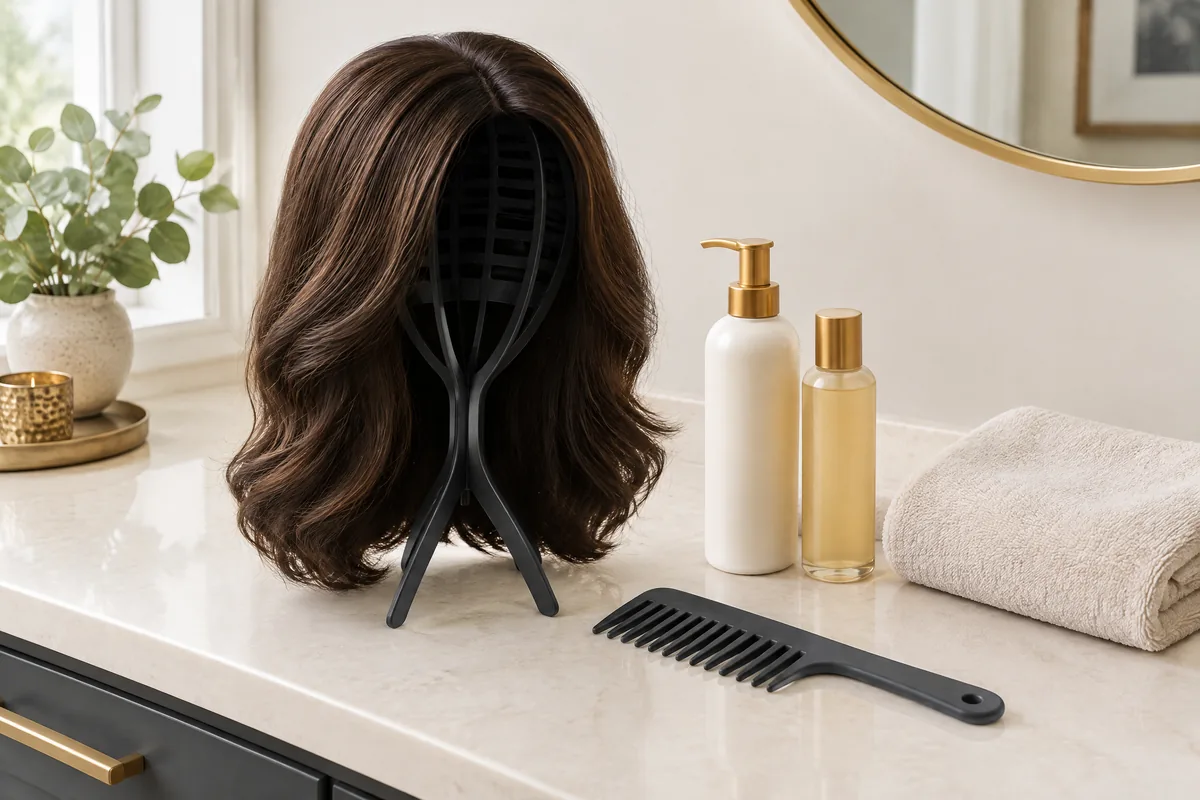
Wig density describes the overall amount of hair contributing to coverage and silhouette. It does not mean that each individual fibre is thick or coarse. A fine fibre can still create a full outline when there are more strands, while a substantial-looking fibre can appear airy in a lighter arrangement. Length, layering, blunt ends, colour and parting all change the visual result.
For a fuller explanation of labels, see wig density before comparing options. Density percentages are not a universal scale. The same number can look different across makers or across cuts, so use a stated figure as a question rather than a verdict. Ask what the term means for that exact piece and compare similar lengths and shapes. A short blunt bob and long layered hair should not be treated as a like-for-like density test.
| Fullness description | What you may see | Better question to ask |
|---|---|---|
| Lighter-looking | A closer, quieter outline; ends may feel less substantial | How does this style look at the crown, sides and ends with my usual part? |
| Medium-looking | Visible body without an intentionally dramatic silhouette | Is the comparison based on the same length, layering and fringe? |
| Fuller-looking | More presence, movement or volume through the lengths | Can I see the front and side, and how much arranging will the shape need? |
| Stated percentage | A maker-specific description, not a universal promise | What does this percentage mean for this individual wig? |
1 also notes that sizing varies by brand, which is why density and fit should be checked separately. A lighter visual density is not automatically physically lighter, cooler or easier to care for. Those qualities depend on the cap, fibre, length and instructions for the particular piece.
The most useful comparison keeps one variable steady. View two similar cuts, or ask the supplier to explain how the desired density is distributed. Then judge whether the outline works with your clothing, glasses and normal parting. “More natural” is not synonymous with “lowest density”; the better choice is the one whose proportions make sense for your face and routine.
Fibre language: human hair, synthetic and Remy
Separate material from marketing language
Fibre terminology answers a different question from density. Human hair and synthetic fibres have different handling requirements, and a blended design may have still other limits. 2 explains that human-hair wigs generally offer more styling flexibility but usually require more maintenance, while synthetic wigs can be lighter and easier to look after. Neither category is automatically better for every daily routine.
Remy is commonly used to describe human hair whose cuticles are kept facing in one direction. It is not, by itself, a certificate of virgin hair, a single donor, a country of origin, a complete processing record or a durability guarantee. Non-Remy is a broad contrasting term; it does not provide a full manufacturing history either. Ask the seller to define the term for the exact style and state what is confirmed rather than filling gaps with assumptions.
OWNSTRAND’s Remy human hair wigs comparison usefully separates the label from the questions that matter: disclosed processing, construction, care and any styling limits. This is especially important when two wigs sound similar but have different supplier conditions.
| Fibre question | Why it changes the finish | What to confirm before buying |
|---|---|---|
| Is it human hair, synthetic or blended? | Movement, sheen and maintenance may differ | Exact material description for the style |
| If “Remy” is used, what does it mean here? | Cuticle direction is only one part of the specification | Definition, processing disclosed and what remains unknown |
| Can heat or chemical work be used? | An unsuitable tool or treatment can damage fibres | Written product instructions and supplier limits |
| How is it washed, dried and stored? | Care affects the finish you see between wears | Style-specific routine, not generic advice |
Do not transfer a heat setting, colouring method or conditioning routine from another wig. The American Cancer Society advises against using dryers or curling irons unless a wig is heat-resistant, and says product instructions should be followed. A generic tip is not permission to alter a particular piece.

Turn a finish preference into supplier questions
Before contacting a supplier, describe the result in observable terms. “Soft at the temples,” “a close crown,” “a side part that stays visible” or “moderate movement at the ends” gives a clearer starting point than “make it natural.” Bring one or two reference images for shape, but treat them as style references, not proof that an identical result is available.
Use this five-part message:
- Wear pattern: part, fringe, tuck, updo or hair left forward.
- Silhouette: close, balanced or visibly full; include preferred length.
- Hairline: how much of the front and temples you expect to show.
- Material: fibre wording, Remy definition if relevant, and disclosed processing.
- Conditions: fitting, returns, permitted cutting, heat, colouring, washing and storage.
Ask for a reply that distinguishes “included,” “possible after assessment” and “not permitted.” That simple classification prevents a broad promise from being mistaken for a product term. It also leaves cutting, thinning, heat styling and other alterations with the supplier’s conditions, as they should be.
A small budget example can make the decision concrete without pretending to predict a price. Suppose a reader sets aside HK$3,000 for the wig and HK$300 for transport and accessories: the working ceiling is HK$3,300. If a quote is HK$2,780, only HK$520 remains for those extras. This is arithmetic for planning, not a recommendation or a statement of current availability. Request a current quotation and confirm what the price includes.
Comfort, scalp and medical situations
Comfort is not a cosmetic afterthought. A cap that rubs, feels unstable or traps heat may change how long you can wear it and how you style it. Try the intended part and movement, sit and stand, and notice pressure at the temples and nape. Ask whether a liner or grip is compatible with the cap, because an added layer can change fit.
If you are having chemotherapy, have a sensitive scalp, a skin condition or sudden unexplained hair loss, involve your oncology team, doctor or dermatologist before choosing adhesives, tapes or products.
Macmillan Cancer Support notes that scalp sensitivity can matter during treatment. Ask your healthcare team about skin contact and use the specific wig supplier’s care directions. 2
The American Academy of Dermatology explains that diagnosis starts with finding the cause of hair loss. A dermatologist can assess that question; a wig changes appearance but does not diagnose or treat the cause. 3
Stop wearing a piece if it causes persistent pain, marked irritation or worsening symptoms, and seek appropriate clinical advice. Do not use this checklist to self-diagnose. For a medical-hair-loss purchase, also ask about returns and whether measurements may change as hair changes; 1 recommends checking the exact brand’s sizing and return terms.
Safety boundary: Never assume that “human hair” means every heat tool or chemical service is safe. Never assume that “synthetic” means one universal fibre. The label, instructions and supplier’s conditions govern.
Your final five-minute finish audit
Before paying, run the same audit each time. It turns a subjective impression into a repeatable decision without pretending that appearance can be reduced to one score.
- Hairline: Can you explain what you like about the edge, temples and part in plain words?
- Density: Have you compared the silhouette from front and side, not just a number?
- Fibre: Is the material and any Remy terminology defined for this exact piece?
- Fit: Does it stay positioned through normal movement, with any planned liner or grip?
- Care: Do you have written instructions for washing, storage, heat and alterations?
- Terms: Are quotation, fitting, availability, returns and supplier responsibilities clear?
If one answer is unknown, mark it as unknown rather than guessing. A transparent “not confirmed” is more useful than an impressive-sounding label. The finish you can maintain every morning is usually a stronger choice than a dramatic feature that depends on unapproved alteration or complicated care.
Canvas Hair & Beauty Academy and OWNSTRAND have the same owner. This article is editorial guidance, not an independent review or an unaffiliated endorsement of OWNSTRAND. Product details, availability and alteration terms should be confirmed directly with the supplier.
Questions & answers
What is the quickest way to judge whether a wig looks natural?
View the exact piece from the front, side and three-quarter angle in steady daylight, with your usual part or fringe. Check the relationship between hairline, density, colour, movement and fit rather than relying on one label or photograph.
Is lower wig density always more realistic?
No. Lower density creates a less-full outline, but realism depends on the cut, length, parting, colour and how the style suits you. Density descriptions and percentages are not universal across brands, so compare the actual silhouette.
Does Remy mean virgin hair from one donor?
No. Remy commonly refers to cuticles being kept in one direction. The label alone does not prove virgin status, a single donor, origin, processing history or a particular lifespan. Ask for those details separately if they matter to you.
Can I use heat tools or colour on any human-hair wig?
No. Human hair does not create one universal care permission. Follow the exact piece’s instructions and supplier conditions. Do not apply heat or chemical advice from another wig, and ask what alterations are allowed before booking a service.
What should I do if a wig irritates my scalp during treatment?
Remove it if it causes pain or worsening irritation and ask your oncology team, doctor or dermatologist for advice. During chemotherapy or with a sensitive scalp, discuss liners, grips, tapes and adhesives with healthcare professionals before use; a wig is cosmetic, not medical treatment.
Put the next step into practice
For a structured introduction to cutting and styling, explore the learning options at Canvas. Hong Kong hair styling courses。
Read more practical notes on hairstyles and preparation for everyday routines. Canvas beauty journal。
Tell the team about your learning goal or styling request. Contact Canvas Academy。
Sources & further reading
- American Cancer Society — Wigs for Hair Loss
Supports checking the exact brand’s size because wig sizing varies, comparing colour in natural light, and avoiding heat tools unless the wig is heat-resistant.
- Macmillan Cancer Support — Wigs for cancer treatment
Supports the distinction between synthetic and human-hair care, the importance of supplier instructions, and seeking professional advice where treatment or scalp sensitivity affects wearing choices.
- American Academy of Dermatology — Hair loss: Diagnosis and treatment
Supports referring unexplained hair loss to a dermatologist for diagnosis and clarifies that wigs can improve appearance but do not slow or regrow hair loss.