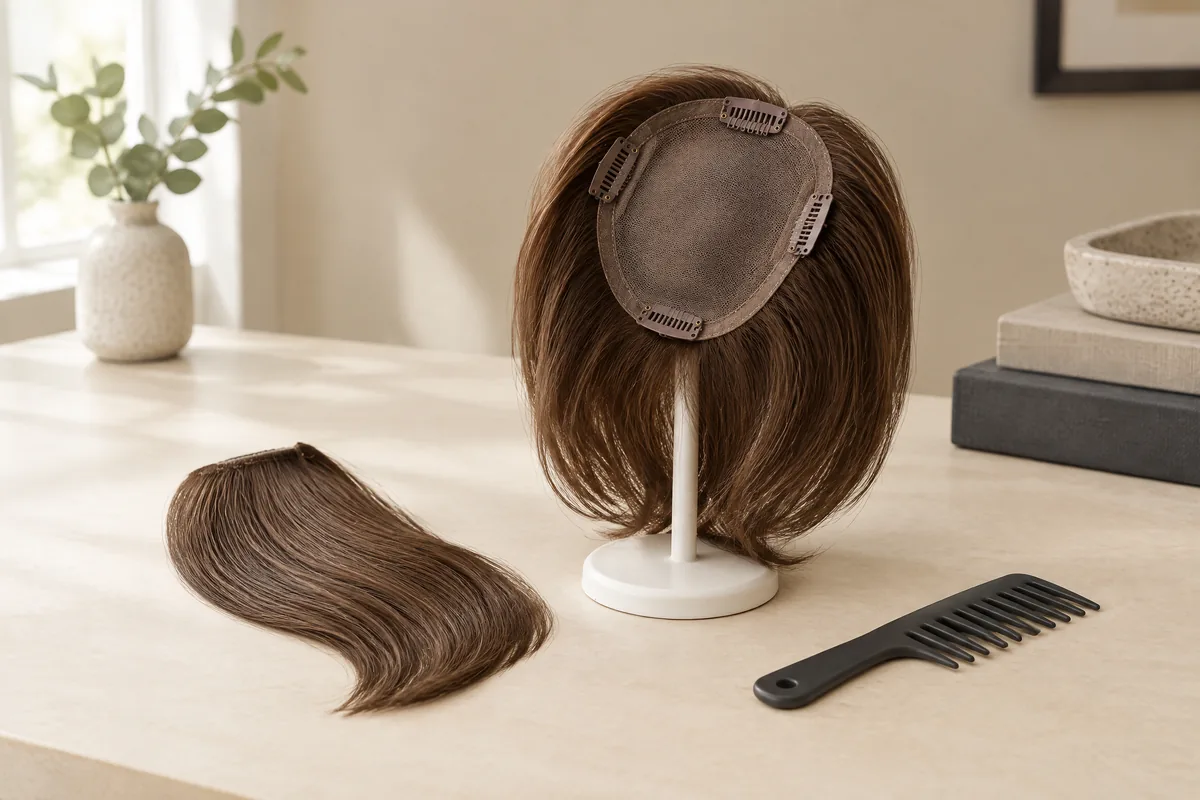
Begin with the area that carries the look
A useful choice is not “Which cap is most natural?” It is “Which area must look and behave convincingly in my normal hairstyle?” That change prevents a broad label from doing too much work. Someone who wears a soft fringe has a different priority from someone who regularly sweeps hair off the face. Someone who changes a side part needs a different check from someone who keeps one part in place.
Write down the hairstyle you expect to wear most. Mark the visible zones: front hairline, part, crown, sides, or the whole cap when hair is tied up. Then decide whether movement matters. Movement can mean changing the part, lifting hair at the crown, exposing the sides, or arranging an updo. The cap question follows from that map rather than from a promise attached to one material.
| What you show most | Question to ask first | Construction detail to confirm |
|---|---|---|
| Forehead and front edge | Will the hairline be exposed or covered by a fringe? | Where the lace ends, how the edge is intended to be worn, and what sits behind it |
| A fixed part | Does the part stay inside one defined area? | Whether the mono section covers that position and its stated boundaries |
| Several parting positions | How far might the part move? | Which areas support the intended arrangement; do not infer unlimited movement |
| Crown or lifted styles | Will the crown be visible from above or behind? | What construction is at the crown and how the hair is attached there |
| A tied or swept-up style | Will more of the cap be exposed? | Coverage, attachment guidance, and styling limits for the exact piece |
The American Cancer Society describes lace front, full lace, monofilament, and hand-tied as different wig constructions, while also stressing fit and personal preference rather than one universally superior choice. 1 That is a useful starting principle: construction describes what a cap is made to do, not what every wearer must choose.
What each construction actually tells you
Lace front: focused visibility at the forehead
A lace front wig has a lace section at the front hairline, while the rest of the cap may use another construction. It therefore answers a focused question: how is the front edge built? It does not, by itself, establish the lace width, the rest of the cap, the attachment method, the fibre, or the supported styling positions.
If your usual look keeps hair forward, the front edge may be less exposed. If you brush hair away from the forehead, ask how that exact style is meant to be worn and what lies behind the lace. A lace front can be a sensible area-specific comparison, but the label is not a guarantee of an invisible edge or a particular fit. Read the product instructions and ask about the edge before making assumptions. For a closer look at the category, see this lace front wig guide.
Full lace: wider coverage, not an automatic styling promise
A full lace wig uses lace across the cap rather than only at the front. That broader coverage may matter when you want to compare more exposed areas or arrangements. It still does not prove that every parting direction, updo, size, or attachment method is available. “Full lace” describes coverage; it does not mean glueless, universal, or automatically better.
Ask which areas are genuinely lace, how hair is attached through those areas, and what the maker says about parting and securing. If only the forehead edge concerns you, broader coverage may add questions without solving your main problem. If wider coverage is central to the way you style, it is worth comparing the exact cap diagram or written specification. This full lace wig guide is a useful place to frame those questions.
Monofilament: a visible-part question
Monofilament describes a fine mesh area where hairs are individually attached. The area may be a defined part, crown, or broader top. “Mono” is not one standard-sized panel, and a mono part does not mean the whole top or front is monofilament. The surrounding construction remains important.
Put a pencil mark on the part you normally wear. Does that position fall inside the stated mono zone? If it moves, how far does the specification say it can move? A mono crown may not reach a front or side part, while a broader mono top may offer more room but still not guarantee every direction. Compare the boundary, not just the label. For terminology and zone-by-zone questions, read this monofilament wigs guide.
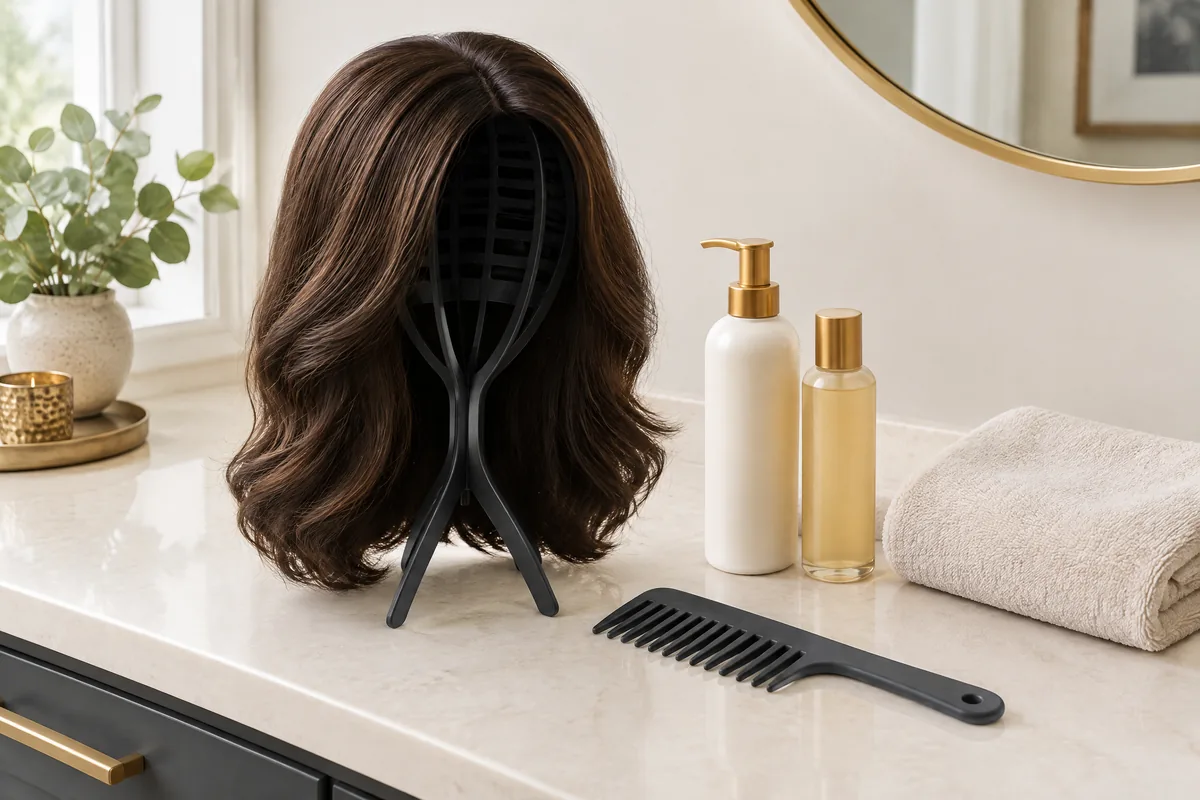
Turn visibility into a cap checklist
Once you know the exposed area, separate four questions that are often mixed together: coverage, hair direction, fit, and securing. This makes two unlike descriptions easier to compare. It also stops a visual feature from being mistaken for a comfort or maintenance guarantee.
Use this sequence:
- Locate the visible zone. Identify the front edge, part, crown, sides, or full cap that matters in your normal style.
- Name the movement. Decide whether you need a fixed part, a shift within a zone, a lifted crown, or an updo.
- Check the construction boundary. Ask where lace or mono begins and ends, and what the remaining cap uses.
- Confirm fit. Check the maker’s measurements, size options, and adjustment features. A category name cannot predict fit.
- Confirm securing. Ask how the exact design is intended to stay in place. Full lace does not automatically mean adhesive-free, and lace front does not settle the question either.
- Confirm care. Follow the exact fibre and cap instructions. Do not transfer heat or cleaning assumptions from another wig.
The result should be a short written brief, such as: “I wear a right part, sometimes sweep the front back, and want the crown to remain covered.” That brief is more useful than saying only “I want the most natural cap.” It tells a retailer which construction areas to explain and tells you which claims are relevant.
Compare trade-offs without choosing a universal winner
Construction decisions involve trade-offs because the visible benefit and the practical burden may sit in different places. More coverage can create more questions about securing or care. A focused front feature may suit a simple hairstyle while leaving the rest of the cap as the decisive fit factor. A mono area can support a particular part while not answering how the hairline looks when swept back.
| Priority in daily wear | May be worth comparing | Trade-off or unanswered question |
|---|---|---|
| Front hairline is exposed | Lace front | What is behind the lace, and how is the exact edge intended to be worn? |
| Several exposed areas matter | Full lace | Does the specific design support the intended parting, attachment, and fit? |
| Part should appear to emerge from scalp | Monofilament in the relevant zone | Is the mono area wide or long enough for the part you actually use? |
| Hair usually stays forward | A construction matched to the front style | A highly exposed cap feature may add complexity without visible benefit |
| You dislike attachment uncertainty | Any option with clearly stated securing guidance | Do not infer glueless wear from a category name |
| Scalp comfort is a concern | A cap whose materials and fit can be checked directly | “Breathable” or “light” wording is not a medical suitability verdict |
This is why material ranking can mislead. Human hair and synthetic fibre are separate choices from lace, mono, or other cap construction. Fibre affects care and styling instructions, but fibre alone does not tell you where the cap is open, where hair is attached, or how the hairline is built. Follow the product label, especially for heat: the American Cancer Society advises not using dryers or curling irons unless the wig is heat resistant. 1

How to assess fit before the mirror decides
A visible edge can still look wrong if the cap is positioned poorly or moves during wear. The American Cancer Society recommends measuring circumference, front to back, and ear to ear, then checking the individual brand’s size chart because measurements can vary. 1 It also notes that head size may change after hair loss, so an adjustable design may matter in that situation.
Measure with the hair flattened as far as practical and record the three dimensions. Compare them with the exact maker’s chart, not a generic “average” assumption. During a fitting, check whether the front sits where intended, the ear tabs lie evenly, and the cap stays in position when you turn your head. A mirror check should include your normal part and a short walk, not only a still front-facing pose.
For a useful fitting conversation, bring three preferences:
- The exposed area: front edge, part, crown, sides, or full cap.
- The movement: fixed, shifting within a zone, swept back, or tied up.
- The boundary: what you will not accept, such as unclear attachment instructions or an unstated mono area.
Do not treat a catalogue image as proof of current availability, exact colour, cap dimensions, or a particular result on your head. Ask for the specific style’s written details and follow its care instructions. If a detail is not documented, record it as unknown rather than filling the gap with a category assumption.
When scalp sensitivity changes the questions
A cap decision can be an appearance choice, but a tender or irritated scalp deserves a different level of care. Cancer treatment affects people differently, and NHS Forth Valley advises discussing expected hair loss with a doctor or nurse; it also suggests visiting a wig specialist before treatment if matching a current colour or style matters. 2
That guidance is not a diagnosis and does not make any cap medically suitable. If you are having chemotherapy, radiotherapy, significant scalp sensitivity, or a reaction to a product, ask your oncology or healthcare team before relying on general wig advice. Stop and seek professional guidance for persistent pain, marked redness, broken skin, or a new unexplained scalp problem. A wig is an appearance option, not a treatment for hair loss.
For ordinary shopping, ask about the materials touching your skin, the pressure points, the adjustment method, and whether a liner is compatible with the exact fit. Do not assume “hand-tied,” “monofilament,” or “breathable” guarantees comfort for every person. Comfort depends on the individual cap, fit, wear time, and your skin. Keep the medical question separate from the styling question so neither is oversold.
A practical decision rule for your next comparison
Use the show–move–confirm rule. First, name what you show most. Second, describe how that area moves in real life. Third, confirm the construction, fit, securing, and care details for the exact style.
For example, a person whose fringe covers the forehead but who changes a side part should not choose solely from the word “lace.” The front may be less important than the parting zone. Someone who sweeps hair away from the face may need a clear front-hairline discussion before considering the cap behind it. Someone who wears a high ponytail should ask a wider coverage and attachment question than someone who keeps hair down.
Keep a simple comparison note with five lines: visible zone, intended movement, cap area, fit information, and unresolved question. The best option is then the one that answers your actual priorities with the fewest unknowns. It may be a lace front, full lace, monofilament, or another construction. The method is designed to make that conclusion earned rather than automatic.
Questions & answers
Is a lace front wig always the most natural choice?
No. It places lace at the front hairline, but the exact edge, cap behind it, fit, fibre, and styling all vary. It is most relevant when the front is the area you plan to expose. Ask about the specific edge and how it is intended to be worn.
Does a full lace wig allow every hairstyle?
No. Full lace describes lace coverage across the cap. It does not establish every parting direction, updo, attachment method, or fit. Confirm the exact construction and styling guidance before treating it as suitable for a particular arrangement.
Are monofilament wigs the same as silk-top wigs?
No. Monofilament refers to a fine mesh area with individually attached hairs. The size and position can vary. Silk top is a different construction term, so compare the stated areas and the rest of the cap rather than treating the names as interchangeable.
How do I choose when my hairstyle changes often?
List the positions you genuinely use, then check whether the relevant lace or mono coverage reaches them. Also confirm how the front, crown, sides, fit, and securing are built. If a description does not state a boundary or supported styling position, treat that point as unconfirmed.
What if I am receiving cancer treatment or have a sore scalp?
Ask your oncology or healthcare team about your situation before relying on general wig advice. NHS guidance notes that treatment effects vary and recommends discussing expectations with a doctor or nurse. A wig can change appearance, but it does not diagnose or treat a scalp condition or hair loss.
Put the next step into practice
For a structured introduction to cutting and styling, explore the learning options at Canvas. Hong Kong hair styling courses。
Read more practical notes on hairstyles and preparation for everyday routines. Canvas beauty journal。
Tell the team about your learning goal or styling request. Contact Canvas Academy。
Sources & further reading
- American Cancer Society — Wigs for Hair Loss
Supports the distinctions between lace front, full lace, monofilament and hand-tied constructions, plus guidance to consider fit, personal preference, measurements, adjustment and heat-resistance instructions.
- NHS Forth Valley — Hair loss due to cancer treatment
Supports the point that cancer-treatment hair loss varies and that expected effects should be discussed with a doctor or nurse; it also notes planning with a wig specialist before treatment.