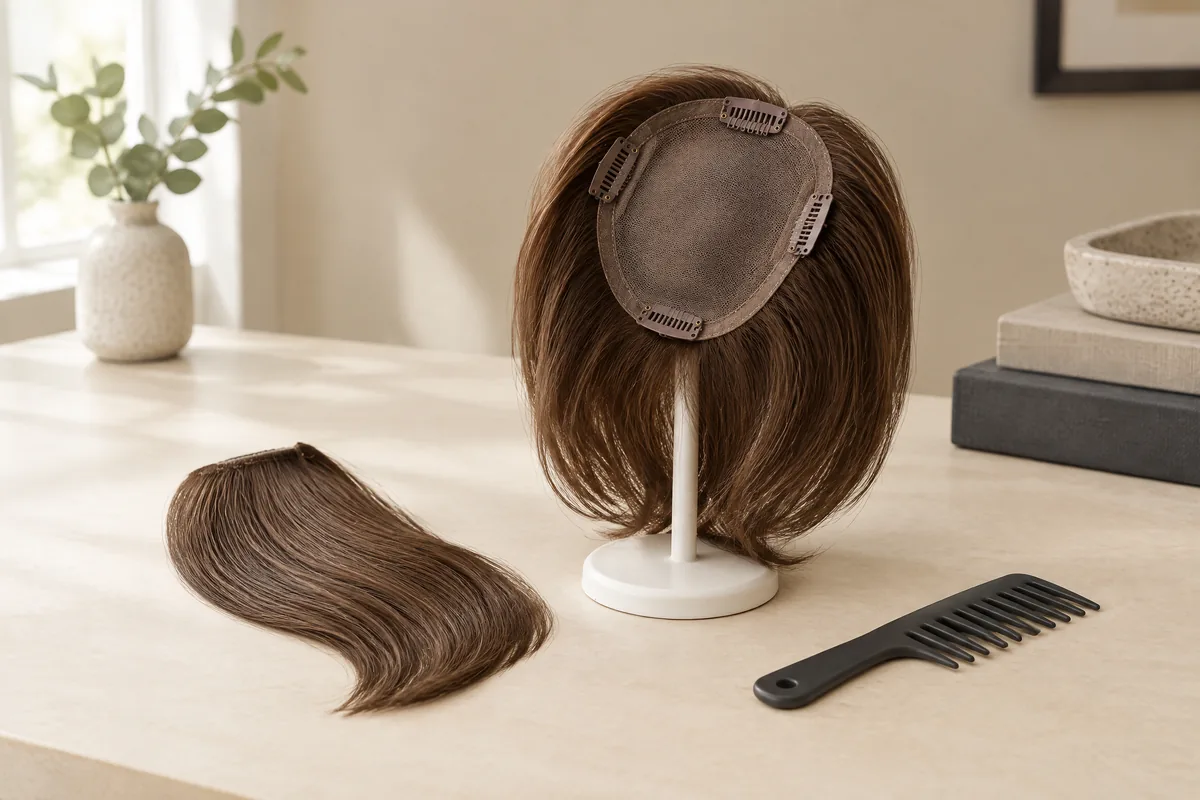
A mirror view from the front can be reassuring, but it hides the crown and profile—the areas that reveal a piece’s outline when you move, sit under overhead light or turn your head. The most useful first decision is therefore coverage: do you want the whole head covered, or only a defined area blended with your own hair?
Begin with the three-angle check
Take a neutral photo or look in three mirrors: front, side and crown. Note where the visual concern actually sits. A changing front hairline calls for different questions from a thinning crown; a wider area across the top may make a full option easier to compare. This is an appearance brief, not a diagnosis.
Use the same hairstyle direction in every comparison. A forward fringe can disguise a front edge, while a side part exposes movement and the parting. Ask to see the outline with the head upright and slightly turned. Do not judge a piece from one polished, front-facing image.
What the outline tells you
The crown shows how a base meets the top of the head. The profile shows whether length, density and volume sit naturally with your face. The front shows the hairline and how much of your own hair remains visible. Together, these angles are more informative than a product term such as “natural” or “custom”.
| Angle to check | What to notice | Question to ask |
|---|---|---|
| Front | Hairline, fringe direction and colour transition | Where does the front edge sit, and can it be assessed in a fitting? |
| Profile | Volume, length and the outline behind the ear | Does the side silhouette agree with the style I normally wear? |
| Crown | Parting, whorl and the base footprint | How far does the piece extend, and where do its edges meet my hair? |
Decide between full and partial coverage
A full wig is designed to cover the head. A toupee or men’s hairpiece is generally intended for a defined area. A hair system is another category name often used for cosmetic coverage, but its actual footprint, construction and wearing arrangement must be confirmed for the specific item. These distinctions matter because a piece can look similar in a photograph while behaving differently at the edges.
If you want to retain your own hair around the sides and back, begin with the area that needs coverage. If coverage is changing or widespread, compare a larger partial design with a full option rather than forcing a small piece to do a full-wig job. There is no prize for choosing the smallest base; the better choice is the one whose outline matches your brief and routine.
For a broad look at full coverage and the questions to take into a Hong Kong enquiry, read men's wigs. The category is a starting point, not confirmation of stock, colour or suitability.
Compare the piece, not the label
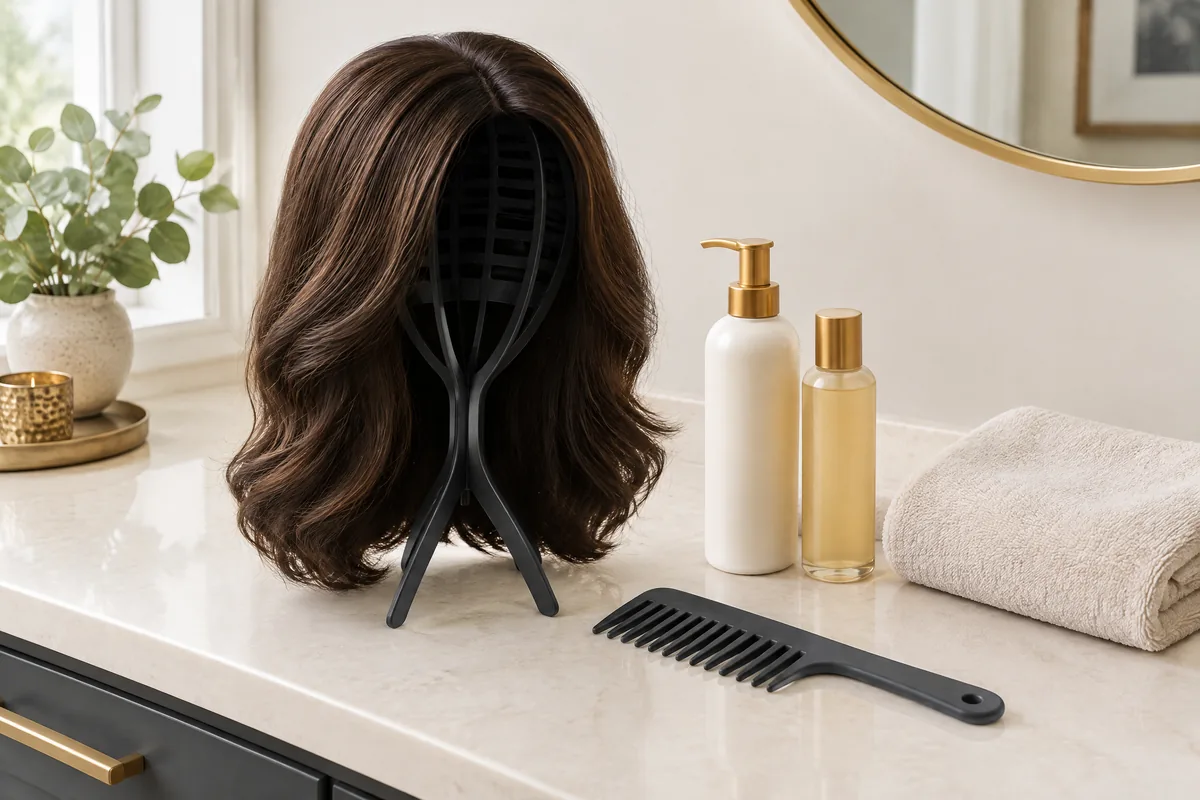
Once the coverage is clear, ask for five particulars: footprint, fit, fibre, base and care. The American Cancer Society notes that sizing can vary between wig brands, so a familiar “average” label is not enough; check the actual size chart and how the item adjusts. 1 The same principle applies to partial pieces: ask for measurements and edge placement rather than assuming a standard.
Fibre changes the daily trade-off. Synthetic hair can be lighter and simpler to maintain, while human hair generally allows more styling flexibility but needs more care; neither is automatically the better choice. The exact maker’s instructions control. Never apply heat to synthetic hair unless the product is expressly heat-resistant, and do not infer a permitted temperature from a general internet guide.
Base language also needs translation into plain facts. “Lace”, “skin”, “monofilament” or a local construction name may describe different features in different markets. Ask what the base is made from, where it sits, how it meets existing hair and what the wearer is expected to do at home.
| Decision point | Full option | Partial piece or hair system |
|---|---|---|
| Coverage | Whole-head outline | Defined crown, front or top area |
| Main fit question | How does the cap sit around the head? | Where do the edges meet my own hair? |
| Appearance risk | An oversized silhouette can look disconnected | A small footprint can leave an obvious boundary |
| Routine | Cap care, washing and storage | Blending, attachment or removal plus care |
| Best comparison basis | Exact size, fibre, base and care | Exact dimensions, attachment, fibre and care |
Use crown, profile and front to test fit
Fit is more than staying on. A full option should feel secure without creating pressure points. A partial piece must also transition at its edges. Sit, stand, turn, look down and raise your eyebrows. If the front appears acceptable only when you keep your head still, ask what would change in a real fitting.
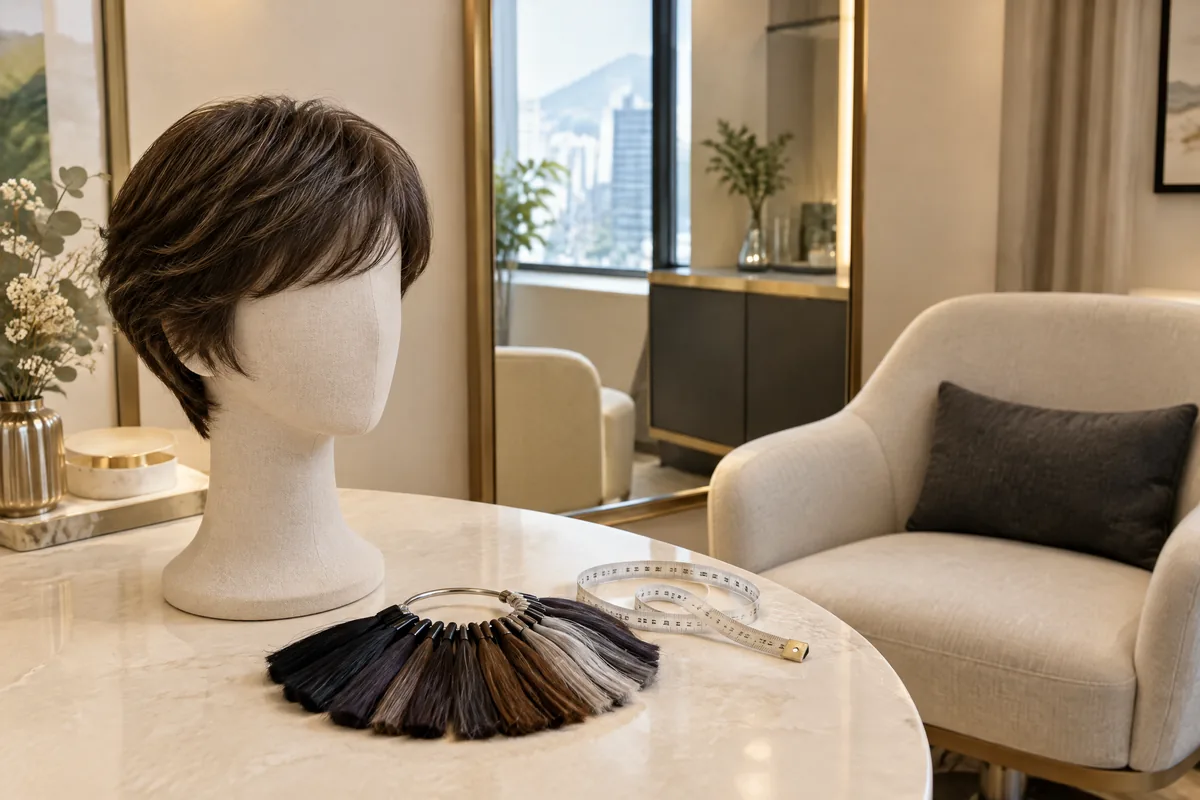
Bring a short written brief: preferred length, parting, fringe direction, grey impression and the area to cover. If you already wear glasses or a hat, include them in the check. Compare in natural or consistent lighting. Colour can shift under shop lighting, so view a swatch or sample near a window when possible.
A useful fitting conversation
Ask these questions in order:
- What exact area does this item cover?
- What are its measurements and adjustment points?
- Which fibre and base are confirmed for this item?
- How does the front edge or partial boundary sit with my own hair?
- Is fitting, trimming or styling included, and what remains my responsibility?
- What washing, brushing, drying and storage instructions apply?
- Is the shown colour available, or is it only a reference image?
A catalogue image can show direction and proportion, but it cannot establish current availability or an exact match. A fitting discussion should make the unknowns visible instead of smoothing them over with confident language.
Weigh maintenance and wearing arrangements
A partial piece may appear economical because it uses less material, yet its routine can be more involved if it needs regular blending, removal or an attachment arrangement. A full wig may simplify coverage, but it can feel warmer or require a different cap routine. These are practical trade-offs, not universal rules.
Ask whether the proposed system is intended to be removable or worn with a particular attachment. Do not assume that the words “hair system” include installation, attachment, follow-up or a maintenance plan. If adhesive or tape is being considered, ask the supplier for item-specific instructions and stop if the skin reacts.
Care should follow the label for the exact item.
The American Cancer Society advises using products made for wigs, storing a wig on a stand for short periods, and avoiding hairdryers or curling tools unless heat resistance is confirmed.1
Macmillan likewise stresses following care instructions and keeping heat and flames away from wigs; synthetic fibres can melt and real hair can frizz. 2
Do not convert a generic washing recipe into a promise about every wig. A human-hair piece, a synthetic cap and a blended fibre may require different handling. Ask who should wash, cut or restyle it, and budget for that routine before deciding.
Make price comparisons fair
A quote only becomes useful when its contents are clear. Put ready-made and custom work in separate columns. Record whether the figure includes measurement, fitting, trimming, washing, styling, attachment products or follow-up. A lower headline price may exclude the work that makes the piece wearable.
As a simple planning example, if a piece is quoted at HK$3,280 and you reserve HK$300 for a first fitting journey and HK$200 for care products, the planning total is HK$3,780. That is a personal budget example, not a market average or a promised service price. Confirm the actual quotation and inclusions in writing.
For a partial-coverage comparison, read toupee. It explains why a crown, frontal or wider-top brief should be discussed separately, while leaving the exact dimensions and supply status to the enquiry.
Protect comfort and medical boundaries
A wig, toupee or hair system changes appearance; it does not diagnose or treat hair loss. The American Academy of Dermatology says effective hair-loss care begins by finding the cause, and no single treatment works for everyone. 3 If loss is sudden, painful, inflamed, associated with scaling, or otherwise worrying, arrange medical assessment rather than using a piece to cover the symptom.
If chemotherapy, radiotherapy or a sensitive scalp is involved, follow the treating team’s advice first. Macmillan notes that a scalp may become sensitive during cancer treatment and recommends discussing skin-sensitive attachment choices with a doctor or nurse. 2 A comfortable cap is not evidence that an adhesive, liner or fibre is medically suitable.
For a hair-system enquiry, read hair system. It is sensible to ask what can genuinely be customised, whether measurement or sample viewing applies, and whether fitting or attachment is actually included.
A short decision route for Hong Kong
Before contacting a shop, prepare one sentence: “I want to cover [area], keep [style direction], and compare [full option/partial piece/hair system].” Add your preferred fibre, colour impression and any comfort concern. This makes an enquiry more useful than sending only a hairstyle screenshot.
Then use this sequence:
- Map the outline. Check crown, profile and front, and mark the area that needs coverage.
- Choose the category. Compare full coverage with a defined partial piece only after the first step.
- Request specifications. Ask for dimensions, fibre, base, fit, care and attachment details.
- View from several angles. Use consistent lighting and move naturally.
- Write down inclusions. Separate the piece price from fitting, styling and ongoing care.
- Pause where health is involved. Let a qualified healthcare professional guide treatment-related or irritated-scalp decisions.
The distinctive method is simple: compare the outline before the product term. When the crown, profile and front all make sense, the choice between a full wig, toupee and hair system becomes a practical coverage decision rather than a jargon contest.
Canvas and OWNSTRAND are owned by the same company. This article is editorial guidance, not an independent product review or a conflict-free endorsement.
Questions & answers
Should I choose a full wig if only my crown is thinning?
Not necessarily. Map the crown, profile and front first, then compare a crown-focused partial piece with a full option. The better choice depends on the footprint, edge transition, comfort and routine you want.
Is a toupee the same as a men’s hair system?
The terms overlap in everyday conversation, but they do not specify identical construction. A toupee is usually discussed as partial coverage; a hair system is a broader category label. Confirm the exact dimensions, base, fibre and wearing arrangement.
Can I judge a men’s hairpiece from a front photograph?
No. A front photograph can hide the crown, side outline and edge transition. Compare front, profile and crown views in consistent lighting, then ask to assess the actual item or sample.
Can I use normal hair products and heat tools on a wig?
Only if the exact item’s instructions allow them. Fibre and construction differ, and synthetic hair may be damaged by unapproved heat. Use wig-specific care guidance and ask who should wash or restyle the piece.
What should I do if hair loss comes with scalp pain or irritation?
Pause cosmetic attachment experiments and seek advice from a qualified healthcare professional. A wig or hair system is an appearance option, not a diagnosis or treatment, and treatment-related scalp decisions should follow your care team’s guidance.
Put the next step into practice
For a structured introduction to cutting and styling, explore the learning options at Canvas. Hong Kong hair styling courses。
Read more practical notes on hairstyles and preparation for everyday routines. Canvas beauty journal。
Tell the team about your learning goal or styling request. Contact Canvas Academy。
Sources & further reading
- American Cancer Society — Choosing and Wearing a Wig
Supports checking brand-specific sizing, comparing full wigs and toppers, distinguishing synthetic from human hair, and following item-specific fitting and heat-care instructions.
- Macmillan Cancer Support — Wigs for Cancer Treatment
Supports cautious guidance on wigs during cancer treatment, sensitive scalps, care instructions, heat and flame risks, and asking a doctor or nurse about skin-sensitive attachment choices.
- American Academy of Dermatology — Hair Loss: Diagnosis and Treatment
Supports the distinction between cosmetic coverage and medical care, and the advice to seek dermatological assessment because hair loss has different causes and treatments.