Why a proportion brief beats a colour number
A grey percentage sounds precise, but two systems with a similar proportion can look very different. One may place silver mostly at the temples; another may scatter it evenly through the crown. A darker front with pale sides can read salt-and-pepper, while the same amount of grey mixed throughout can look lighter overall. The useful question is not “What number am I?” but “Where should the eye notice contrast?”
Hair colour also changes the conversation because the hair you see is the result of pigment in individual strands. The American Academy of Dermatology explains that hair turns grey or white when follicles stop creating melanin, the substance that gives hair its colour.1 That fact is useful context, not a reason to diagnose your own hair or make a medical promise. For a cosmetic choice, describe the visible pattern you want to echo.
A practical brief might say: “Mostly dark brown at the front, silver concentrated at both temples, a few lighter strands through the sides, and a darker crown.” Another might say: “An even salt-and-pepper impression, with no bright patch at the hairline.” Both are more actionable than “30% grey”, especially when colour names vary between suppliers.
The three-zone scan
Use a mirror, neutral daylight and the hairstyle you wear most often. Do not judge from a heavily filtered selfie or a single indoor bulb. Note three things in each zone:
- Front and temples: Is the outline dark, silver, or mixed? Is one temple lighter?
- Sides: Does grey sit near the ear, run upward, or appear as fine scattered strands?
- Crown: Does the whorl look lighter because strands change direction, or is it genuinely more silver?
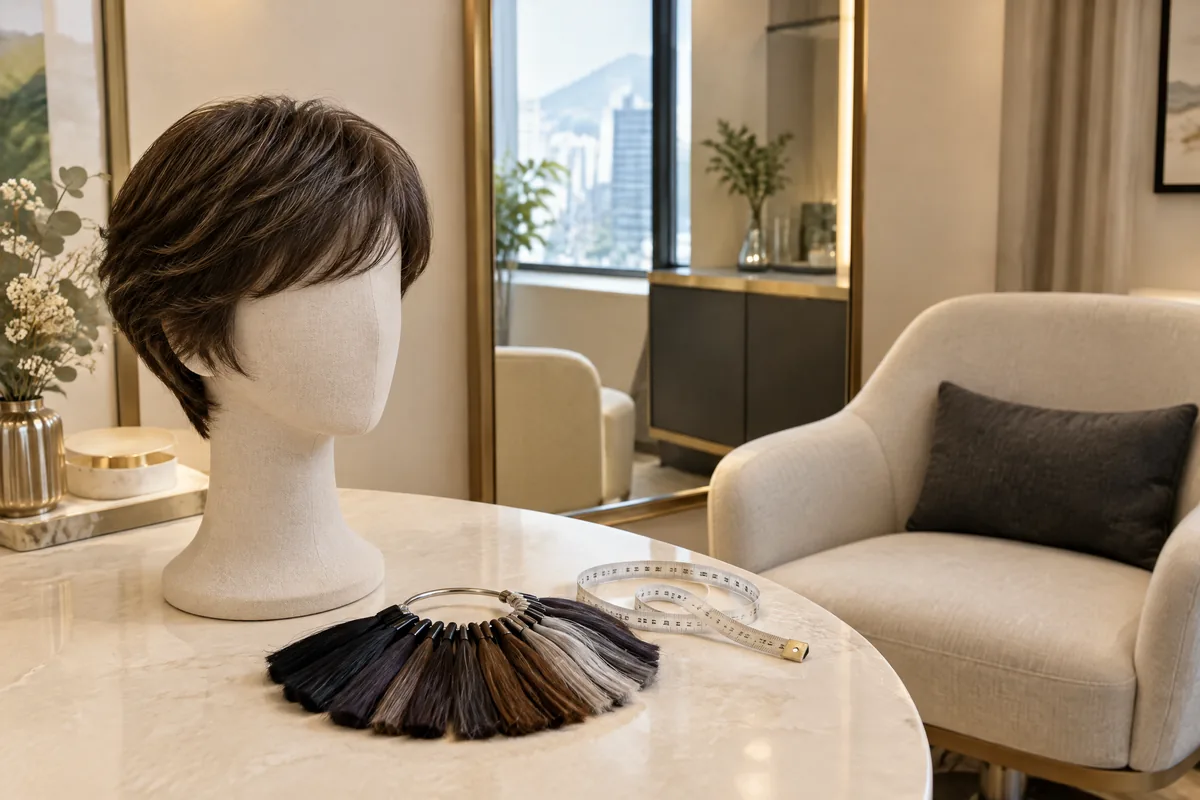
Write what you see before choosing a sample. Outdoor or natural light is a sensible reference when comparing a swatch with hair; the American Cancer Society gives similar general advice for wig colour comparison.2 Daylight still cannot settle an exact match, because screens, shadows and surrounding colours alter perception.
How to describe grey without overpromising
Use plain visual language first, then add a proportion only if it helps the discussion. “Dark overall with silver temples” tells a stylist where contrast matters. “Balanced salt-and-pepper across the top” communicates distribution. “Mostly silver with a few darker strands” describes the overall read without pretending that every strand can be counted.
The brief should separate three decisions that are often blended together:
- Distribution: Where does grey appear—temples, sides, crown, or all three?
- Contrast: Is the darker-to-lighter difference subtle, crisp, or high contrast?
- Direction: Should the piece echo your current pattern, or move towards a more even silver look?
That last choice is personal. Matching existing hair may feel familiar, but a deliberately more even blend can create a cleaner style when the surrounding hair is changing. Neither is a default “natural” answer. The aim is an appearance you can explain and recognise in ordinary settings.
| Observation | Better wording for an enquiry | Decision it supports |
|---|---|---|
| Silver is strongest at the temples | “Keep a darker front; let both temples read lighter” | A temple-led blend rather than an evenly light top |
| Grey is scattered through sides and crown | “Mixed strands throughout, with no single silver block” | A distributed salt-and-pepper direction |
| Top reads mostly silver | “Light overall, with darker strands for contrast” | A predominantly grey option, not a dark base with highlights |
| One area looks different in indoor light | “Please compare this in neutral daylight” | A request for a consistent viewing reference |
How light, texture and styling change the read
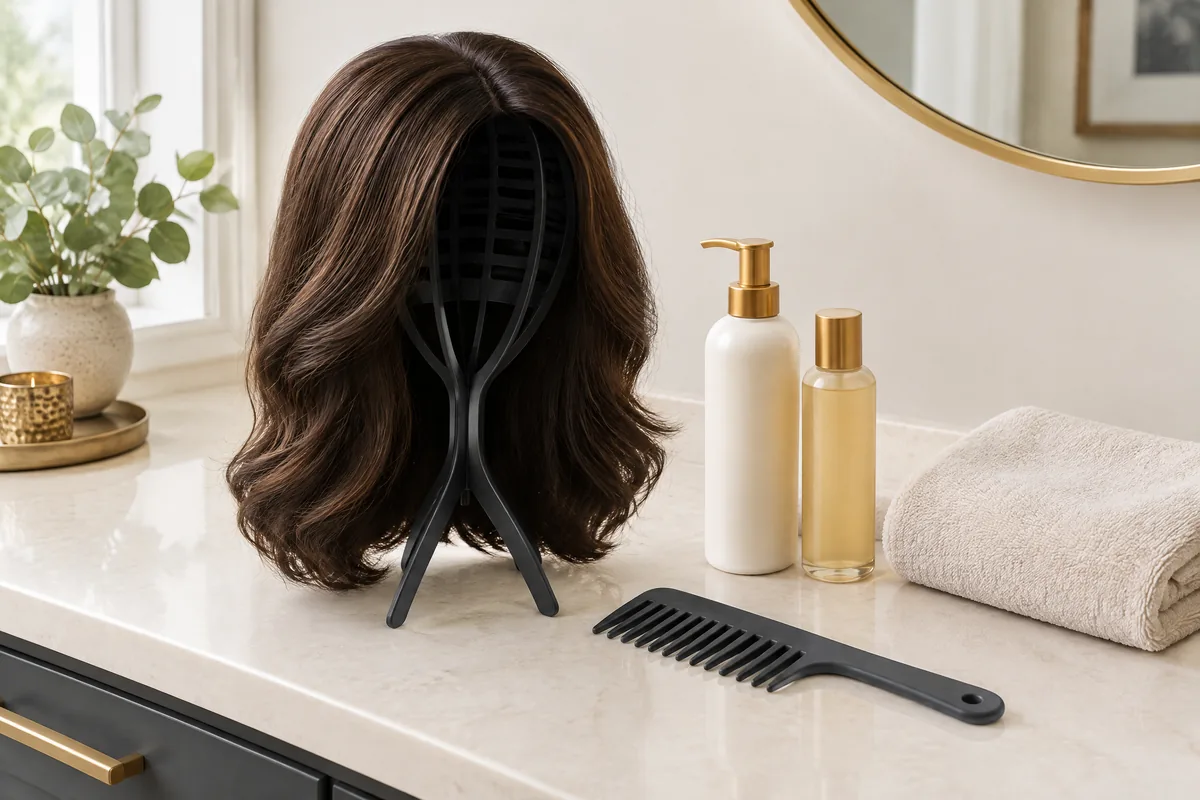
Colour is never viewed alone. Short hair can make individual silver strands look more graphic; longer movement can soften the boundary. Straight, wavy and textured finishes reflect light differently, so a swatch and a styled piece may not create the same impression. Density and direction matter too: a crown whorl can expose lighter strands at one angle and hide them at another.
Take two references if you can: one showing your everyday style and one showing the colour under neutral daylight. Label them “current pattern” and “preferred direction”. That distinction prevents a favourite inspiration image from being mistaken for a record of your own hair. It also lets you discuss whether the goal is continuity, a gentle transition, or a clearly silver style.
A colour brief should never quietly become a coverage promise. If the issue is a front edge, explain the front and temples; if the visible concern is at the top or back, map the crown separately. A grey hair system for men can be discussed by proportion and placement, but the page itself cautions that lighting and individual descriptions affect what is seen and that an exact match is not guaranteed.
A two-photo method that stays honest
If you send images for discussion, make them useful rather than dramatic:
- Take one in consistent daylight without a beauty filter.
- Keep the camera distance and angle similar between images.
- Include front, both sides and the crown if those areas differ.
- Add a short caption: “current hair”, “preferred silver balance”, or “style reference”.
- Treat images as communication aids, not proof of how a finished piece will look.
This method protects against a common mistake: selecting a cool grey from a blue-tinted screen, then judging the finished colour under warm indoor light. It also leaves room for the real decision, which is how the design should sit beside your hair and fit your desired styling.
How coverage changes the colour brief
The same blend can need different wording depending on the area being covered. A small crown-focused piece may meet hair that is darker around the perimeter. A front-focused piece may be seen against temples that are much lighter. A broader style may need a consistent tone across more zones. Colour and coverage are separate decisions, but the boundary makes their interaction visible.
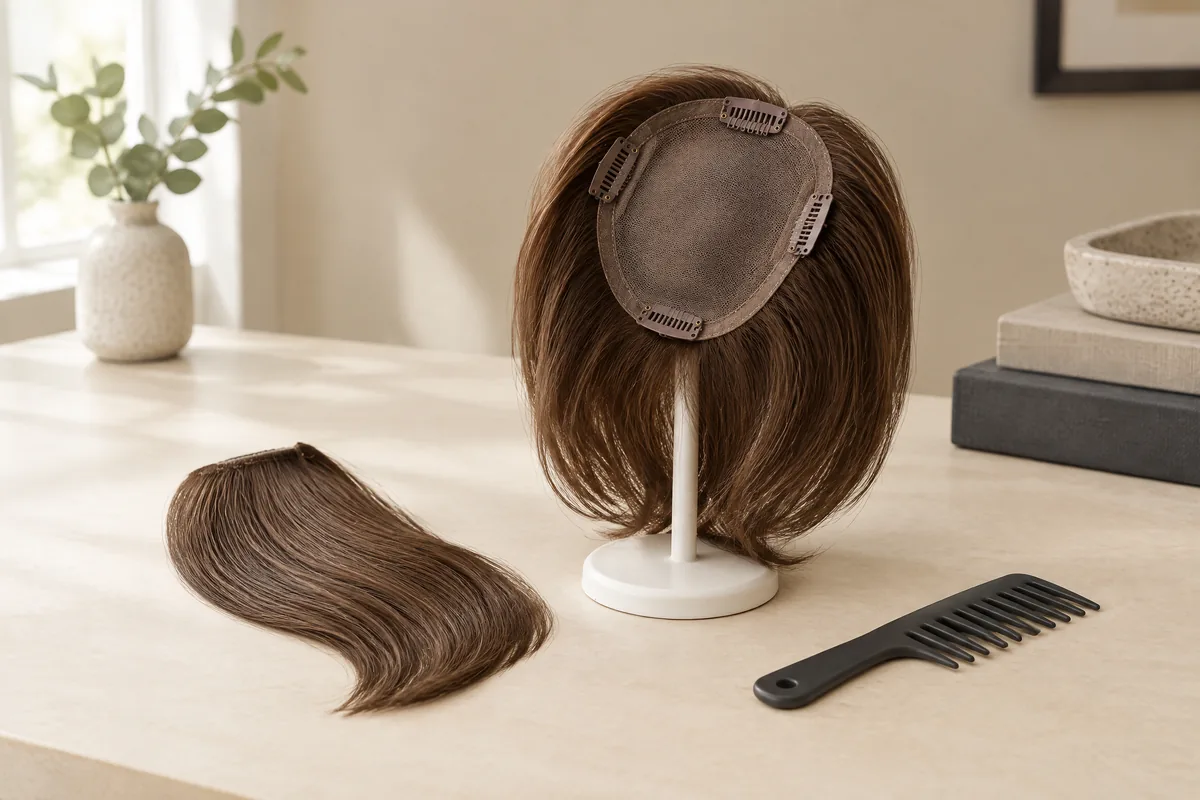
For thinning at the top, describe the area from above and behind, then record the direction and density of the hair around its edge. A men's hairpiece for thinning crown is presented as a crown-focused cosmetic option, while broader partial pieces and full wigs answer different coverage questions. Its key practical point is to check the exact footprint, base, dimensions, colour, fit and supply rather than infer them from the label.
For a front concern, describe the outline you want to remain visible and how you normally part or brush the hair. A front piece that looks balanced in a forward style may read differently when lifted or swept sideways. Do not let a colour brief imply that an edge will disappear, that a style will suit everyone, or that a cosmetic system treats a receding hairline. Those are separate questions requiring specific information and, where relevant, professional medical advice.
| Coverage situation | Colour detail to record | Trade-off to discuss |
|---|---|---|
| Temples and front | Darkness at the edge versus lighter sides | A close echo may preserve contrast; an even blend may look intentionally changed |
| Crown only | Grey around the whorl and the surrounding border | A small piece may preserve more existing hair, but the boundary becomes important |
| Front plus top | Whether grey is continuous from hairline to crown | A single tone may simplify the look; zoned variation may echo your pattern better |
| Whole-head style | Overall lightness, texture and density | More consistent coverage may reduce blending choices but changes the whole silhouette |
The useful output is a question list, not a guarantee: “Where does this option place the grey?”, “What are the actual dimensions?”, “Which fibre and base are confirmed?”, and “What is included in the quotation?”
How to compare fibre, base and care information
Grey balance cannot rescue an unsuitable construction. Confirm whether the item is human hair or synthetic fibre, its base design, measurements, texture and stated care instructions. Do not assume that a natural-looking photograph identifies the fibre, or that two products with similar grey colours share the same styling limits. Follow the maker’s label for cleaning and styling; do not apply a heat or chemical routine copied from another product.
When comparing a standard catalogue piece with a custom discussion, ask which facts are fixed and which can be requested. A custom route may allow a conversation about grey proportion and measurement, but that does not mean every catalogue piece can be altered or that a particular shade is available. Ask for the exact option, confirmed supply and a written quotation before treating a price as a budget.
A simple budget check can prevent false precision. If a quoted piece is HK$3,280 and you reserve HK$300 for transport or incidental items, the working total is HK$3,580: HK$3,280 + HK$300 = HK$3,580. That is an example of arithmetic, not a market average or a promise about any service. Keep product price, fitting, alterations and care items as separate lines so a “cheaper” colour option is not compared with a broader package.
How to make the appointment conversation efficient
Bring your three-zone notes and ask the same questions in the same order. Start with appearance, then construction, then logistics:
- Appearance: Where should grey be concentrated? Should the overall read stay dark, balanced, or mostly silver?
- Coverage: Which area does the exact piece cover, and where does its edge meet existing hair?
- Construction: What fibre, base, dimensions, texture and care conditions are confirmed?
- Practicalities: Is the item available, what does the quotation include, and what arrangements need confirmation?
At an OWNSTRAND enquiry, the men's hair system for receding hairline page describes sample viewing, measurements and questions about fit and availability; it also makes clear that a category label does not confirm a particular construction or supply. That is a useful standard for any consultation: ask about the item in front of you, not the broadest interpretation of its name.
If your scalp is painful, inflamed, unusually itchy or reacting to an adhesive or product, pause the cosmetic decision and ask an appropriate health professional. The NHS notes that hair loss has many possible causes and advises seeing a GP if you are worried about it.3 A system can change appearance; it does not diagnose or treat the cause. For chemotherapy-related loss or significant scalp sensitivity, follow the oncology or clinical team’s advice first.
A final grey-blend checklist
Before committing to a colour direction, check that your brief answers these points:
- What is the current pattern in the front, sides and crown?
- Where should silver be visible, and where should darker contrast remain?
- Are you matching existing hair or choosing a more even grey look?
- Which area needs coverage, and what boundary should remain visible?
- What fibre, base, dimensions, texture and care instructions are confirmed?
- Has the colour been discussed under a consistent reference light?
- Are availability, quotation and fitting arrangements confirmed for this exact option?
The best grey blend is not the one with the most impressive percentage. It is the one whose distribution, contrast, coverage and care requirements you can describe before you decide. Leave room for variation in light and hair direction, and keep cosmetic styling separate from medical questions. That makes the conversation clearer, the trade-offs visible and the final choice more genuinely yours.
Questions & answers
Should I choose a grey percentage before contacting a stylist?
No. A percentage can start the conversation, but a description of distribution—such as silver temples with a darker front—is usually more useful. Record the front, sides and crown separately, then ask what the specific option’s colour wording means.
Can a grey blend match my natural hair exactly?
An exact match cannot be promised. Lighting, screen settings, hair direction and differences between areas can change the impression. Compare references in consistent daylight and treat them as discussion aids, not a guarantee.
Does a crown piece use the same colour brief as a front piece?
The principles are similar, but the boundary changes what matters. A crown piece meets hair around a whorl, while a front piece is judged against the hairline and temples. Describe the coverage edge as well as the grey distribution.
Can a hair system treat a receding hairline or restore pigment?
No. A hair system is a cosmetic styling choice. It does not treat hair loss, restore pigment or promise regrowth. If loss is worrying, sudden or accompanied by scalp symptoms, ask a qualified health professional about the cause.
What should I confirm before paying for a grey hairpiece?
Confirm the exact item, coverage area, fibre, base, dimensions, colour description, care conditions, availability and what the quotation includes. Keep any fitting or alteration costs separate, and do not infer suitability from a category name or photograph.
Put the next step into practice
For a structured introduction to cutting and styling, explore the learning options at Canvas. Hong Kong hair styling courses。
Read more practical notes on hairstyles and preparation for everyday routines. Canvas beauty journal。
Tell the team about your learning goal or styling request. Contact Canvas Academy。
Sources & further reading
- What causes gray hair, and can I stop it? — American Academy of Dermatology
Explains that hair turns grey or white when follicles stop creating melanin, and distinguishes normal greying from conditions requiring professional assessment.
- Wigs for Hair Loss — American Cancer Society
Supports using outdoor or natural light when comparing wig colour with a swatch and treating brand sizing and colour as points to check rather than assumptions.
- Hair loss — NHS
Explains that hair loss can have different causes and advises speaking with a GP when worried, supporting the article’s separation of cosmetic styling from medical questions.