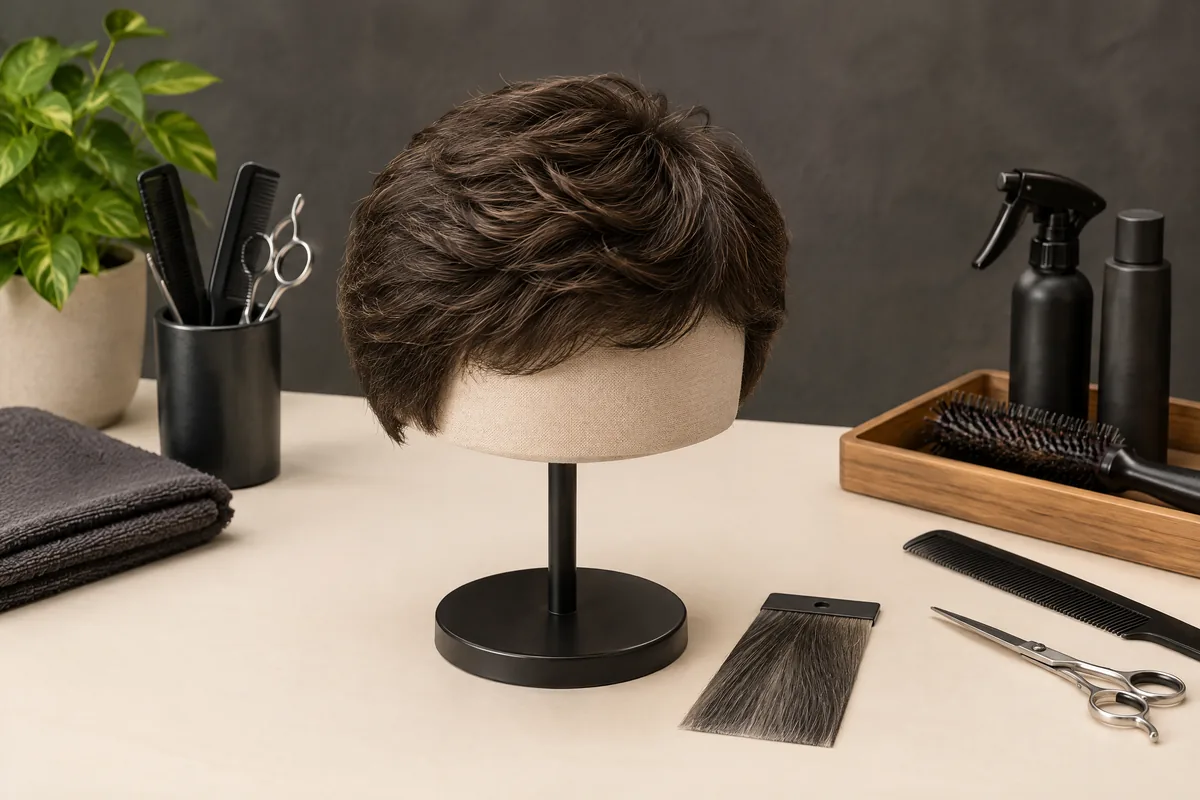
Start online for styles, construction, colour direction and a rough budget. Visit in person when the decision depends on a physical sample, head measurement, scalp comfort, or a conversation that can change the brief. The safest route is often hybrid: research at your desk, then spend travel time only on choices that a screen cannot settle.
The rule: research online, verify in person
Online research is excellent for narrowing a field. You can save photographs, note cap terms, compare stated prices, and write questions without committing to a purchase. It is weaker at showing how a shade sits beside your hair, how a cap feels after several minutes, or whether a reference image can actually be adapted.
A salon visit is not automatically better. It costs time, may require an appointment, and can create pressure to decide before you have compared alternatives. The useful question is not “online or salon?” but “what uncertainty remains?” If the answer is visual or physical, a sample and direct discussion earn their place.
OWNSTRAND describes its online route as an enquiry for styles, quotations and arrangements, rather than a completed checkout or remote measurement. Its Kwun Tong setting supports sample viewing and discussion of head measurements. Read the practical comparison in custom wig salon vs online Hong Kong before treating a message as an order.
Decision shortcut: If you can describe the question precisely in a message, start online. If the answer requires touching, wearing, measuring, or seeing two options beside your face, plan a visit.
What can be settled from a desk?
Desk research should answer low-risk questions first. Look at silhouette, length, fringe, parting, density, fibre description, cap construction, care instructions, payment terms, return policy, and whether the seller actually operates a service in Hong Kong. Save the exact style name and colour label; a screenshot without those details is difficult to verify later.
Separate “listed” from “confirmed”. A product photograph is not proof of current stock. A reference price is not a quotation for your specification. A colour tile is not a physical swatch. This distinction prevents the common online mistake of optimising a choice that has not been shown to be available or suitable.
Use a research sheet with three columns: “known”, “needs confirmation”, and “cannot judge online”. Put delivery timing and return conditions in the second column. Put scalp comfort, real-world fit, and the final colour impression in the third. This turns browsing into a short enquiry instead of an endless scroll.
A ten-minute online shortlist
- Save no more than three styles that share the same purpose. Compare three everyday shoulder-length options rather than mixing a topper, short crop, and formal long wig.
- Record exact fibre, base, available sizes, adjustment features, care limits, and price currency. Do not infer heat tolerance from “synthetic”; follow the product label.
- Write five questions that could change your decision: sample availability, measurement, quotation inclusions, colour representation, and visit arrangements.
- Set a stop point. If the remaining uncertainty is physical, stop browsing and request the next practical step.
| Desk question | Online material can tell you | It cannot prove |
|---|---|---|
| Is the look right? | Length, outline, fringe and parting in images | How the cut frames your face or moves daily |
| Is colour promising? | Style-specific names, swatches and broad tone | An exact match under your lighting |
| Is it affordable? | Listed price, currency and stated inclusions | Final quote, alterations, delivery or availability |
| Is fit plausible? | Size chart, cap terms and adjustment features | Pressure points, slipping and comfort |
| Is care manageable? | Labelled washing and styling instructions | How much time the routine takes you |
Which decisions are hard to reverse?
Think in reversibility, not shopping channel. A saved image is easy to change. A cut, colour service, custom specification, non-returnable purchase, or journey made for an appointment is harder to undo. A hybrid process usually beats a rushed online order or an unprepared visit.
Classify each choice as green, amber, or red. Green choices are easy to revisit, such as a mood-board image. Amber choices need confirmation, such as a style’s shade list or whether a visit is available. Red choices affect money, fit, comfort, or a custom brief; they deserve a direct answer and written record.
| Decision | Reversibility | Best next action |
|---|---|---|
| General length or silhouette | High | Compare online and save references |
| Exact shade beside visible hair | Medium | Compare in steady light; request a swatch or sample |
| Head measurement and cap tension | Low | Ask how measurement is done; prefer a fit check |
| Custom base or hairline brief | Low | Discuss result, limits, price and follow-up directly |
| Heat or chemical styling | Low | Check the exact care label; do not generalise fibres |
| Payment, delivery and returns | Medium to low | Read terms and confirm inclusions before paying |
The American Cancer Society advises using natural light when comparing a wig with a hair swatch and notes that head measurements and size charts can vary by brand 1. That is a reason to use online images for direction, not as final authority on fit or shade.
How to judge colour without fooling yourself
Colour is a desk-research trap because screen, room light, camera, and material all influence what you see. Compare the style-specific shade label with roots, mid-lengths, and ends in one consistent setting. If your hair remains visible, use the sections that will sit beside the wig rather than a flat lock held under different light.
Decide whether you want continuity or contrast. A close depth can make a transition less noticeable. A warmer, cooler, lighter, or darker direction can be an intentional change. Neither is universally correct. The useful question is whether the difference is deliberate and comfortable, not whether a colour name sounds familiar.
A chart should narrow choices, not guarantee them. Names and numbers may differ between ranges, and the same shade can read differently on a smooth long style than on a short layered one. Keep the style name, exact shade label, and viewing conditions together when asking for clarification.
For a practical colour checklist, the wig color matching guide emphasises depth, undertone, variation, and the exact style label. Treat it as a starting point, not an independent promise of a particular shade.
When a measurement or sample changes the answer
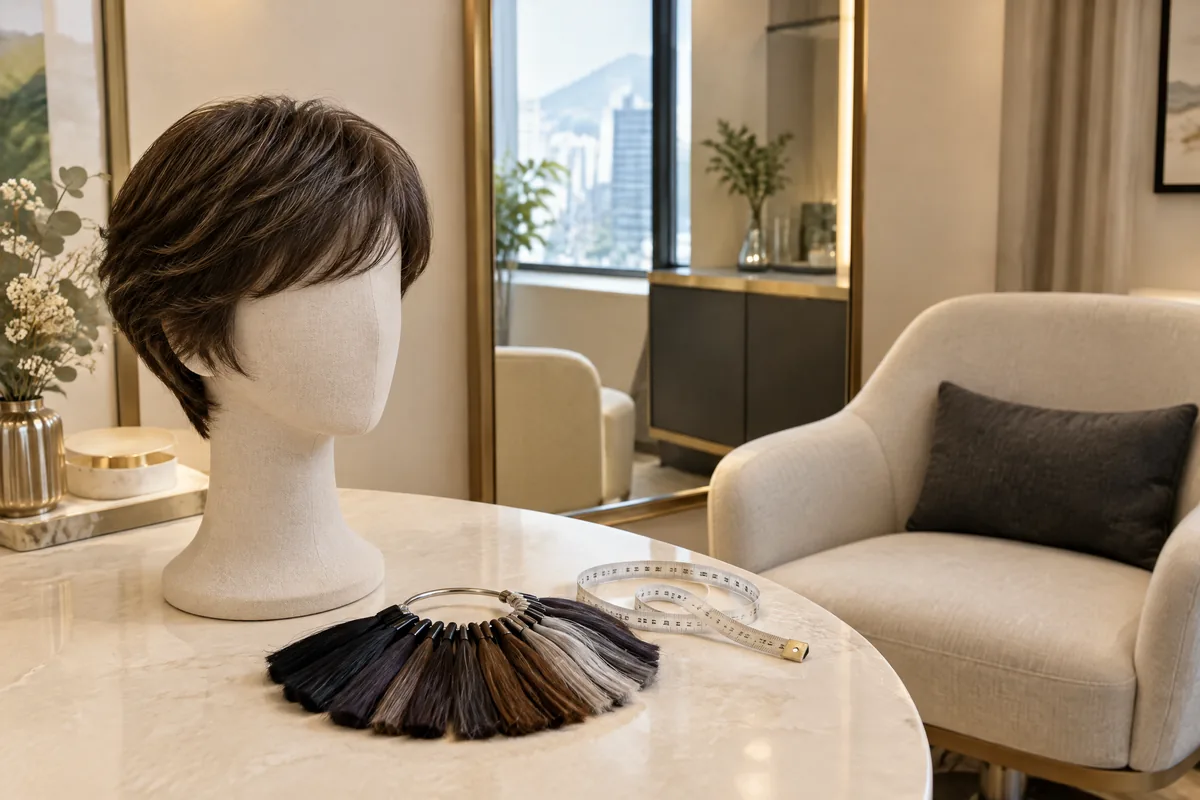
A sample earns a visit when your choice depends on proportion, hairline, volume, or the relationship between cap and head. A photograph can show shape, but cannot tell you whether the front sits naturally, whether sides feel tight, or whether the base moves when you turn. Ask what can be adjusted and what cannot before a custom discussion becomes specific.
Bring two or three reference images with one sentence beside each: “I like the fringe,” “I want less volume,” or “I want the colour change but not the length.” This makes the conversation concrete. Ask what will be measured, which part of the price covers fitting, what follow-up is included, and what care the exact fibre requires.
If you are comparing a shop in Kowloon, location alone is not evidence of a branch, stock, or appointment. The wig shop Kowloon guide identifies a Kwun Tong setting and advises confirming samples, quotation, supply, and visit details before travelling. That is the right habit for any provider: verify the specific service rather than assuming a district result tells the whole story.
A useful visit agenda
- First five minutes: explain everyday situation, desired coverage, styling time, and firm budget limit.
- Next ten minutes: compare shortlist by shape, colour direction, cap construction, and visible hairline.
- Then measure or fit: ask what is measured, how comfort is checked, and what can change later.
- Before leaving: record exact option, quoted inclusions, care conditions, next step, and unconfirmed points.
Keep medical needs separate from appearance preferences. If hair loss is sudden, painful, inflamed, or unexplained, a wig does not identify or treat its cause. The American Academy of Dermatology says accurate diagnosis starts with a dermatologist, and notes that wigs provide immediate cosmetic coverage but do not slow loss or regrow hair 2.
How to compare time, money, and privacy
The cheapest route is not always the lowest-cost decision. An online purchase can save travel while creating a return, alteration, or replacement problem if fit and colour were uncertain. A visit can cost transport and time, but may prevent an avoidable mismatch. Put those trade-offs on paper instead of treating convenience as one number.
Use this equation: total decision cost = item price + travel/time cost + likely alteration or return cost + care supplies. These are estimates, not promises. For time, multiply expected hours by a value you choose for your schedule. For travel, include two journeys if fitting or collection may require a return visit.
| Cost or effort | Online-first | Visit-first | Question to confirm |
|---|---|---|---|
| Research time | More browsing, easy to do privately | Less browsing if shortlist is focused | Can key questions be answered before travel? |
| Travel | Usually none at the start | Transport and possible return visit | Is sample or measurement available? |
| Fit risk | Higher when measurements are unclear | Lower when fit can be discussed | What is adjustable, and what is the return policy? |
| Privacy | Familiar, controlled setting | Private room may be available; ask | Who will be present and how long is it? |
| Decision pressure | Easy to pause | More social pressure is possible | Can you take the quotation away? |
Privacy is part of suitability. You do not have to disclose a medical reason to ask about style, fit, or care. If you mention treatment or scalp sensitivity, ask how comfort can be accommodated and whether your clinical team should advise first.
What to ask before you commit
A good enquiry makes the answer auditable. Ask for exact style and shade, not “something natural”. Ask whether the quote includes fitting, cut, wash, styling, delivery, or alteration. Ask whether a message is only an enquiry or creates a payment obligation. Keep the response with the page details used.
For an online enquiry, send the shortlist and five questions. For a visit, send the shortlist first and ask what to bring. Do not let “custom” substitute for details about measurement, materials, timing, follow-up, and cancellation. If the answer is vague, the decision is not ready.
A message you can adapt
I am comparing three styles for everyday wear. My priorities are [shape], [colour direction], [coverage], and a budget around [amount]. Please confirm exact fibre and cap construction, available shade, measurement or fitting steps, quotation inclusions, care limits, return terms, and whether a sample or visit can be arranged. I understand this message is an enquiry unless you confirm otherwise.
When online is enough—and when to pause
Online is usually enough for low-stakes style exploration, a repeat purchase with known fit, or early budget comparison where no payment is made. It is useful when travel, privacy, or mobility makes a visit difficult. Keep the decision provisional until the seller confirms what matters.
Pause and seek direct discussion when the wig will be customised, your head size is unusual or changing, a visible hairline must look right, your scalp is sensitive, or exact colour matters beside remaining hair. If a return is unavailable, raise the threshold for certainty further.
For chemotherapy, ask your oncology or nursing team about timing and scalp care. Macmillan notes that treatment can make the scalp sensitive, that a liner may help some people, and that care should follow the wig specialist’s instructions 3. Do not apply tape, heat, adhesive, or styling products to a sensitive scalp simply because an online tutorial suggests it; obtain clinical advice where relevant.
The final decision can be small: buy now, book a visit, request a sample, or keep researching. A clear “not yet” is better than a non-reversible purchase made to end uncertainty. The best framework is not pro-online or pro-salon. It matches the channel to the evidence the decision needs.
Questions & answers
Can I decide on a wig entirely online?
You can shortlist style, colour direction, fibre, and budget online. A final decision is less reliable when it depends on physical fit, a sample beside your hair, scalp comfort, or a custom specification. Treat online information as provisional until those points are confirmed.
What should I bring to an in-person wig consultation?
Bring two or three reference images, exact style or colour notes, everyday styling priorities, and a written budget. Ask what will be measured, what the quotation includes, which care rules apply, and whether a return or follow-up visit is available.
Are online wig colour charts accurate?
They help compare broad depth, undertone, and variation, but are not an exact colour guarantee. Screen settings, room light, photography, fibre, and the individual style affect appearance. Compare the specific shade beside your hair in consistent light where possible.
Should I visit a salon if my scalp is sensitive?
A visit can help discuss cap feel, liners, fit, and materials, but it is not a medical assessment. If sensitivity relates to treatment, inflammation, pain, or an unexplained scalp problem, ask your doctor or clinical team first and follow specialist advice.
How do I avoid feeling pressured to buy during a visit?
Say at the start that you are comparing options and will take the quotation away. Ask for the exact option, inclusions, care conditions, return terms, and next step in writing. A useful visit can end with waiting.
Put the next step into practice
For a structured introduction to cutting and styling, explore the learning options at Canvas. Hong Kong hair styling courses。
Read more practical notes on hairstyles and preparation for everyday routines. Canvas beauty journal。
Tell the team about your learning goal or styling request. Contact Canvas Academy。
Sources & further reading
- American Cancer Society: Choosing and Wearing a Wig
Supports natural-light colour comparison, head measurement, and checking that sizing can vary by brand.
- American Academy of Dermatology: Hair Loss: Diagnosis and Treatment
Supports dermatological assessment for unexplained hair loss and clarifies that wigs provide cosmetic coverage rather than regrowth.
- Macmillan Cancer Support: Wigs for Cancer Treatment
Supports caution around treatment-related scalp sensitivity, liners, and following specialist care instructions.