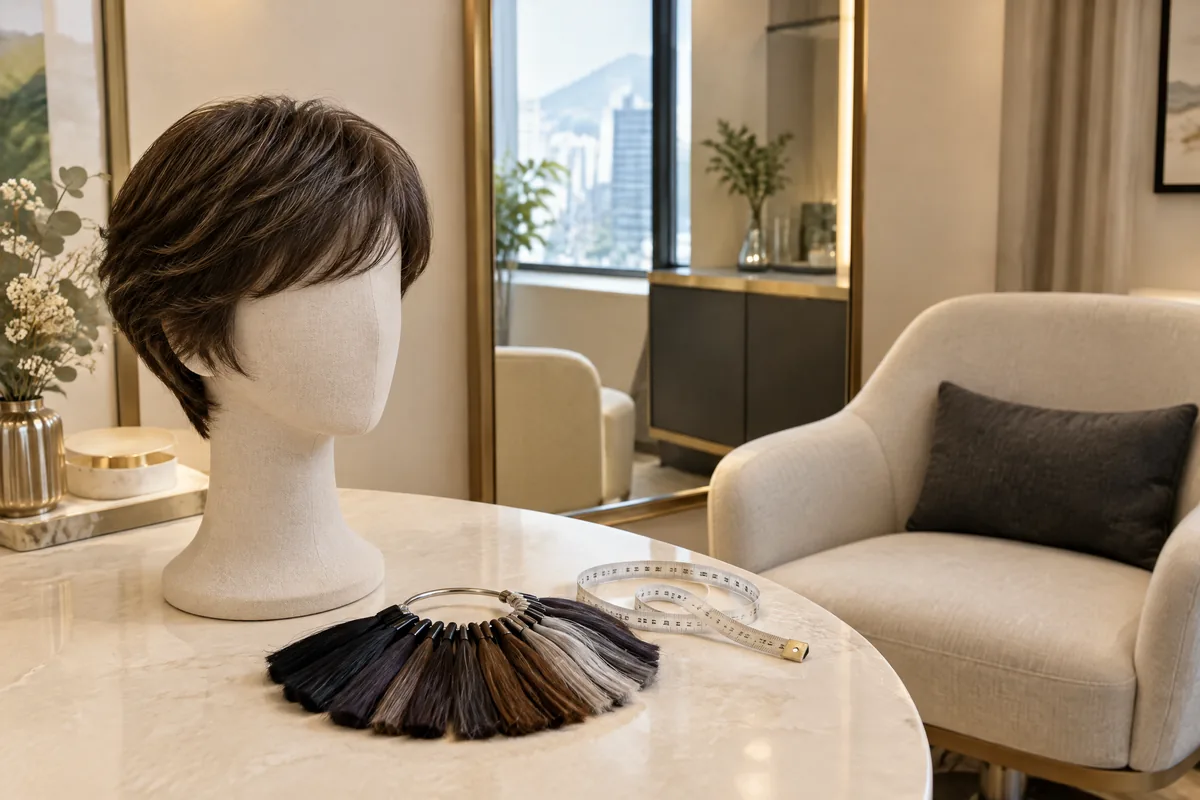
Start with the routine, not the label
A material comparison is useful only when it answers a practical question: what will you do with the wig between the moment you put it on and the moment you store it? Human hair can offer a natural look and more scope for styling, but it generally asks for more time and care. Synthetic fibre often arrives with a set shape and can be easier to manage, yet the styling limits vary by fibre. 1
That does not make one option universally superior. A short, familiar shape worn for quick weekday trips may reward consistency. A longer piece for changing partings or dressed-up occasions may make flexibility more valuable. Start by writing down three facts: how often you expect to wear it, whether you want to restyle it, and what amount you can spend beyond the purchase price.
A useful rule: choose the fibre that makes your ordinary week easier, not the one with the most impressive specification.
What the two fibres actually change
Human hair wigs use real hair; synthetic wigs use manufactured fibres. A blend can sit between them, so a product title alone is not enough to establish how it behaves. Cap construction, density, length, fit and the maker’s care sheet can alter the wearing experience just as much as fibre does.
Human hair is commonly chosen for its movement and the possibility of styling it more like natural hair. That flexibility is conditional: the individual wig still has limits for washing, colouring, drying and heat. Human hair also responds to humidity and weather rather than holding one preset shape. Breastcancer.org describes it as the most natural-looking option but also the more expensive and maintenance-heavy choice. 1
For a Hong Kong shopping reference, compare the stated fibre and care notes on synthetic wigs rather than relying on the category name alone.
Synthetic wigs are often lighter on the budget and easier to keep in a consistent style.
A regular synthetic wig should not be treated as if it were growing hair: dyeing and direct heat may damage it.
Heat-friendly synthetic fibre is a separate category, not a permission slip for any temperature or tool.
Cancer Research UK advises checking the manufacturer’s information because direct heat can melt or frizz some synthetic fibres. 2
| Comparison point | Human hair | Synthetic fibre | What to verify |
|---|---|---|---|
| Everyday shape | Can be adjusted, subject to product limits | Often retains its designed shape | Is the stated style fixed or changeable? |
| Restyling | Usually offers more options | Depends on the exact fibre; regular fibre may have strict limits | Are heat or chemical services expressly permitted? |
| Weather response | May change with humidity | Often holds its preset shape, but can still be affected by heat | How will you store and wear it locally? |
| Care effort | More brushing, styling and condition checks may be needed | Often simpler, but still needs its own washing and storage directions | What does the care sheet actually say? |
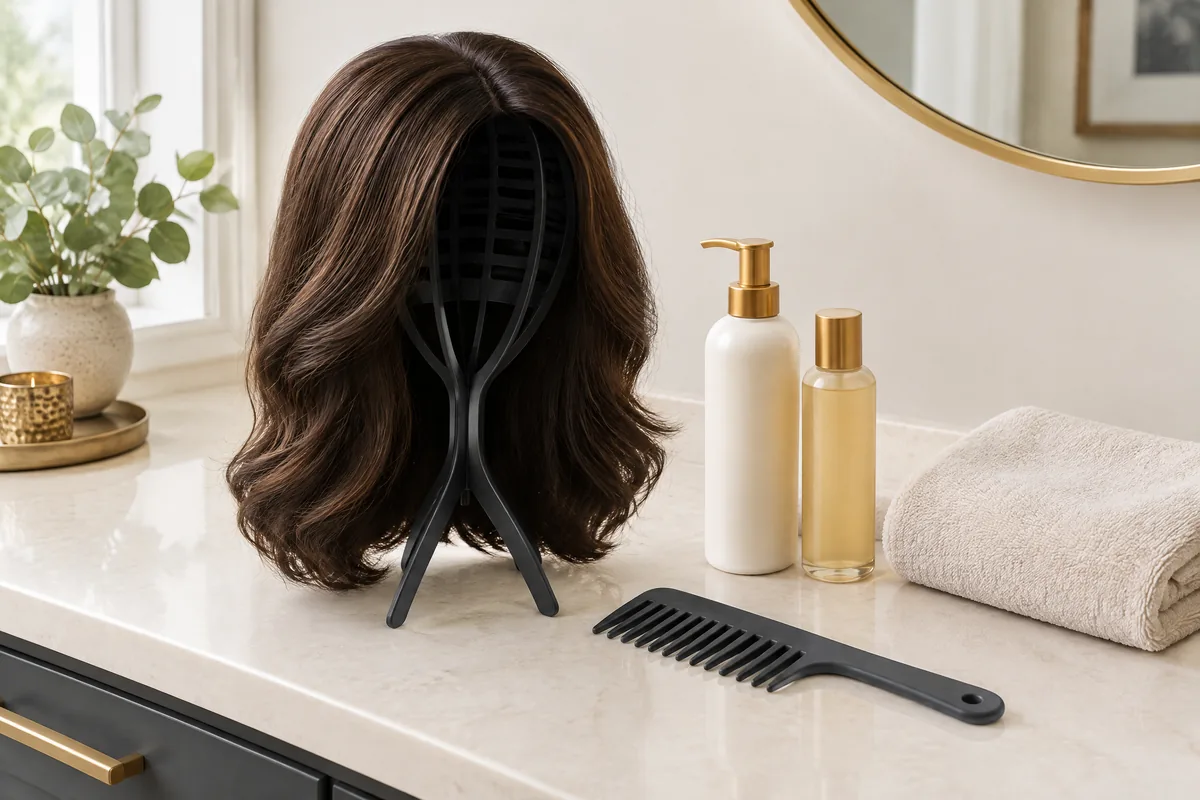
Styling flexibility has a maintenance price
If you change your look often
Human hair can make sense when you want to alter a parting, soften a fringe or move between polished and relaxed looks. The benefit is not that every human-hair wig can be treated exactly like your own hair. It is that the material may give you more room to work, provided the product guidance allows it and the work is done appropriately.
That extra room creates tasks. You may need to plan styling time, use products intended for wigs, detangle carefully and allow the piece to dry as directed. Colour changes also carry cost and risk; “can be coloured” is not the same as “every colour service is safe”. If a change matters, ask whether it should be handled by a wig professional rather than improvising.
If you want a dependable shape
A regular synthetic wig can suit someone who wants to shake it out, make a small adjustment and leave home. Its preset curl or outline may be an advantage when you do not want to rebuild the look each morning. It can also be a drawback if you expect a new style every few days.
Do not generalise from one synthetic wig to another. Some are heat-friendly and some are not; even within a heat-friendly category, the exact maker’s limits control. If the label is silent, treat heat as unconfirmed. This conservative approach protects the fibre and prevents a costly experiment.
For a Hong Kong wardrobe, separate “humidity concern” from “fibre choice”. Weather may influence how much you value a stable shape, but it cannot guarantee that one wig will stay unchanged in every setting. Check the exact construction, texture and instructions instead of buying on a broad promise.
The care routine is part of the price
The purchase figure is only one line in the budget. A fair comparison also includes time, specialist styling, cleaning, accessories and the possibility of owning a second option while one is being cared for. Cancer Research UK notes that some real-hair wigs may need professional styling or setting, while a supplier should explain whether a particular wig can be washed at home. 2
For synthetic fibre, the lower-effort route still needs discipline. Use products intended for wigs, follow the washing method supplied for that item, and let it dry as directed. Avoid kitchen heat, hot hair tools and assumptions borrowed from another piece. The American Cancer Society similarly warns against using a dryer or curling iron unless the wig is heat resistant. 3
| Budget line | Human-hair example | Synthetic example | Why it belongs in the decision |
|---|---|---|---|
| Purchase | Higher starting price is common | Lower starting price is common | Sets the initial cash requirement |
| Styling | May require more regular time or professional help | Often relies on the preset shape | Your time has value even when no invoice appears |
| Care products | Follow the exact fibre and cap instructions | Use wig-specific products and item instructions | Wrong products can shorten the useful life |
| Backup plan | A second piece can cover cleaning or styling time | A second lower-cost style may add variety | Reduces pressure on one wig |
| Replacement | Depends on wear, care and the item; avoid promises | Depends on wear, care and the item; avoid promises | Do not calculate from a universal lifespan |
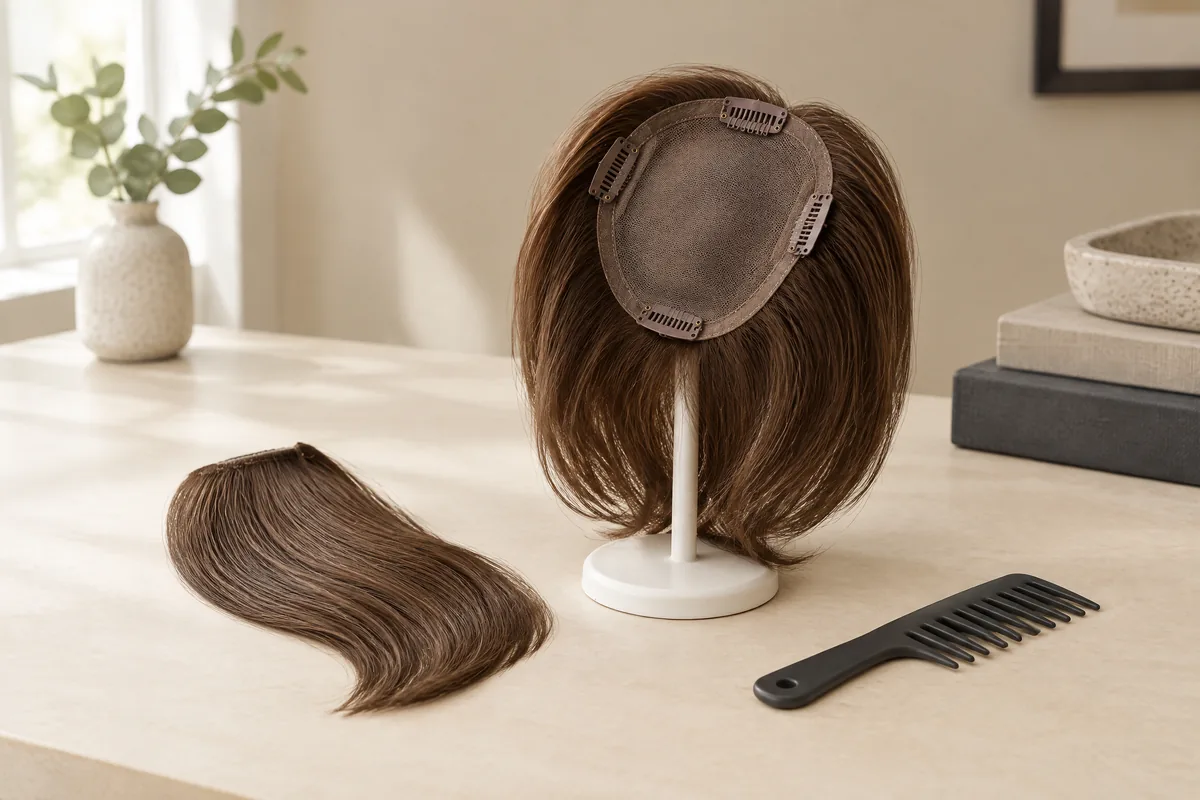
A transparent way to compare budget
Instead of asking only “Which is cheaper?”, calculate a simple planning total. For example, if a synthetic option costs HK$1,200, you reserve HK$180 for care items and HK$120 for a fitting adjustment, the working budget is HK$1,500. If a human-hair option costs HK$4,800, with HK$400 reserved for care and HK$600 for a professional adjustment, the working budget is HK$5,800. These are clearly labelled examples, not market averages or quotes.
Then add the value of convenience in plain language. Would you rather pay more once for a style you can discuss and alter, or spend less for a shape that saves morning decisions? Neither answer is financially correct for everyone. A low purchase price is not a bargain if the item’s care demands conflict with your schedule.
Do not use an advertised lifespan as a guaranteed return calculation. Wear frequency, friction, storage, washing, styling and the particular fibre all matter. Breastcancer.org gives broad examples of shorter synthetic and longer human-hair use, while also tying outcomes to care and frequency; those figures should guide questions, not promise a result for your wig. 1
Check the product condition before deciding
“Condition” here means the state and information of the item, not just whether it is new. Ask whether the style is available, what fibre is confirmed, whether the colour shown is representative, and which cap size and construction apply. An image can help with shape, but it cannot prove the exact colour, density, softness or fit in your light.
A useful enquiry is specific: “What are the fibre and cap details for this style, which care instructions come with it, and what changes are permitted?” A vague question such as “Is it good?” makes it harder to compare two items fairly.
The product pages for human hair wigs list individual styles with fibre, cap design, size and availability information to ask about. Read those details as item-level information, not as a promise that every human-hair wig has the same construction.
Fit deserves its own checkpoint. Measure according to the maker’s method, check adjustment features and confirm the return or exchange policy before purchase. A comfortable fibre in the wrong cap is still a poor daily choice.
Use a decision test that survives real life
Score each candidate from 0 to 2 on the questions below: 0 means unclear or unsuitable, 1 means workable with compromise, and 2 means it fits your routine. This is not a scientific test; it is a way to expose assumptions before money changes hands.
- Can I wear the intended shape without daily restyling?
- Are the washing, drying and storage steps realistic for me?
- Is the fibre’s heat position clear for this exact item?
- Does the cap information match my measurements and comfort needs?
- Can I afford care and adjustment costs, not just the ticket price?
- If the first choice is unavailable, do I have a sensible alternative?
A higher score does not make the wig objectively better. It shows which option has fewer unresolved questions. If two candidates tie, choose the one with clearer instructions and a better return or fitting conversation rather than adding imagined benefits.
| Your priority | Likely direction | Trade-off to accept | Question before buying |
|---|---|---|---|
| Change the look often | Human hair may be worth exploring | More care, time and budget | Which styling and colour actions are allowed? |
| Put on a consistent shape | Regular synthetic may be practical | Less freedom to reshape | Will this style remain suitable for my occasions? |
| Want some flexibility at a lower entry price | Consider a confirmed heat-friendly or blended option | Still vulnerable to unsuitable heat and wear | What are the item-specific limits? |
| Need comfort or scalp-sensitive handling | Compare cap and liner details separately from fibre | Fibre alone cannot guarantee comfort | What fitting and materials are confirmed? |
When hair loss or scalp symptoms are involved
A wig is an appearance choice, not a treatment for hair loss. If chemotherapy, another treatment or scalp discomfort is part of the situation, ask the relevant healthcare team about timing, sensitivity and suitable head coverings. Cancer Research UK notes that some people find soft fabrics or liners more comfortable when the scalp is sensitive, and recommends taking time with fitting rather than rushing. 2
Do not diagnose a scalp problem from a product page. Stop and seek medical advice for symptoms that concern you, and ask before using adhesives, liners or styling products if sensitivity is an issue. A fitter can help with practical selection; a healthcare professional should guide health questions.
The practical conclusion
Human hair and synthetic fibre solve different problems. Human hair may reward someone who values natural movement and styling latitude enough to accept more care and spending. Synthetic may reward someone who values a repeatable silhouette, lower entry cost and fewer styling decisions. A heat-friendly or blended fibre can occupy a middle position, but it still requires exact instructions. The detailed human hair vs synthetic wigs comparison is useful when you want to check those questions against a specific item.
The best choice is the one you can maintain honestly. Compare the look you want, the product condition, the care steps and the full working budget. Then ask for the missing facts before you buy. That method is more reliable than choosing by touch, category reputation or a promise that one material suits everybody.
Questions & answers
Are human hair wigs always more comfortable than synthetic wigs?
No. Comfort depends on cap construction, fit, weight, lining, heat and personal sensitivity as well as fibre. Compare measurements and construction for the exact item, and ask a professional about scalp concerns.
Can I use a straightener on a synthetic wig?
Only when the exact wig is expressly identified as suitable for that type of heat and its instructions state the limits. Regular synthetic fibre may be damaged by direct heat; never infer permission from the word synthetic alone.
Which wig is better for humid Hong Kong weather?
There is no universal winner. Synthetic styles may hold a preset shape, while human hair can respond more like natural hair to humidity. Compare the exact texture, care sheet and the look you can maintain in your daily setting.
How should I compare the cost of human hair and synthetic wigs?
Use a working total: purchase price plus care products, fitting or professional styling, possible accessories and a backup plan. Treat lifespan claims as variable rather than guaranteed, because wear and care differ.
What should I do if my scalp feels sore under a wig?
Remove or loosen the item and seek advice from an appropriate healthcare professional, especially during treatment or when symptoms persist. A wig fitter can discuss fit and soft liners, but a product page cannot diagnose or treat scalp symptoms.
Put the next step into practice
For a structured introduction to cutting and styling, explore the learning options at Canvas. Hong Kong hair styling courses。
Read more practical notes on hairstyles and preparation for everyday routines. Canvas beauty journal。
Tell the team about your learning goal or styling request. Contact Canvas Academy。
Sources & further reading
- Synthetic vs Human Hair Wigs: Which Fiber Type Is Right for You?
Explains the practical trade-offs among synthetic, heat-friendly, blended and human-hair fibres, including relative maintenance, styling flexibility, cost examples and the effect of wear frequency and care.
- Wigs, hats and scarves
Provides independent guidance on synthetic versus real-hair wigs, manufacturer heat instructions, fitting, professional care, scalp-sensitive alternatives and financial considerations.
- Choosing and Wearing a Wig
Supports the advice to compare cap fit and construction separately from fibre and to avoid heat unless a wig is confirmed heat-resistant, while outlining maintenance and care precautions.