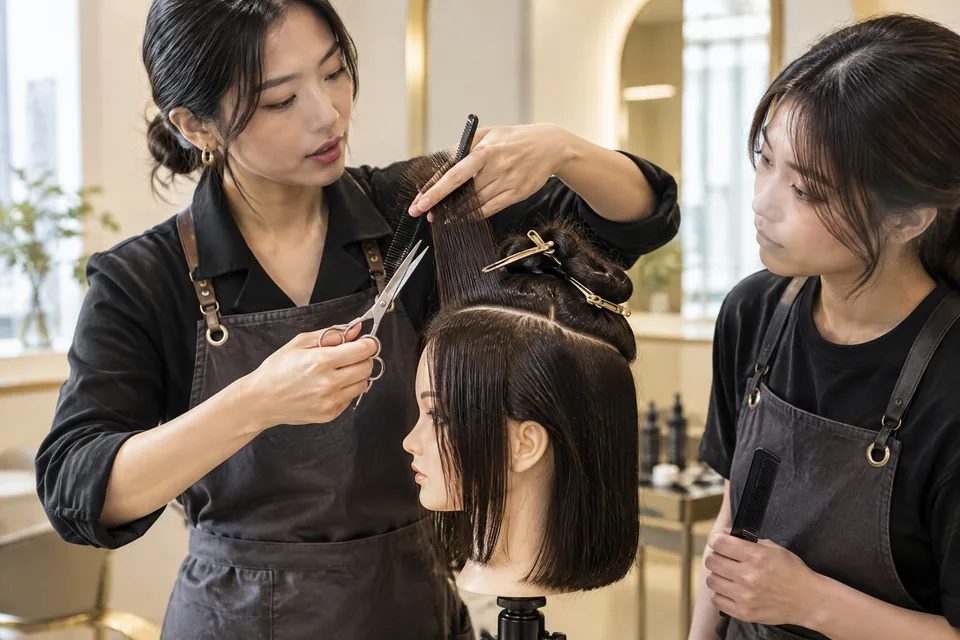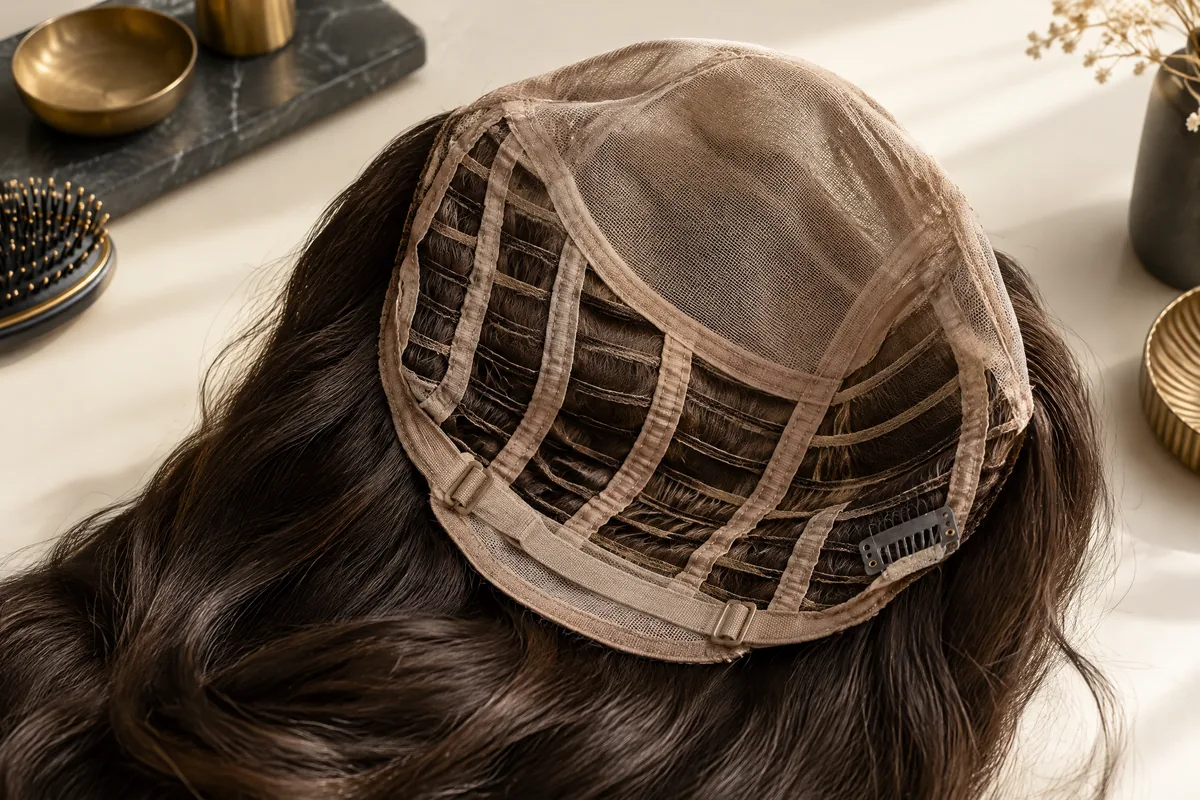
Read the direction beneath the finished style
The nape is the lower hairline at the back of your head. On a pixie, the hair there may point down the neck, move forward towards the area behind the ears, or sweep diagonally across the neckline. Those directions can produce different edges even when two samples have similar crown volume and fringe length.
Natural hair has a growth direction: BCcampus's barbering textbook calls this the grain and explains why nape and sideburn patterns matter before cutting. A wig does not grow from your scalp. For a wig, distinguish the direction in which hair leaves the base from the direction created by brushing or styling its ends.1
With permission, gently separate a small nape section and watch how it settles without pulling it flat. Ask the supplier whether that movement comes from the construction, the cut or its prepared styling. A photograph of brushed-down ends cannot tell you whether the same section will lie down after routine care at home.
OWNSTRAND's guide to pixie wigs discusses fringe, side coverage, crown volume and nape outline rather than presenting one short shape as universal. Treat those as separate comparison points. Select samples with broadly similar top shapes so you can judge the lower edge without being distracted by a completely different fringe.
Start with the look you actually want around your neck. A soft, broken outline and a crisp crop are different design choices, not better and worse versions of the same cut. Keep that preference visible in your notes; otherwise a fitter may solve an exposed edge by adding length that changes the character you liked.
Compare forward, downward and swept napes
Use direction words relative to the wearer, not to the photograph. Here, forward means moving towards the areas behind the ears; downward means towards the neck; swept means travelling sideways or diagonally across the nape. Mixed directions are possible. Mark the left, centre and right separately if the sample does not have one consistent flow.
A forward-directed finish can connect the back of the crop to the side sections. Look behind each ear for bunching or a sudden change in direction. A downward finish makes the central neckline easier to read, but inspect whether the ends lie softly or form a heavy, straight band. Neither observation alone establishes a fitting fault.
A swept finish gives the back a more directional appearance. Its overlapping sections may cover one part of the edge while leaving another more visible. Inspect both rear corners, not just the centre. If you prefer visible texture, decide whether small separations between pieces are acceptable or whether you want a more continuous outline.
| Nape direction | Inspect on the short sample | Main trade-off | Useful supplier request |
|---|---|---|---|
| Forward towards the ears | Join behind each ear and transition into side hair | Connected outline versus possible bulk at the corners | Show the join from both rear profiles |
| Downward towards the neck | Central edge and softness of the ends | Clear neckline versus a potentially blunt band | Compare a softly tapered finish with the existing edge |
| Swept across the nape | Overlap and the more exposed rear corner | Directional texture versus uneven-looking coverage | Show both sides after the hair settles |
For example, two samples may look equally tidy from behind while your head is upright. When you look down, one reveals a narrow cap corner and the other keeps that corner covered with longer, downward ends. That is a useful coverage comparison. It does not prove that the first sample has the wrong cap size.

Place sideburns around ears, glasses and beard lines
Sideburn placement includes the starting position beside the temple, the width of the section and where its tip ends. Do not describe it only as short or long. Compare its relationship to your ear: above the ear opening, around the middle of the ear, or nearer the lower ear. These are personal visual references, not sizing standards.
Look at both profiles with your usual glasses on. Cancer Hair Care notes that glasses and a wig together can create pressure and disturb the appearance, so the combination deserves its own check. Ask the fitter to assess the contact area; do not force a glasses arm through a delicate base to make the outline work.2
A pointed side piece may keep the ear visible, but it can look disconnected if the hair immediately behind the ear points away from it. A wider, softer piece can make the transition more continuous while adding coverage at the temple. Compare the join as well as the tip, especially if the nape moves forward towards the same area.
For a cropped look worn with facial hair, OWNSTRAND's men's wigs guide distinguishes full wigs from partial hairpieces. With a full wig, compare its sideburn edge with any beard or remaining side hair you plan to show. A colour or density mismatch at that join may matter more than matching the fringe to a reference photo.
Suppose a sideburn looks balanced without glasses, then lifts when the glasses are put on. Repeat the check with the fitter watching the cap edge. Hair caught by the arm, pressure on the side section and movement of the whole base require different responses. Shortening the tip before identifying the cause could remove coverage without resolving the interference.
Look for gaps while your head moves
A front view leaves the rear corners largely hidden. Ask for permission to assess the sample on your head, or request additional views if wearing it is not possible. Keep the camera near head height, with consistent light and distance. An overhead picture can exaggerate the visible base and is less useful for comparing the everyday outline.
Macmillan recommends a gentle movement check, if you are able, to assess whether a wig stays secure. It also notes the challenge of making very short styles look natural around the hairline. For a pixie comparison, use comfortable everyday movements and watch both security and edge coverage rather than judging either from one still photograph.3
A repeatable movement sequence
Keep your usual underlayer and hair preparation the same between samples. Start upright, then look down as you would at a phone. Return to neutral before turning left and right. Finally, tilt towards each shoulder within a comfortable range. Stop if anything feels uncomfortable; a bigger movement is not automatically a more useful test.
- Photograph the neutral back and both profiles.
- Repeat the back view while looking down.
- Capture the rear corner exposed during each turn.
- Note whether a gap disappears on returning upright.
- Record pressure or slipping separately from visible hair separation.
Describe the gap, not just the verdict
Write down what becomes visible: skin between hair ends, your own hair, a fabric rim or a section of the base. Record the location and movement that reveals it. "Right rear corner visible when looking down; edge stays still" gives a supplier more to work with than "the back looks unnatural" or "the wig is too small".
Avoid pulling the nape lower to improve a photograph. That may change the forehead position or bring side sections onto the ears. Equally, do not smooth every gap away between pictures. First capture the settled result, then let the fitter demonstrate any permitted styling adjustment and repeat the same movement to see what actually changes.
Separate design direction from cap-size questions
The most useful distinction is whether only the hair moves or the base moves too. Cancer Hair Care describes a good fit as snug and comfortable without shifting as the head moves. Many wigs have adjustable straps at the nape, but adjustments should be assessed for the actual cap rather than used to hide every visible gap.2
If the base remains in position and hair separates at one corner, discuss direction, length and coverage there. If the front and rear edges move together, pause the haircut discussion and ask for a fitting assessment. Placement, underlayers and adjustment settings may be involved. Visible movement is a clue to investigate, not a measurement of cap size.
Watch for the opposite problem too: a sample can appear secure while pressing against the ears or feeling overly tight. A neat edge does not justify discomfort. Tell the fitter where pressure occurs and when it starts. Do not keep tightening the nape straps simply because one sideburn sits differently from the other.
A practical comparison might reveal that a swept nape exposes a small rim while the cap stays still, but a downward sample shifts forward during the same turn. The first needs a discussion about the finish or coverage; the second needs fit and positioning addressed before its hair direction can be compared fairly.
Choose the trade-off before any trimming
More length can soften an exposed edge, but it also changes how cropped the style looks. Macmillan's short-wig guidance notes that slightly longer styles can work better around the hairline. That is a reason to compare a modestly longer perimeter, not a promise that adding hair will correct every nape or sideburn problem.3
Head shape also matters to the visual transition. BCcampus explains that the lower back of the head includes curved areas and that a prominent occipital ridge may call for retained length around it in natural-hair cutting. Use that principle to discuss the silhouette over your head shape, not to assume the wig needs a particular construction.1
Decide which compromise you prefer: a sharper crop with some visible separation during movement, a softer perimeter with more coverage, or a swept finish that needs a particular styling routine. Ask what can realistically be changed on the sample. Trimming removes length; it cannot create extra coverage or automatically change the direction of hair attached to the base.
Any heat reshaping must follow the original manufacturer's instructions for the specific fibre and wig. Human hair, synthetic and blended materials should not be treated alike. Ask the supplier to show the permitted home routine for the proposed finish. If the direction requires frequent preparation you would not do, a different sample may be the better purchase.
Give the supplier a short-cut reference card
Combine one useful reference image with your own observations. Mark what you like about the picture and which parts you want different. A photograph may show an attractive neckline without revealing the model's cap edge or movement, so it should guide the desired appearance rather than serve as evidence that the same finish will work unchanged.
The example below is a discussion card, not a prescription or a finished fitting specification. Replace its entries with what you observed on the sample. Keep left and right clearly labelled from the wearer's perspective. Ask the supplier to record confirmed measurements and feasible changes separately, so an aesthetic preference is not mistaken for an agreed product specification.
| Card field | Example entry to adapt | What the supplier should clarify |
|---|---|---|
| Nape direction | Downward centre; softer forward flow behind ears | Whether this direction suits the proposed base and cut |
| Sideburn endpoint | Near mid-ear, with a narrow soft tip | Position on the wearer with glasses on |
| Movement observation | Right corner opens when looking down; cap edge stays still | Coverage change versus a fit adjustment |
| Desired compromise | Keep the crop, accept a slightly softer rear edge | How much length would be retained |
| Home finish | Prefer a settled outline without a daily directional reset | Permitted care and styling for the exact fibre |
| Photos attached | Neutral back, low-chin back, both profiles | Which views need repeating during fitting |
For a local discussion, OWNSTRAND's wig shop Hong Kong information gives its sole physical location as Unit 2103, 50 Hoi Yuen Road, Kwun Tong, Hong Kong (利寶時中心). Its custom human-hair service may include sample viewing, head measurement and a return fitting with washing, cutting and blow-drying. Ask which steps apply to your chosen option and arrange the visit before travelling.
Before agreeing to a final trim, ask the fitter to repeat your recorded movements with the proposed outline. The decision is not simply whether the back looks neat in a mirror. Choose the combination of nape flow, sideburn position, stable fit and manageable home styling that best preserves the short-cut character you want.
Questions & answers
Can I copy the nape direction from my previous haircut?
Use it as a visual reference, but include a back or rear-profile photograph. Hair attached to a wig base may settle differently from your own hair, so ask which parts of the old outline can be reproduced.
Should both sideburns have exactly the same measured length?
Not necessarily. Ear position and the way the wig sits can affect the visible endpoints. Ask the fitter to compare their appearance on you rather than matching the lengths only when the wig is off your head.
What if the supplier can send only a mannequin video?
Request both rear profiles and an unbrushed nape close-up. The video can clarify the sample's finish, but it cannot establish your personal fit. Leave decisions about final perimeter trimming until the wearing arrangement is assessed.
Is a blunt neckline always less convincing than a tapered one?
No. A deliberate blunt edge can suit the desired style. Compare its weight and continuity with the side sections; tapering is useful when you want softness, not an automatic requirement for every pixie.
Can a high collar affect the comparison?
Yes. Collar contact can push short nape ends away from their settled position. Start with a neckline that leaves the area clear, then repeat the check in a collar you commonly wear to judge that practical interaction.
Put the next step into practice
Build a clearer understanding of hair shape and everyday styling through learning at Canvas. Hair styling courses in Hong Kong。
Explore more practical styling and selection notes. Canvas hair and beauty journal。
Tell the team which hair styling techniques you would like to learn. Contact Canvas Academy。
Sources & further reading
- BCcampus — Barbering Techniques for Hairstylists: The Design Consultation
Explains natural hair grain at the nape and sideburns, and how head shape influences short-cut proportions. Useful for describing the appearance you want to a fitter.
- Cancer Hair Care — Getting a good fit
Describes comfortable, stable wig fit, nape adjustment straps and practical issues when glasses meet the wig. Helps separate fitting concerns from hairstyle preferences.
- Macmillan Cancer Support — Wigs for cancer treatment
Offers general advice on short-wig hairlines and checking security with gentle movement. Its fitting principles are helpful when assessing a close-cropped outline.