Why one length cannot describe the whole wig
An inch figure needs a starting point and a measuring method. A longest-strand measurement is different from the length of a face-framing section. A tape pulled down a straightened curl is also answering a different question from a photograph of that curl resting against a shoulder. Keep these descriptions separate rather than expecting one number to explain the finished style.
Milano Collection states that its overall wig measurement runs from the crown to the longest strand pulled taut. It also notes that waves and curls appear shorter and that companies measure differently. That is a useful example of a supplier convention, not a universal rule for every wig. Read the named maker's method before comparing figures across brands.1
For a purchase decision, keep two records: the listed hair measurements and the relaxed outline. The first helps you understand the cut; the second tells you whether the finished hair clears your collar, sits around your chest or reaches your preferred point on your back. Neither record replaces the other, especially when a listing gives only one overall length.
Read front, crown and nape as a map
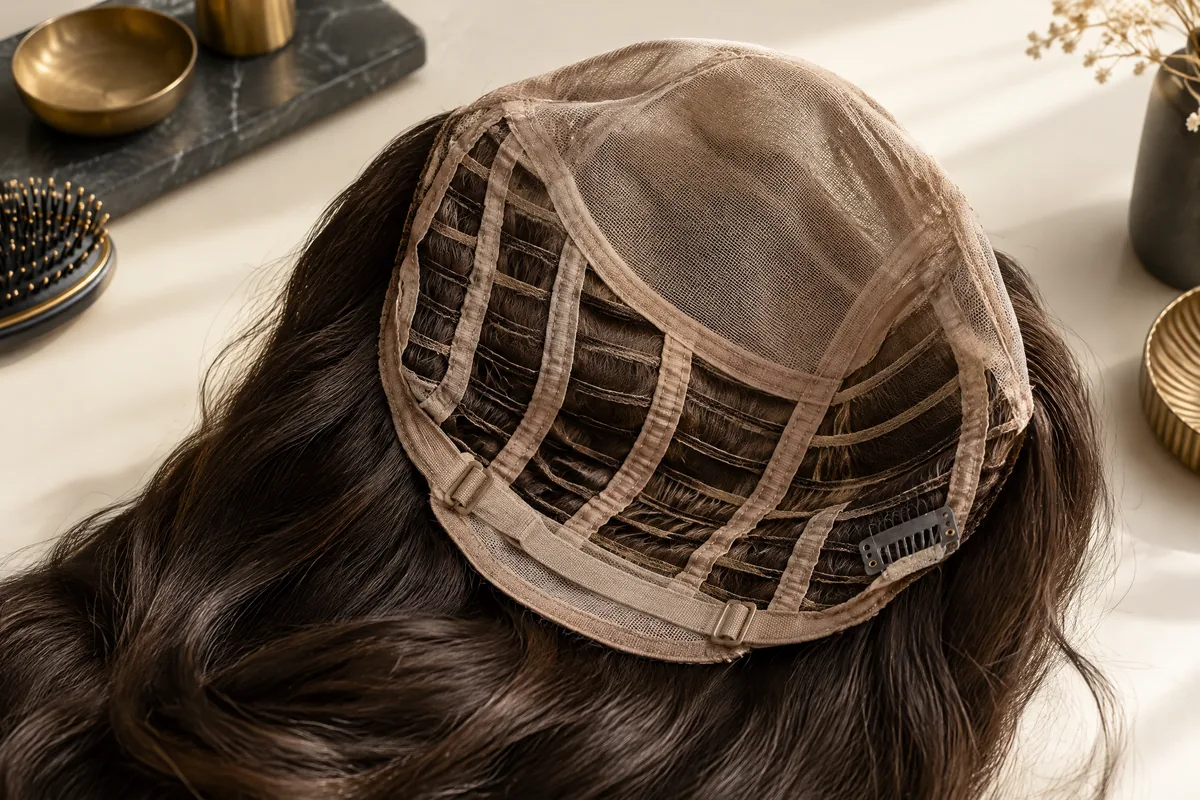
Front length describes hair beginning near the front of the cap, often a fringe or face-framing section. Crown length concerns hair beginning around the top; nape length concerns hair at the lower back. These sections start at different heights. A shorter nape strand can therefore reach a similar endpoint to a longer crown strand without either measurement being wrong.
Jon Renau's Chantal specifications illustrate the difference: bang length is 19.5 inches, crown 20 inches, nape 15 inches and side 18.25 inches. Those are separate regional measurements for one style, not four competing claims about its total length. Use such a map to understand which hair frames the face and which hair contributes to the back outline.2
| Measurement entry | What it helps you judge | What to record beside it |
|---|---|---|
| Front or bang | Fringe coverage and face-framing length | Where it starts and ends; whether swept aside |
| Crown | Top layers and hair travelling down the back | Stated method; how much upper-layer separation shows |
| Nape | Lower-back hair and the bottom outline | Endpoint against your neck, collar or back |
| Side, when supplied | Coverage near ears and shoulders | Left and right fall with the intended parting |
| Overall or longest strand | Maximum stated length under the maker's method | Whether stretched; whether only a few ends reach it |
The distinction is visible in OWNSTRAND's long wigs catalogue: Amore Brittany is listed with a 5-inch front, 11.75-inch crown and 15-inch nape, in synthetic wavy/curly fibre. It would be misleading to describe the entire wig as a uniform 15 inches. These figures describe regions; the listed style requires an enquiry for quotation and availability.
Do not add crown and nape lengths together. They are not consecutive pieces of one strand. Also keep hair measurements separate from cap-fitting measurements such as front-to-back head size. A comfortably fitted cap establishes where the hair begins on you, but a cap dimension is not a forecast of where a curl ends.
Record relaxed fall without pulling the curl
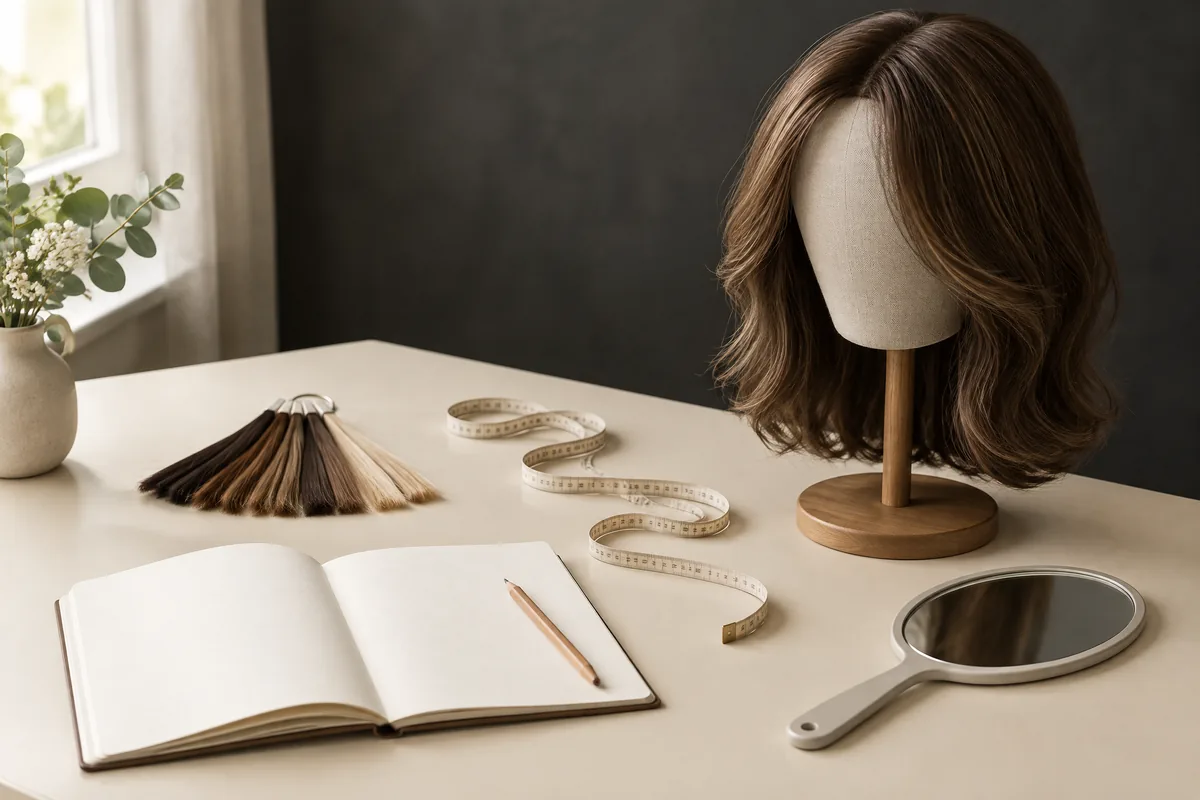
Make the relaxed record with the wig in its intended wearing position, fully dry and arranged as you plan to wear it. If you cannot try that specific piece, a suitably shaped mannequin can help compare samples, but its head and neck proportions are not yours. Label mannequin observations separately from any later worn observations.
Set up a repeatable view
Use a soft tape, a mirror and plain clothing that makes the ends easy to see. Keep your head upright and shoulders relaxed. Place the parting where you want it and release hair trapped beneath the cap edge or behind a shoulder. Take front, side and back photographs from a similar distance, without tipping your chin to make the hair look longer.
Your notes should identify the condition of the sample: supplied curls, finger-separated curls or another permitted finish. Record the measuring origin and the resting endpoint. If you write down a distance, run the tape beside the natural fall rather than winding it around every bend. This is a practical visible-fall record, not a substitute for the manufacturer's fibre-length specification.
Follow one section at a time
- Identify the front section and let it rest in its normal position. Note its endpoint relative to the cheek, jaw or collarbone.
- Repeat at the crown, viewing the back without lifting the section or stretching its curls.
- Repeat at the nape, keeping hair outside your clothing so the lower ends remain visible.
- Note both the main outline and any isolated longer ends; do not let one strand represent the whole style.
- Release each section after handling it and let it settle before recording the next view.
A curl held under tension may look longer simply because you have opened its turns. That observation can be useful only when reproducing an explicitly stated supplier method, with the owner's permission and appropriate handling. For choosing where the everyday style will land, leave it relaxed. Do not tug at the root, brush out the shape or use heat merely to obtain a number.
Compare the silhouette, not just wave names
A broad wave lets the eye follow a relatively open, flowing line. A spiral turns around itself and can place more visible texture within a shorter downward distance. These are useful observations, but they do not create a fixed conversion between measured and worn length. Compare the actual depth and spacing of the bends, particularly near the ends.
When exploring wavy wigs, inspect where movement begins. A mostly straight upper section with waves below the shoulders gives a different outline from waves starting high around the face. The same longest-strand figure may describe both. Decide whether you want the movement concentrated below the collar or distributed through the upper layers.
| Relaxed pattern you can see | Length impression to examine | Useful comparison | Main trade-off |
|---|---|---|---|
| Broad, shallow waves | Longer continuous downward lines | Back view and resting endpoints | Gentle movement rather than compact definition |
| Deep waves | More repeated sideways bends | Similar cut with shallower waves | More texture, potentially less visible drop |
| Loose spirals | Separate turns with space between them | Side view and face-framing sections | Definition with a less uniform bottom edge |
| Compact curls | Closely repeated turns | Relaxed sample at the intended length | Strong texture may occupy more width than expected |
Look at width as well as downward reach. Two styles can end at the same shoulder line while one surrounds the jaw with more volume. Conversely, a curl pattern may appear long at the back but finish noticeably higher in front because of face-framing layers. Front and back photographs together prevent the longest section from dominating your decision.
For a fair texture comparison, keep cut and wearing position as similar as possible. Comparing a heavily layered spiral style against an almost one-length wave changes two variables at once. That may still help you choose an overall look, but it cannot tell you how much of the difference comes from curl pattern alone.
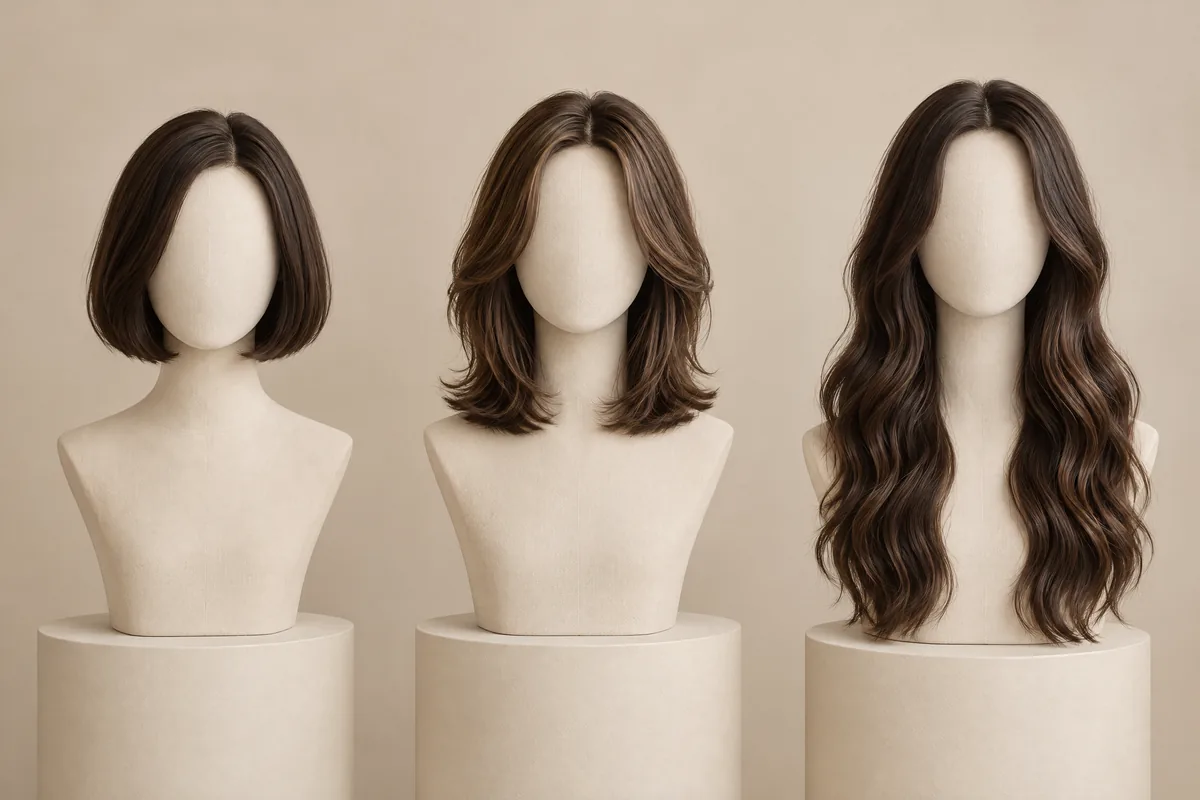
Why identical catalogue measurements land differently
Imagine two hypothetical wigs both advertised as 18 inches under the same crown-to-longest-end method. One has shallow waves; the other has compact spirals. Opening the spirals for measurement can reveal the same stated reach, while the released turns occupy more of the strand's path. The spiral style can therefore finish higher when worn without containing less measured length.
Now imagine two 18-inch styles with similar waves but different layers. One has many ends clustered near its longest point; the other has shorter upper layers and only a small lower section reaching that point. Their maximum length agrees, but their visual weight does not. If you want a substantial long outline, assess the main body of ends rather than the lowest tip alone.
Match the starting point before comparing endpoints
A crown figure of 18 inches and a nape figure of 18 inches are not equivalent descriptions. The crown strand travels from a higher point; the nape strand begins lower. A listing that says only “18 inches” leaves this comparison unresolved. Ask which region or overall method the number refers to, rather than choosing the larger-looking photograph.
Wearer proportions add another difference. The route from crown to shoulders, the neck length and the cap's correct position all affect the endpoint against the body. A model's chest-level finish is not a promise of the same landmark on you. Do not shift the cap backwards to gain apparent length; judge the style with its intended fit and hairline position.
There is consequently no dependable instruction to add a standard number of inches for every curl. A mild wave and a compact spiral are not interchangeable, and styling can change how their turns sit. If the endpoint is important, compare relaxed samples or consistent views of the exact styles, then describe the desired landmark in your enquiry.
Choose which part of the long look matters most
If your goal is hair visibly below the shoulders at the back, prioritise the relaxed back outline and the nape section contributing to it. If your goal is long framing around the face, prioritise front and side fall. A long back does not guarantee a long front, and a short face-framing layer does not make the whole style short.
For curly wigs, choose between a compact, defined shape and a more extended downward outline before chasing maximum inches. You might prefer a shorter visible drop with well-separated spirals over a longer style with looser movement. Alternatively, reaching a particular point on your back may matter more than keeping tightly defined curls.
Consider a hypothetical workday with a shirt collar, shoulder bag and desk chair. A curl that rests on the collar while standing may shift when you sit or turn. With permission during a fitting, try those ordinary movements and look at the ends again. Choose acceptable contact points rather than rejecting every style that touches clothing.
A useful priority list separates the features you need from details you can compromise on. Bring it to a fitting or keep it beside your photographs, then mark each style against the same requirements. For a long textured style, the following priorities offer a practical starting point:
- Essential: the main back outline reaches your preferred landmark when relaxed.
- Essential: the front sections frame the face where you want them.
- Flexible: a few longer tips extend beyond the main outline.
- Flexible: curl definition differs slightly from a reference photograph.
- Unacceptable: achieving the desired look requires handling or heat the fibre does not permit.
Preserve the shape while you assess length
Do not assume a curly appearance means you can straighten and re-curl the sample. Ellen Wille's discontinued Gina Mono is a useful manufacturer reference: it is described as a layered curly synthetic wig, while its specifications explicitly state that it is not heat styleable. Its discontinued status makes it an example of a specification, not an available buying suggestion.3
For the piece you are considering, follow its manufacturer's detangling, drying and styling instructions. A brush, comb or heated tool appropriate for one fibre may be inappropriate for another. If the sample needs arranging before comparison, ask for the permitted method. Separating curls or changing the finish can alter the apparent outline even when the listed hair lengths stay unchanged.
If cutting is part of the plan, discuss the finished curl shape rather than requesting the same amount removed from every region. Shortening front layers and shortening the nape solve different problems. Judge the intended result in its relaxed finish, and agree which sections matter most before an irreversible cut. Extra length provides options only when the planned adjustment suits the specific piece.
Take a length record into your style enquiry
Send the style name, its listed regional measurements and a reference showing the outline you want. Add a plain-language request such as “defined curls, with the main back ends below my shoulders and the front near my collarbone”. That is more useful than “18 inches please”, because it identifies both the texture and the visible result that matters.
For OWNSTRAND, discuss the particular catalogue style and whether a relevant sample can be viewed before making travel plans. Its sole location is Unit 2103, 利寶時中心, 50 Hoi Yuen Road, Kwun Tong. Area-specific pages do not indicate additional branches. Quotation, supply and viewing arrangements need to be agreed for the item; a style enquiry is not an order.
Finish your comparison with one sentence for each option: “The front works, but the relaxed back falls too high”, or “The back length works, but the crown layers create more width than I want”. These observations make the trade-off clear. Choose the wig whose resting shape suits your priorities, not the one whose single printed number appears most impressive.
Questions & answers
Should I measure the wig while it is wet?
Not for a record of your usual dry, worn outline. Record it after the piece has dried and been arranged according to its care instructions. If a supplier requests measurements in another condition, label that record clearly so it is not confused with the relaxed dry fall.
Can I use centimetres instead of inches?
Yes. Use one unit consistently in your comparison notes and retain the supplier's original unit alongside any conversion. One inch equals 2.54 centimetres. Changing units does not resolve a different measuring origin or the distinction between stretched length and relaxed fall.
What if the left and right sides seem different lengths?
First release any hair caught behind an ear or shoulder and check the intended parting. A side part or asymmetrical cut can create different resting outlines. If the difference remains unexplained, ask about that exact style rather than trimming a section to force symmetry.
Is a ruler in a product photograph enough to compare lengths?
It helps only if the origin, unit and condition of the hair are clear. A ruler beside stretched hair cannot establish relaxed curl fall, and a tightly cropped photograph may hide the main outline. Request context rather than estimating a reliable body endpoint from an isolated close-up.
Should I order a longer wig just to leave room for cutting?
Only if the extra length serves a defined adjustment. Discuss the intended finished outline and which regions would be shortened, along with any extra cost. An unnecessarily long style may add handling before alteration, while cutting alone cannot reproduce another wig's layering or curl pattern.
Put the next step into practice
Build a clearer understanding of hair shape and everyday styling through learning at Canvas. Hair styling courses in Hong Kong。
Explore more practical styling and selection notes. Canvas hair and beauty journal。
Tell the team which hair styling techniques you would like to learn. Contact Canvas Academy。
Sources & further reading
- The Ultimate Wig Length Chart: Find Your Perfect Length — Milano Collection
Explains Milano's crown-to-longest-strand measurement with hair pulled taut, why texture changes apparent fall, and why measuring conventions vary between companies.
- Chantal: Manufacturer Specifications — Jon Renau
Provides separate bang, crown, side and nape lengths for one style, illustrating why regional figures should not be treated as a single uniform hair length.
- Gina Mono: Discontinued Curly Synthetic Wig Specifications — Ellen Wille
A discontinued manufacturer reference that describes layered curls but explicitly rules out heat styling, showing why curl appearance cannot establish styling permission.