Why a neat side part can leave a raised crown
A side part organises the front and top into a broad sweep. A crown swirl changes direction within a smaller area. A hairpiece can look convincing from the front yet develop a raised strip where its sweep reaches that turning area. Flattening the strip repeatedly may conceal the symptom while leaving the underlying mismatch unchanged.
A hair whorl is a circular or spiral arrangement of hairs around an axis, determined by follicle growth direction. Its position and spin are separate features, so the word ‘clockwise’ is not a complete styling instruction. The direction at the precise point where the piece meets your hair matters more than the overall label.1
Treat a ridge as an observation, not proof of a faulty base. Hair travelling towards hair from the other side can bunch, but excess length, styling product or a lifted edge can produce a similar outline. Your task is to separate these possibilities before choosing a remedy that removes hair or changes the construction.
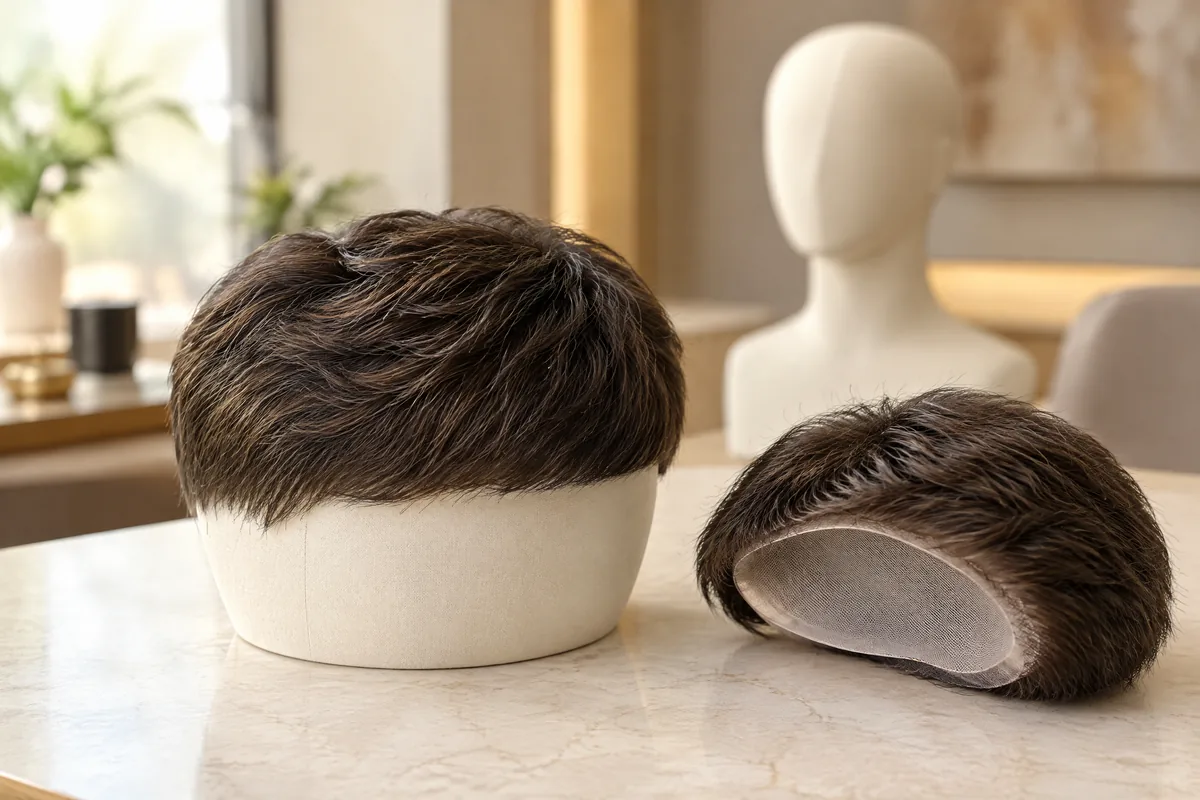
For a men's hairpiece for thinning crown, the turning area and the proposed boundary need to be considered together. OWNSTRAND's crown collection lists HIM In Full Effect and Jon Renau JJ as different topper options requiring quotation and availability enquiries. Their category does not establish an identical footprint or an identical way of parting the hair.
Draw the side part and swirl on separate sheets
Use a clear top-view photograph showing the part, crown and surrounding hair in your ordinary style. Ask someone to photograph from above rather than guessing from a front-facing mirror. Keep the original image orientation: label front, back, your left and your right. A mirrored phone image can reverse the apparent relationship you are trying to understand.
Place two transparent sheets over the same printed photograph. These are drawing aids, not materials to put on your head. On both sheets, copy the head outline and the same registration marks at the front centre and ear positions. Those marks let you stack the drawings without accidentally shifting the swirl towards the part.
On sheet P, trace the side-part line and draw arrows showing the ordinary sweep on each side. Stop the arrows where the front sweep actually stops; do not extend them through the crown simply because a straight line looks tidy. Mark the intended end of the part, including any section where it becomes indistinct.
On sheet W, mark the visible swirl centre and several short arrows around it. Record local direction at the future rear and side boundaries, not just a large circular arrow. Leave areas hidden by sparse coverage or longer hair labelled ‘unclear’. Inventing a direction inside a patch you cannot see makes the overlay less useful.
Keep the following notes beside the sheets so the sketch remains connected to the hairstyle you wear. They help the fitter distinguish your everyday styling preference from the local direction near the crown boundary, where the two may differ:
- Which side you normally part, and where that line ends.
- Where crown hair turns towards the proposed edge.
- Which sections are hidden or difficult to judge.
- Whether the ridge exists without a hairpiece or appears only with the sample.
Overlay the drawings on the sample's actual flow
Ask the fitter to establish the sample's intended placement before comparing directions. Make a third sketch from a top-view photograph of that fitted position, with permission. Trace the base boundary and front marker onto the same outline. Compare at a consistent scale; an enlarged product photograph over a smaller head photograph can falsely suggest an overlap or gap.
Record the sample's resting hair flow first. Use short solid arrows for the direction you can observe close to its base, and longer dashed arrows for the proposed combed sweep. Do not pull strands apart to expose their attachment. If the starting direction is unclear, ask the fitter to demonstrate it and leave the drawing provisional.
Stack P and W over the sample sketch. Circle a short section wherever arrows point towards one another. Also mark places where the flows cross sharply and places where they run together. These are candidates to inspect, not automatic failures: strand length and the way hair overlaps can make a drawn conflict visually harmless.
Imagine a left side part whose top hair sweeps right, while remaining hair beside the rear boundary travels left. A sample sweeping right into that area may leave two groups meeting head-on. If a raised strip appears at the same circled point, that supports testing a different route before asking for more density or a different base.
Tell a direction clash from an edge or length problem
Watch what moves when the fitter gently separates the raised hair. If the base remains seated and the strip disperses, hair flow is worth testing. If the boundary itself lifts or rocks, stop trying to solve it through combing. The fitting and attachment need attention before any styling comparison can be meaningful.
| What you see | Useful distinction to make | Next reversible check |
|---|---|---|
| Raised strip where opposing arrows meet | Hair may be bunching while the base stays seated | Separate the two flows and try a curved exit |
| Ridge remains when hair above it is parted | The base or attachment may be contributing | Have the fitter assess placement and edge seating |
| Rounded bulk despite matching arrows | Overlap, length or product may be involved | Spread the overlapping hair gently before discussing a trim |
| Smooth crown but exposed boundary | Direction improves while coverage becomes weaker | Restore placement and test the other route |
A toupee describes partial coverage, not a particular hair-flow design. When comparing one with a crown topper, ask to see the actual turning area and boundary on the sample. A broader piece may move that boundary elsewhere, but it also covers more existing hair and does not automatically remove the conflict.
Do not rotate or slide a fitted sample merely to make the arrows match. Its dimensions, front orientation and attachment positions still have to work. The overlay is useful because it lets you test changes in the hair's route while keeping the fitting constant, rather than disguising one problem by creating another at the front or sides.
Compare two routes without cutting the crown
Begin with the same sample placement and a gentle reset permitted for its fibre. Ask before handling a sample, adding water or applying any product. Use fingers or the recommended comb, not repeated hard brushing. For your growing hair, the American Academy of Dermatology advises gentle wide-tooth combing and avoiding pulling or tugging.2
Route A: keep the side part, soften its rearward sweep
Keep the familiar front part, but stop treating it as a straight instruction through the entire crown. Guide the hair across the top, then let the rear section turn diagonally into the local direction shown on sheet W. The aim is a continuous change of direction, rather than pushing the ends directly into the opposing boundary hair.
Work on a small section around the circled conflict, leaving the front unchanged. Allow the ends to overlap the surrounding hair where they naturally settle. If the only way to hide the boundary is to flatten the roots firmly, note that limitation. A route that looks smooth only while your hand holds it is not a useful everyday choice.
This route favours someone who wants to retain a defined side part for work or a familiar front profile. Its compromise is a less rigid part towards the back. It may fail when the sample's resting flow repeatedly returns into the collision, or when the diagonal exit uncovers an edge that the original sweep had hidden.
Route B: follow the swirl, let the part end earlier
Reset to the original starting style, then allow the crown section to curve with the observed local swirl. Let the side part finish before that turning area instead of forcing a continuous line. Guide the crown hair around the centre into a direction that joins the surrounding hair, keeping the base at the same fitted position.
Use sheet W's arrows at the boundary, rather than combing a perfect circle around the centre. A visible swirl does not mean every strand needs to orbit it. The objective is a softer transition where the two hair groups meet. Keep checking coverage, because a smooth curved exit can still expose the base at its inner side.
This route accepts a less formal crown in exchange for less opposition at the boundary. It suits a style where the front part can fade into a relaxed top. Its disadvantage is that the crown may no longer match a sharply parted reference photograph, even when it blends better from above and behind.
Judge the routes from more than the front mirror
Photograph both routes from the same top, rear and side positions, with similar lighting. Compare the crown after releasing your hands and after ordinary head turns. Avoid judging one style under a bright ceiling light and the other in softer light: you may be comparing reflection and scalp visibility rather than a genuine change in the ridge.
| Decision point | Route A: part-led diagonal sweep | Route B: swirl-led curved route |
|---|---|---|
| Front appearance | Preserves the established side part | Keeps the front part but allows it to end earlier |
| Crown appearance | Controlled diagonal transition | Softer curved transition |
| Main compromise | May retain opposition near the rear | May lose a sharply defined rear part |
| Reason to reject it | Ridge returns or boundary needs forceful flattening | Curved flow exposes the edge or creates another split |
| Useful result | Coverage stays intact with a gentle rear turn | Coverage stays intact with less crown manipulation |
In an illustrative comparison, Route A removes the raised strip but reveals a rear corner when the wearer looks down. Route B leaves a softer-looking crown while keeping that corner covered. Route B is the stronger choice if reliable rear coverage matters more than a crisp part continuing backwards. Neither result requires an immediate haircut.
In another scenario, both routes produce the same raised band and the base edge moves when the wearer turns. That points back to fitting rather than a contest between combing styles. If both routes sit flat but create a bulky shelf of overlapping ends, a controlled length adjustment becomes a more sensible discussion than replacing the base.
Change the haircut or base only for the problem shown
Consider a haircut when the flows already join but the ends create excess bulk or an awkward step. Ask the stylist to identify the specific overlap and preserve enough length to cover the boundary. Cutting the crown short simply to remove a ridge can sacrifice that coverage, and hairpiece strands will not grow back after an unsuitable trim.
A base discussion is more relevant when its correct footprint places the boundary in a difficult turning zone, or its construction will not support the requested parting route. Ask what the exact sample permits and compare another fitted option. A different construction is a trade-off involving coverage, styling and upkeep, not a universal upgrade from the one you have.
For a men's hairpiece, OWNSTRAND describes a custom human-hair process that can include sample viewing, head measurement and a return fitting with washing, cutting and blow-drying. Bring the three sketches and ask which services apply to the specific option. That process does not mean every catalogue topper can have its base or hair direction altered.
Take the winning route into your daily routine
Record the successful route with a top-view photograph and two or three arrows showing where the front sweep changes direction. This is easier to repeat than remembering ‘comb clockwise’. Keep a rear-view photograph too, since the front can look unchanged while the boundary becomes more visible. Ask the fitter to demonstrate a repeatable reset for the exact fibre.
Heat should not be the first attempt to force a reluctant crown into place. The American Academy of Dermatology recommends reducing heat exposure and using the lowest setting when heat is used on growing hair.2 For the hairpiece, follow its manufacturer's instructions instead; neither human-hair habits nor a heat-friendly label supplies a safe setting for every product.
When arranging an OWNSTRAND sample discussion, request the relevant option and clarify what can be viewed before travelling. Its shop is Unit 2103, 利寶時中心, 50 Hoi Yuen Road, Kwun Tong. The most useful request is specific: show the part-led and swirl-led routes at the intended placement, then compare coverage before agreeing to any irreversible change.
Questions & answers
Can I keep a slick, straight part all the way to the back?
Only if the fitted hairpiece and surrounding crown hair support that route without exposing the boundary. A continuous line is a style preference, not a requirement. Ask to compare it with a part that becomes softer before reaching the swirl.
Should I draw both swirls if I have a double crown?
Yes. Mark each visible centre separately and record the local direction between them. Do not replace them with one large circle. The sample may meet different flows along its left and right rear boundaries, so a single overall spin label is insufficient.
Is a wet-hair photograph useful for the tracing?
It can supplement the sketch if it makes direction easier to see, but clumped wet strands show coverage differently from your usual dry style. Keep a dry everyday-style photograph as the main reference, and label the wet image clearly rather than treating the two as interchangeable.
Will adding more hair hide a directional ridge?
More density may hide a small gap while making a collision look bulkier. Ask the fitter to separate a coverage shortage from opposing flow before discussing added hair. A ridge and visible scalp can exist together, but they do not necessarily need the same adjustment.
Should the hairpiece have its swirl exactly over my own?
Not necessarily. A piece can cover the original centre, leaving its boundary as the visible meeting point. Compare how hair joins at that boundary while the base is correctly placed. Matching two centres on a drawing is less useful if it creates poor coverage or an unsuitable front orientation.
Put the next step into practice
Build a clearer understanding of hair shape and everyday styling through learning at Canvas. Hair styling courses in Hong Kong。
Explore more practical styling and selection notes. Canvas hair and beauty journal。
Tell the team which hair styling techniques you would like to learn. Contact Canvas Academy。
Sources & further reading
- Scalp hair whorl patterns in patients affected by Neurofibromatosis Type 1: A case-control study
Explains that scalp whorls reflect follicle growth direction and have distinct positions and spins, helping readers map local crown flow rather than rely on a clockwise label.
- 10 hair care habits that can damage your hair
Offers gentle combing and heat-reduction advice for growing hair. Hairpiece care still needs the exact fibre's manufacturer instructions.