Set up one light, not three different impressions
A ceiling light is useful because it resembles the overhead lighting you may encounter at an office desk, restaurant table or lift lobby. The aim is not to create the harshest possible inspection. It is to see whether two top panels behave differently when the viewing conditions remain reasonably consistent.
Use one fixed overhead lamp and mark the chair position beneath it. Leave the lamp brightness unchanged, avoid flash and keep direct window light out of the comparison. If daylight is changing rapidly, close the blind for this pass. Keep the wig or topper on the same wearer, with the same permitted liner or underlayer.
A loose sample on a table can help you understand construction, but it cannot show how the top sits on your head. Complete the visible comparison in a properly positioned piece. Follow its fitting directions first; the American Cancer Society also advises following the instructions supplied with a wig when putting it on. 3
The checklist below keeps the setup repeatable without turning it into a technical test. Take a quick photograph of the chair position and write down anything you cannot match, such as different root colours. Those differences belong in the notes, not in a construction verdict.
- Mark the chair and camera positions so both samples return to the same places.
- Use the same lamp setting, phone lens and camera distance.
- Start with dry hair and no newly added powder, spray or concealer.
- Note the colour, underlayer and hairstyle for each sample.
- Ask before moving a part or touching a delicate base.
Give both samples the same visible part width
A narrow part hides more of the underlying panel than a wide one. Comparing a tightly closed part on one wig with a deliberately opened part on another answers a styling question, not just a construction question. Start with a width you would actually wear, then reproduce that opening as closely as practical on both samples.
Use a photograph of the first part as your visual reference. Note its position relative to the centre of the forehead and how far it runs towards the crown. Do not push a comb into the base to measure the gap. A ruler held beside, rather than against, the hair can provide a rough scale in your photograph.
If the two styles cannot safely reproduce the same part, record that limitation instead of forcing them to match. A fixed part may still suit someone who never changes their hairstyle. A movable part has value only where the intended opening remains inside its usable panel. Compare construction at the shared width first, then assess styling freedom separately.
Read mono and silk-top labels as different information
Monofilament names the mesh area
The National Alopecia Areata Foundation describes monofilament as fine, transparent mesh at the crown or part, with individual hairs tied into it to suggest natural hair growth. It also explains that a wig can combine a mono top with a lace front and wefted back. These features describe different zones, not competing names for one whole cap. 1
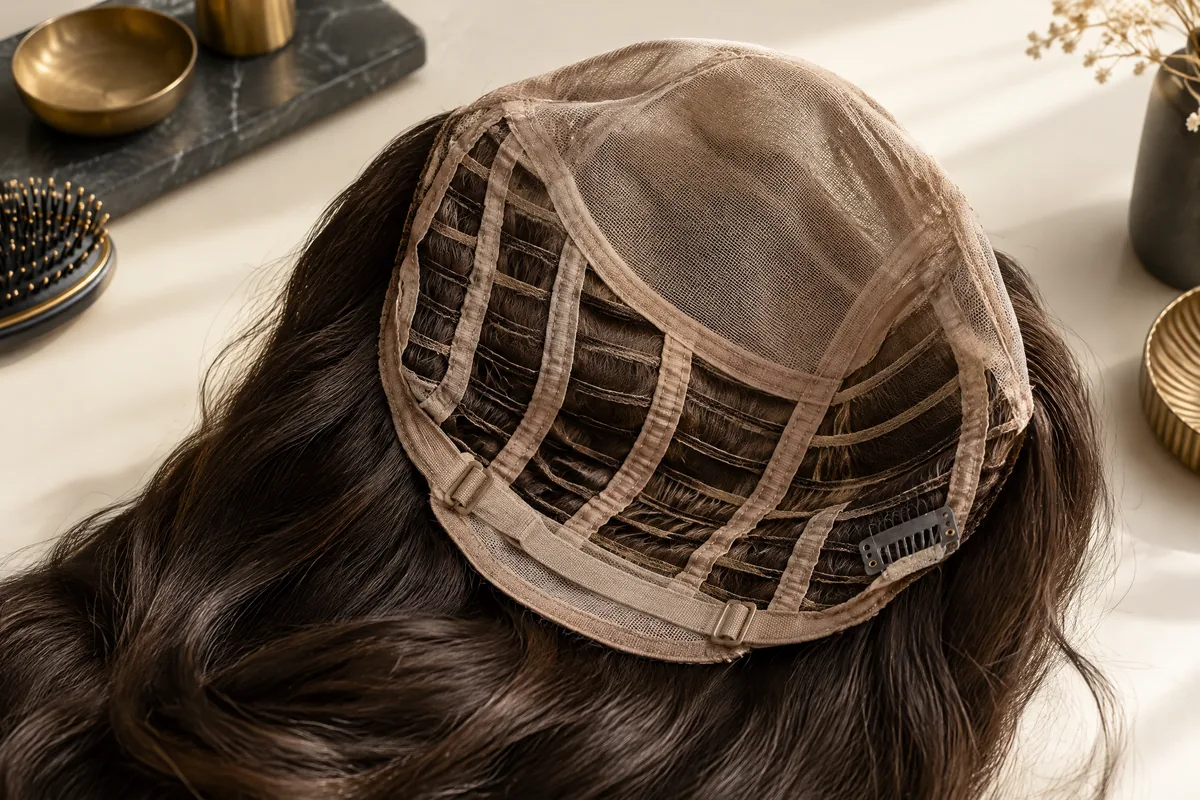
For the overhead comparison, locate where that mesh area starts and stops. A narrow mono part, a crown panel and a broader top do not give you the same exposed area. OWNSTRAND's guide to monofilament wigs distinguishes those zones; use the sample's actual panel shape to decide where your preferred part can sit.
Silk-top wording needs a maker's explanation
A layered top can conceal the hair knots below its visible surface. Jon Renau, for example, describes its French-drawn construction as hiding knots between layers of glass silk. That is an explanation of this manufacturer's design, not proof that every product called silk top or French top has identical materials, layers or coverage. 2
When looking at a silk top wig, ask which area uses that construction and examine its transition into the surrounding cap. Do not infer real silk fabric, a completely knot-free appearance or unrestricted parting from the name. A smooth-looking central opening and a discreet panel edge are separate features worth assessing.
Inspect three angles while the lamp stays fixed
Keep the seated wearer in the marked position and move the observer or camera between views. Start each sample with the head upright, rather than tilting one down and the other back. If you need a small head tilt to see the crown, repeat that tilt for both. Otherwise a change in shadow can look like a change in construction.
The three views below serve different purposes. They are not three chances to choose the most flattering photograph. Take all three for both candidates, including an ordinary-distance view. Close-ups help locate details, but an enlarged phone image should not become the only basis for deciding whether a part looks convincing in everyday conversation.
| Viewing angle | Look at this area | Useful observation to record |
|---|---|---|
| Above the crown | Full exposed part and its rear end | Where the visible panel stops; any repeated dots along the opening |
| Front, at eye level | Beginning of the part and top silhouette | Whether the part starts smoothly and whether the top appears raised |
| Front-side, roughly 45 degrees | One side of the part and its panel transition | Whether an edge, colour change or step appears from this direction |
These are convenient viewing positions, not a laboratory standard. If the rear crown is especially important to your hairstyle, add a rear photograph after the main comparison. Keep it labelled as an extra view. Do not replace an unflattering front-side image with a rear image and then call the two photo sets equivalent.
Keep three separate columns in your notes
A panel boundary is the transition between the scalp-effect area and the surrounding cap construction. Look for a change of texture, colour or height near the end or side of the part. Record its location precisely: a transition beside the front opening has different styling consequences from one hidden behind the crown hair.
Knot visibility concerns the small attachment points at the roots. Note whether you see isolated dots, a repeated pattern or no obvious dots at normal viewing distance. If you cannot distinguish a knot from mesh, shadow or a dark root, write 'small dots visible; cause unclear'. A photograph alone does not reliably identify every dark point.
Apparent thickness needs two descriptions: the height of the top above the head, and the fullness of hair beside the part. Those are not necessarily the same. NAAF defines density as the amount of hair, affecting fullness; an overhead photograph cannot tell you whether a raised area comes from density, root styling, layers or fit. 1
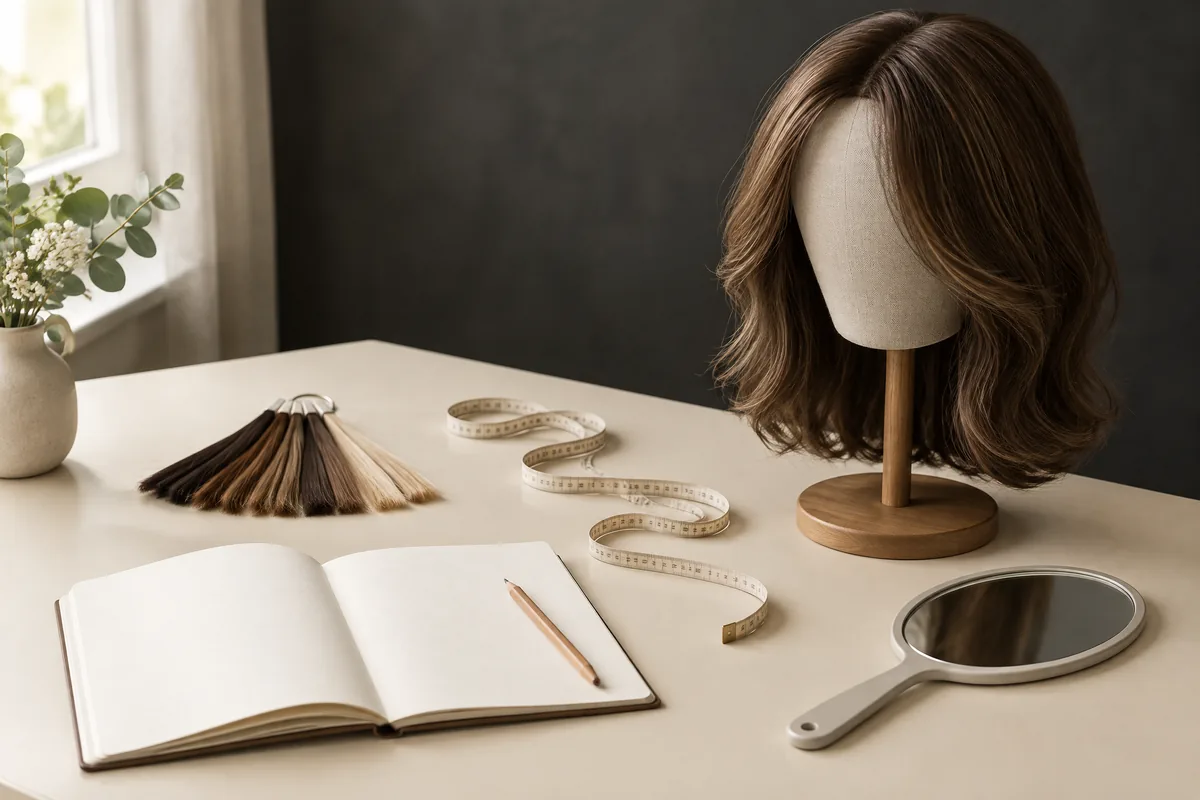
Use descriptive notes rather than a combined mark out of ten. The sheet below keeps the observations independent. Replace the prompts with what you see, and use 'unclear' when the angle does not reveal enough. A blank entry is better than turning a supplier's flattering wording into something you supposedly observed.
| Observation | Sample A notes | Sample B notes |
|---|---|---|
| Panel boundary | Where does a transition appear, if anywhere? | Is it in the same exposed location? |
| Knot or dot visibility | What is visible at normal distance and close up? | What is visible at those same distances? |
| Apparent top height | Flat, softly raised or visibly stepped from the side? | Same profile description, without guessing its cause |
| Fullness beside the part | Does the hair lie close or stand away? | Does the desired width stay open naturally? |
| Conditions | Part width, underlayer, root colour and styling | Any difference that limits the comparison |
Make the trade-off fit the hairstyle you wear
Imagine two hypothetical samples. Sample A shows a few attachment dots in an enlarged overhead photograph, but has a quiet panel transition and sits close to the head. Sample B shows fewer dots at the same distance, yet a slight step is visible from the front-side view. Neither observation establishes an overall winner; they favour different priorities.
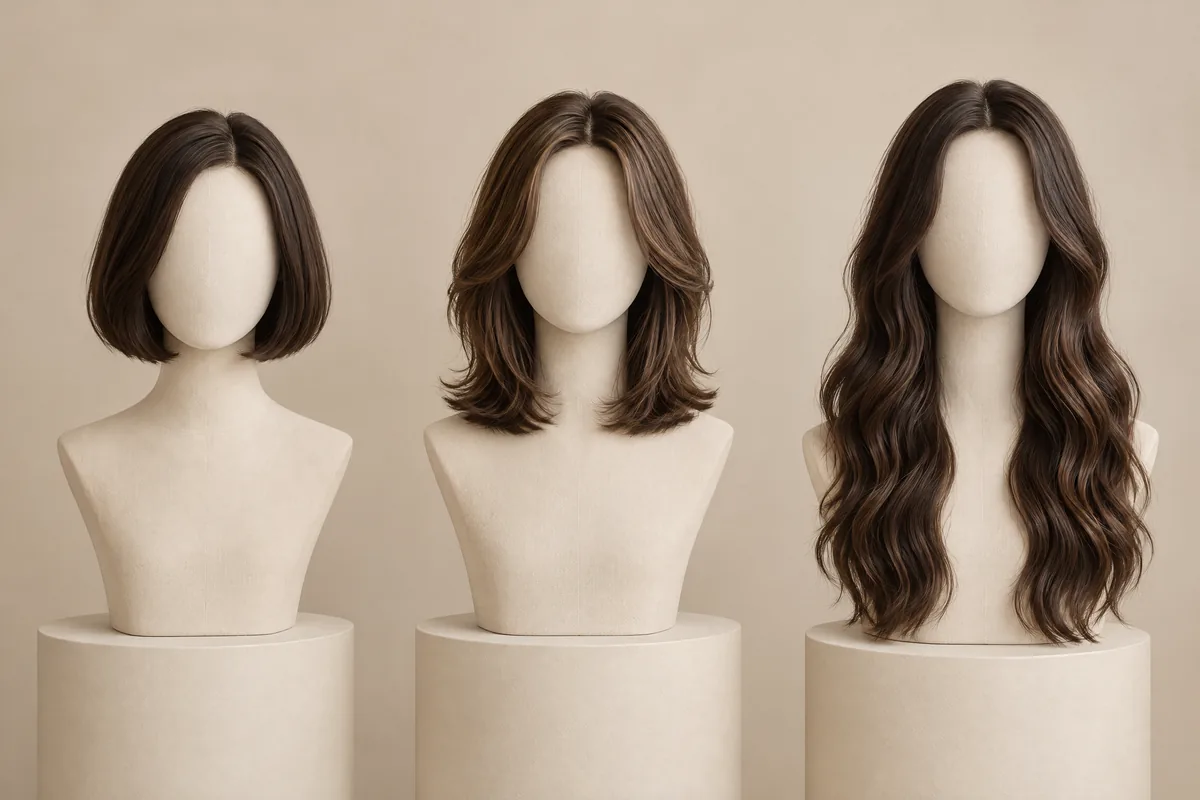
For someone who wears a smooth side part with little root lift, Sample A's lower profile may matter more than its close-up dots. For someone whose usual style keeps soft volume beside the part, Sample B's profile may blend into that shape. The decision should use both the controlled view and the hairstyle the person genuinely intends to maintain.
Consider a second situation: the centre part looks continuous, but shifting it sideways reveals the panel's border. If you alternate between centre and side partings, that border becomes a practical limitation. If you keep one part, it may rarely be exposed. A wider panel can provide more room, but its name alone cannot establish the usable range.
A useful decision rule is to identify the feature that interrupts your own style at ordinary distance. Prefer the sample that resolves that feature while keeping the other compromises acceptable. Do not add knot, boundary and height observations into one realism total: that would hide which particular improvement you are paying for or giving up.
Apply the same comparison to a topper's smaller footprint
A topper leaves surrounding hair visible, so the comparison includes where the piece meets your own hair. NAAF explains that toppers provide partial coverage and blend with existing hair, whereas a full wig supplies total scalp coverage. The visible top panel and the outer perimeter of a topper are different boundaries; inspect both rather than confusing them. 1
Keep the topper in its correct position during the three views. Moving it backwards merely to hide an edge changes the coverage and may change where the attachment points sit. Record how the exposed part joins your own part at the front, then check the sides where the topper hair falls into your existing hair.
OWNSTRAND's hair toppers catalogue includes the Amore Diamond Topper, listed with Remy human hair, a monofilament base and a 5 by 3 inch footprint. That is a named product example, not a sample tested here or a stock promise. Its base dimensions describe coverage, not the width of an exposed part.
For example, a topper may have an attractive central part yet leave a visible join where its shorter hair meets your longer hair. That is a blending compromise rather than evidence that its top construction is poor. Conversely, a well-blended perimeter does not settle whether the central panel has the appearance you want under the fixed light.
Repeat once in your normal style, without altering the base
After the matched-width pass, arrange each sample into the everyday hairstyle you are considering. Use only techniques allowed for its fibre and construction. The American Cancer Society cautions against using a dryer or curling iron unless the wig is heat resistant; a mono or silk-top label does not provide permission for heat styling. 3
This second pass answers whether ordinary styling makes the observed compromise acceptable. It should not erase the first set of notes. If a softer part conceals a transition, note that the appearance depends on keeping that part. If added root lift improves the silhouette, consider whether you want the work of maintaining it.
Leave foundation, knot bleaching and permanent cutting out of a first comparison. They change the item rather than simply reveal it, and the base may be delicate. Jon Renau's French-drawn guidance specifically warns that unsuitable brushes, combs and tools can damage its base. Follow the exact maker's care instructions instead of treating all top panels alike. 2
Finally, check colour separately near a window or outdoors. The American Cancer Society recommends natural light for comparing a wig with a hair swatch. Your ceiling-light pass is useful for panel observations, but should not be the only colour check, especially when a topper must blend with hair that remains visible around it. 3
Bring a specific comparison to a Hong Kong fitting
Bring the two three-view photo sets and your separate notes, rather than asking only which construction is more natural. You might say: 'I wear a low side part. This sample's opening works for me, but the panel edge appears when I turn. Can I compare another option at the same width without adding root volume?'
For an OWNSTRAND visit, ask which specific samples can be arranged and confirm the quotation and supply details beforehand. Its location is Unit 2103, 利寶時中心, 50 Hoi Yuen Road, Kwun Tong; district guides are not additional branches. Keep your boundary, knot and profile priorities visible during the discussion so a pleasing hairstyle does not obscure the detail you wanted to compare.
Questions & answers
Should I remove my usual wig liner for the comparison?
Not just to improve a photograph. Use the liner or underlayer permitted for the piece and intended for daily wear. If you compare alternatives, label those as separate conditions because the surface beneath a sheer panel may affect its appearance.
Can phone portrait mode help me judge the part?
Avoid it for the matched photographs. Artificial blur can obscure fine edges and small root details. Use the ordinary camera mode, the same lens and an unedited image; keep any enhanced photograph separate.
Does a silk-top label tell me the wig's weight?
No. Weight depends on the complete item, including hair length, fibre and cap construction. Ask for the model's stated weight and assess how it feels when correctly fitted rather than estimating it from the top label.
What if I wear a fringe that covers the start of the part?
Include the fringe in the everyday-style pass. Concentrate on the crown and any opening that remains visible. An inspection with the fringe lifted can reveal construction, but it is not the same as your normal appearance.
Can I use a mannequin photograph instead of wearing the sample?
It can show panel layout, but it cannot establish your fit or how a topper joins your own hair. Treat it as construction information and request a properly arranged fitting before deciding on the worn profile.
Put the next step into practice
Build a clearer understanding of hair shape and everyday styling through learning at Canvas. Hair styling courses in Hong Kong。
Explore more practical styling and selection notes. Canvas hair and beauty journal。
Tell the team which hair styling techniques you would like to learn. Contact Canvas Academy。
Sources & further reading
- National Alopecia Areata Foundation — Wigs and Toppers: Understanding the Basics
Explains monofilament mesh, combined cap constructions, hair density and the coverage differences between toppers and full wigs.
- Jon Renau — What's so great about French drawn tops?
The manufacturer's explanation of its French-drawn layered design and delicate-base care; its construction details should not be generalised to every silk-top product.
- American Cancer Society — Wigs for Hair Loss
Offers practical guidance on fitting directions, heat precautions and using natural light for hair-colour comparison.