Why ‘too full’ is not one problem
A crown that seems high and ends that seem heavy are different complaints. Removing hair from the lengths may soften a solid outline, but it will not make an ill-fitting cap sit properly. Before deciding what to change, name the location: above the forehead, over the crown, beside the cheeks, behind the ears or through the lower lengths.
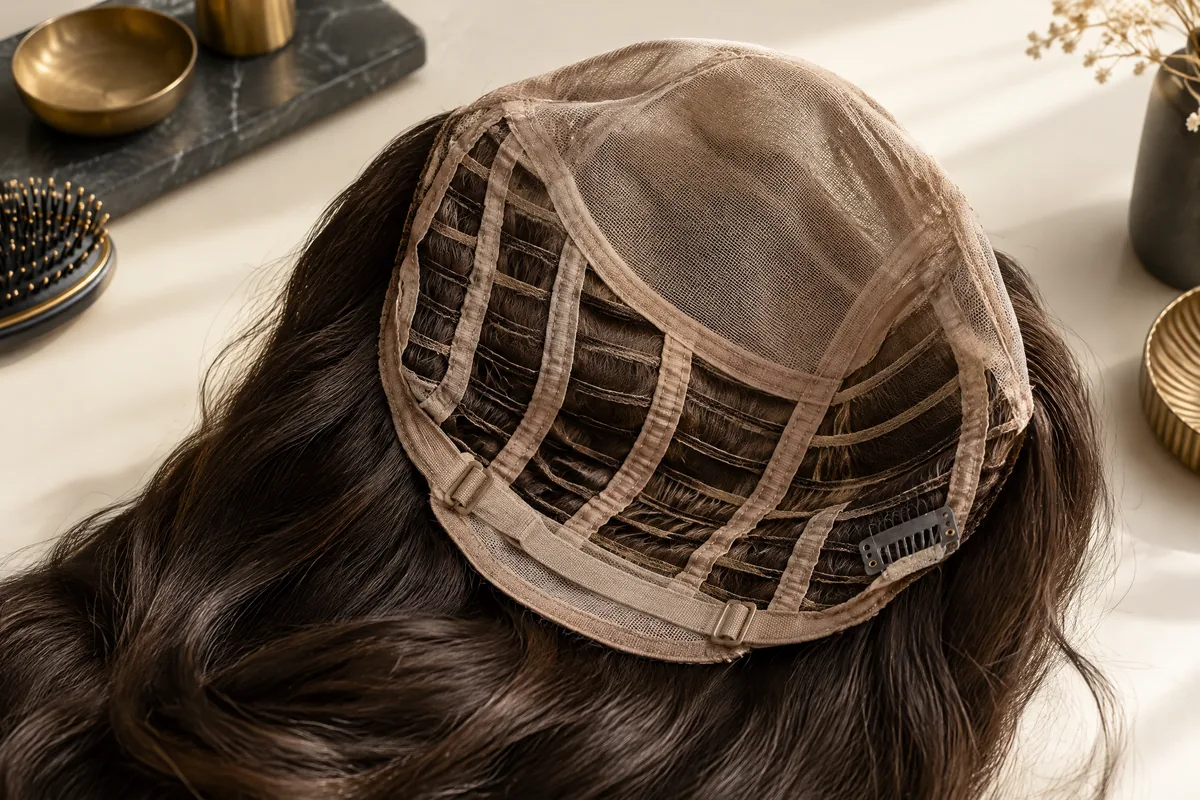
For this comparison, separate three possible causes. Fibre density means the amount of hair attached to the base. Cap lift means height associated with how the base sits or how the roots are supported. Styling bulk means width or height created by the hair’s arrangement, including waves, brushed-out curls and forward-swept sections. More than one cause can be present.
Construction can change apparent fullness even between similar cuts. Jon Renau’s comparison of Kristen and Kristi describes nearly identical lengths but different cap designs; the hand-tied design lies flatter in that example. The useful lesson is that silhouette alone does not measure fibre quantity, not that every hand-tied wig will suit every head better.1
Set up a comparison that changes one thing at a time
Start with a dry, detangled wig in its intended everyday condition. Wear it with the same liner, grip and underlying hair arrangement throughout the comparison. A folded liner or concentrated bun could change how the cap sits. Record what you are wearing underneath so a later photograph does not silently introduce a different fit.
Check seating before styling. Follow the fitting directions supplied with the piece and avoid tightening straps simply to compress a high crown. The American Cancer Society advises checking the particular brand’s sizing chart because sizes can vary. A label such as ‘average’ is therefore not enough to rule out a fit problem.2
Use a plain background and the same top, especially around shoulder-length ends. Keep the camera at approximately the same height and distance, with your head upright. Disable beauty filters and avoid switching between a close selfie and a distant portrait. These are practical consistency checks: they make shape changes easier to see without claiming to quantify density.
Hold length and parting constant
Keep the existing length and parting throughout the first comparison. Moving a part sweeps hair to a different side, while tucking the ends into clothing hides part of the outline. Both can make the wig look lighter without removing a fibre. They may become useful styling options later, but they muddy the initial comparison.
If you are considering a replacement, the descriptions in OWNSTRAND’s low density wigs guide provide useful vocabulary for a less-full silhouette. Compare similar cuts rather than a long, blunt style against a layered crop. A density label is a starting description; it does not tell you where unwanted height or width originates on your particular piece.

Compare normal styling, smoothed roots and side light
Take a front photograph, each side profile and a rear view with your normal styling. Note the exact area you dislike before changing anything: ‘the crown sits high’ is more useful than ‘it looks fake’. Include one view with the hair resting naturally rather than holding sections out to display them. This becomes your baseline.
Do not turn the exercise into a contest to make the wig as flat as possible. Your preferred result still needs movement and enough coverage for the hairstyles you wear. The purpose is to see which part of the outline responds to arrangement and which remains, while keeping the hairline and cap seating undisturbed.
Compare ordinary styling with gently flattened roots
Using only the handling permitted by the manufacturer, guide the visible surface hair downward with your fingers or the recommended tool. Smooth lightly rather than pressing the cap against your head. Do not add water, a hot tool or a heavy product just to achieve a flatter photograph. If the roots do not settle gently, record that observation instead.
Keep the part unchanged and leave the ends in their original shape. Retake the same views, then let the hair return to its usual arrangement. If the height reduces but the lower width remains, separate those findings. The root outline may respond to styling, while a rounded cut or crowded lengths may still need a different discussion.
Factory root lift is another consideration. Some wigs contain built-in teasing, often called permatease, which supports the shape near the base. Jon Renau lists low density and low permatease separately in its HD collection description. Ask whether your own style includes this feature; do not treat supported roots as removable surplus hair.3
Use side light to inspect, not count
After the normal and smoothed-root photographs, repeat both arrangements beside a window with light falling from one side. Keep the position consistent and avoid direct glare. Look for the outline above the head, overlapping layers and any base becoming visible. Side light is an inspection aid, not a reliable way to count fibres or assign a percentage.
Compare the side-lit pictures with the earlier room-light views. If the wig bothers you only when a strong highlight catches one section, colour contrast or surface sheen may be influencing your reaction. If the same broad outline remains in both settings, the concern is more consistent. Neither observation alone proves that thinning is the appropriate solution.
Fill in a three-cause worksheet
Write one observation in each row rather than forcing a single verdict. You might record less crown height after smoothing, a raised patch that remains near the back and unwanted width through the ends. That combination calls for separate styling, fit and cut conversations. A single instruction to ‘take out lots of hair’ would leave too much open to interpretation.
| Possible cause | What to record in your comparison | Reversible trial | What that trial cannot establish |
|---|---|---|---|
| Fibre density | Fullness remains through the same lengths after roots are smoothed; identify the area | Arrange the same sections closer together without altering the part | It cannot measure fibre quantity or prove excess density |
| Cap lift | Height or uneven seating remains when surface hair settles | Remove and reseat the wig correctly; smooth the usual liner and underlying hair | It cannot distinguish every construction feature from a sizing mismatch |
| Styling bulk | Width changes when outward sections are guided down or forward sections are redistributed | Return hair to a gentler version of the same style | It cannot predict whether the new arrangement will hold throughout your day |
A useful worksheet records uncertainty too. Write ‘possible cap lift; needs inspection’ when you cannot see what is supporting the crown. Do not pull apart knots, cut short root hairs or stretch the base to investigate. Keep the piece intact so a stylist can assess the original construction rather than a problem created during the check.
Try reversible changes before reaching for scissors
Work through the options in order and photograph only the change you are assessing. Correct reseating comes first, followed by surface arrangement and then small changes to how much hair frames the face. The American Cancer Society’s styling guidance suggests bringing forward only the hair needed for the desired appearance, illustrating how arrangement can change the look without cutting.2
| Change to consider | Potential benefit | Trade-off or stopping point |
|---|---|---|
| Correct reseating with the usual accessories | May remove uneven height caused by placement | Stop if comfort or security worsens; do not force a fit |
| Gentler root arrangement | May reduce styling-created crown height | Built-in lift may remain; repeated pressing is not a solution |
| Bring fewer side sections forward | Can narrow the face-framing outline | The side or ear area may become more exposed |
| Test a permitted alternative part after the baseline | Redistributes visible volume | It changes the comparison and may reveal construction |
| Restore the normal style | Tests whether the preferred change is practical | A temporary flat photograph is not an everyday result |
Keep heat-setting outside this first reversible round. The American Cancer Society warns against using a dryer or curling iron unless the wig is heat resistant. Even for heat-friendly fibre, follow that specific manufacturer’s directions. A temperature recommended for another brand is not permission to reshape yours, and heat-setting may alter the original style.2
Before keeping a new arrangement, check it in ordinary movement rather than only at rest. Wear the glasses and neckline you normally use, and avoid holding sections in place for the photographs. A slimmer outline is useful only if the coverage and shape still work during routine wear:
- Turn your head and look down without holding the hair.
- Check the side outline with your usual glasses on.
- Look at the parting and rear coverage in both lighting setups.
- Return to normal styling and decide which version you genuinely prefer.
Read the result through concrete examples
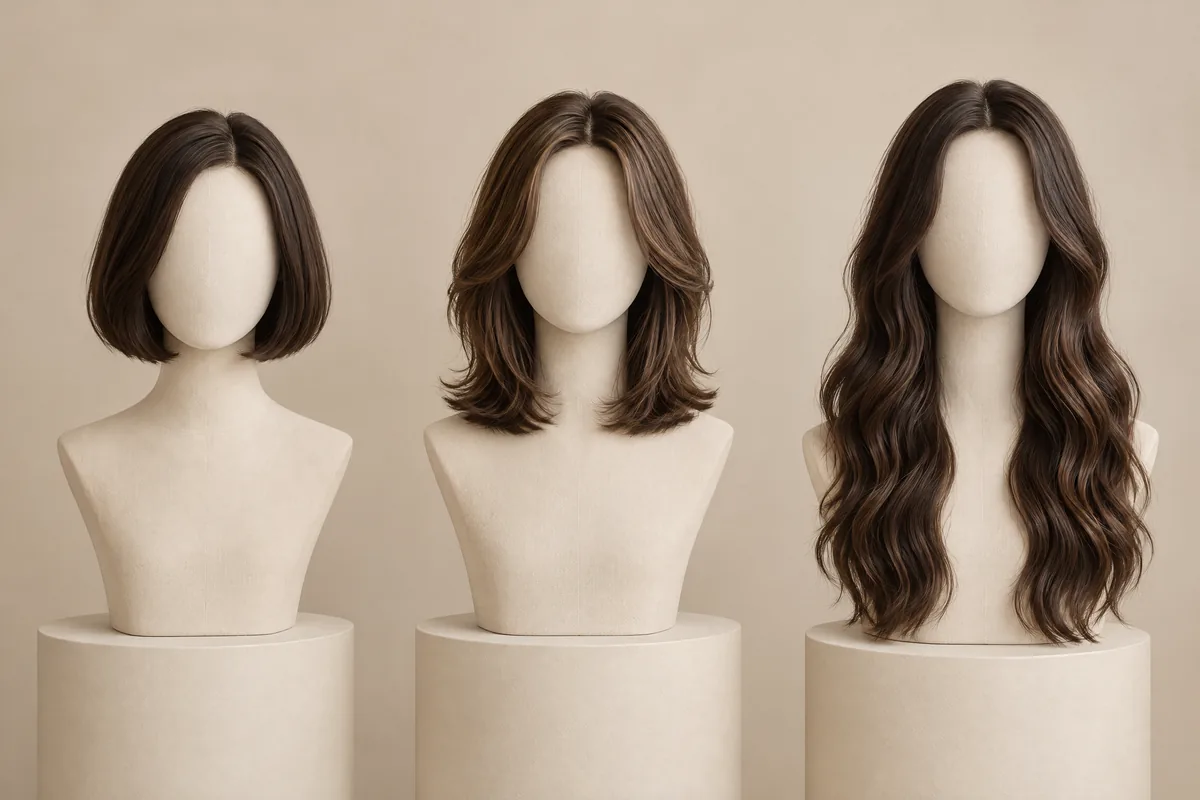
Consider an illustrative shoulder-length bob with a high-looking crown but acceptable ends. With the same side part, gentle smoothing reduces the crown outline; correct seating feels secure, and the lower shape remains pleasing. This points towards trying less root lift in daily styling. Thinning the lengths would target the area that was already satisfactory and could sacrifice a clean bob edge.
Now imagine a straight wig whose broad sides remain after the roots settle. The cap sits evenly, but several layers overlap around the jaw. A stylist might discuss local reshaping or selective thinning rather than reducing the entire wig. The choice depends on whether you want softer movement or a crisp edge: removing fullness can change both, even when length is retained.
In a third example, the outline narrows after reseating over a smoother underlying hair arrangement. That is a reason to improve the wearing setup, not cut the wig. If it repeatedly shifts back to the raised position, take the piece for a fit assessment. A one-off improvement does not establish that the cap dimensions or attachment arrangement are right.
Decide whether professional thinning earns its trade-off
Thinning becomes a reasonable discussion when unwanted fullness remains in a defined area after the reversible trials, and you still want the existing length and general cut. The American Cancer Society includes stylist trimming and thinning among its wig-styling options. Choose someone experienced with wigs and the fibre involved, rather than assuming a natural-hair technique transfers unchanged.2
The trade-off is permanent removal. A wig cannot regrow cut fibres, and less coverage may make the base easier to see in movement or a different parting. A cleaner silhouette might be worth that compromise, but not if you depend on those same sections for coverage. Preserving the perimeter, fringe and visible part can matter more than achieving maximum flatness.
Discuss alternatives separately. Changing the outline through a cut is not the same as reducing fibre quantity, and removing supported roots is not a safe default for a high crown. If a structural feature conflicts with the close silhouette you want, a different cap design may be the better purchase. Cutting more from the current piece cannot guarantee that transformation.
Bring a precise brief to a fitting discussion
When browsing OWNSTRAND’s women's wigs, keep the style names alongside your worksheet. Its catalogue lists both Amore Arden and Bay as light-density synthetic options, yet their listed lengths differ substantially. That is a useful reminder to compare the cut and cap details, not select from the word ‘light’ alone; ask for a quotation and availability for the exact option.
For a local conversation about wigs Hong Kong, OWNSTRAND describes private sample viewing and head measurement for handmade custom human-hair pieces, followed by fitting, washing, cutting and blow-drying when the piece is ready. Its salon is Unit 2103, 50 Hoi Yuen Road, Kwun Tong, Hong Kong (利寶時中心). Ask about arrangements and whether your existing wig can be assessed before planning a visit.
Bring the normal, smoothed-root and side-lit pictures with a short written instruction: ‘Keep this length and part; reduce only the fullness beside the jaw if coverage permits; leave the hairline and fringe unchanged.’ Ask the stylist to identify the first area, explain the expected compromise and pause after a small initial adjustment. Authorise further removal only after seeing it worn and moving.
Questions & answers
Can the weight on a product listing tell me how much thinning it needs?
No. Total weight includes the base as well as the hair, and length affects it. A listed weight can help compare specifications, but it cannot locate surplus fullness or justify removing a set amount.
Should I wash a new wig before doing the comparison?
Only according to the supplied instructions and any return conditions. Washing may change the arrangement, so record whether the wig is new or freshly cared for and compare it in one consistent condition.
What if the left side looks fuller than the right?
Check whether the same part sends more hair to that side and whether the cap is seated evenly. An intentional asymmetric cut can also explain the difference. Do not thin one side merely to make a photograph symmetrical.
Can I remove a few fibres with tweezers instead of visiting a stylist?
Avoid using plucking as a small trial. It is still permanent removal and can disturb attachment points or leave an uneven visible area. Take your marked photographs to a wig-experienced stylist instead.
What should I ask about returns before any alteration?
Ask whether cutting, thinning, washing or heat styling changes the seller’s return or exchange terms. Get the answer for the exact purchase before arranging work; do not assume a general policy covers an altered piece.
Put the next step into practice
Build a clearer understanding of hair shape and everyday styling through learning at Canvas. Hair styling courses in Hong Kong。
Explore more practical styling and selection notes. Canvas hair and beauty journal。
Tell the team which hair styling techniques you would like to learn. Contact Canvas Academy。
Sources & further reading
- All About Density — Jon Renau
A manufacturer comparison showing how different cap construction can change apparent fullness between similar-length styles.
- Wigs for Hair Loss — American Cancer Society
Practical guidance on brand-specific sizing, wig fitting, stylist adjustments and avoiding heat tools on fibres not rated for heat.
- HD Collection Volume I — Jon Renau
Lists low density and low permatease as separate design features, helping distinguish hair quantity from built-in root support.