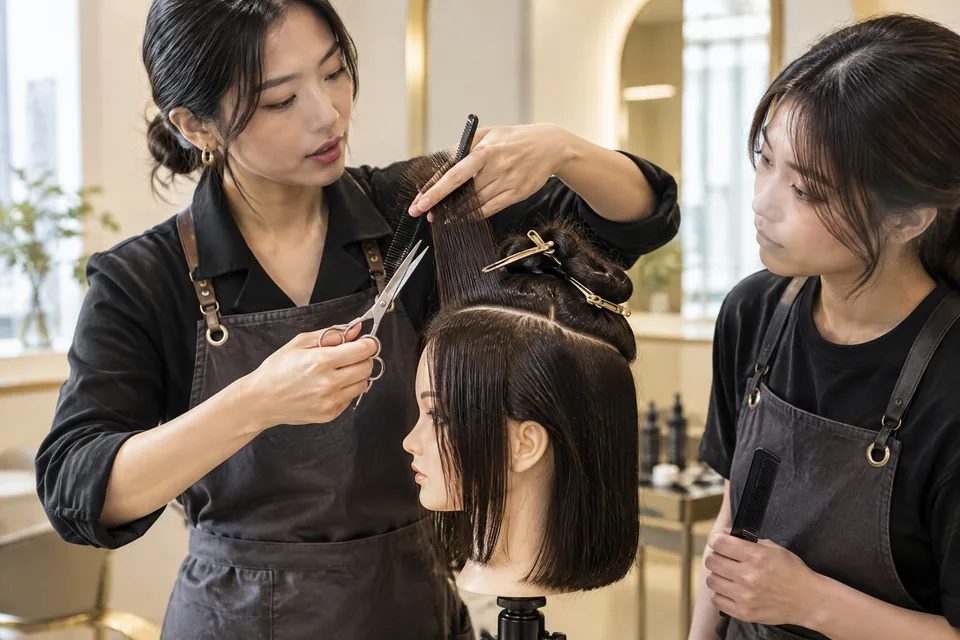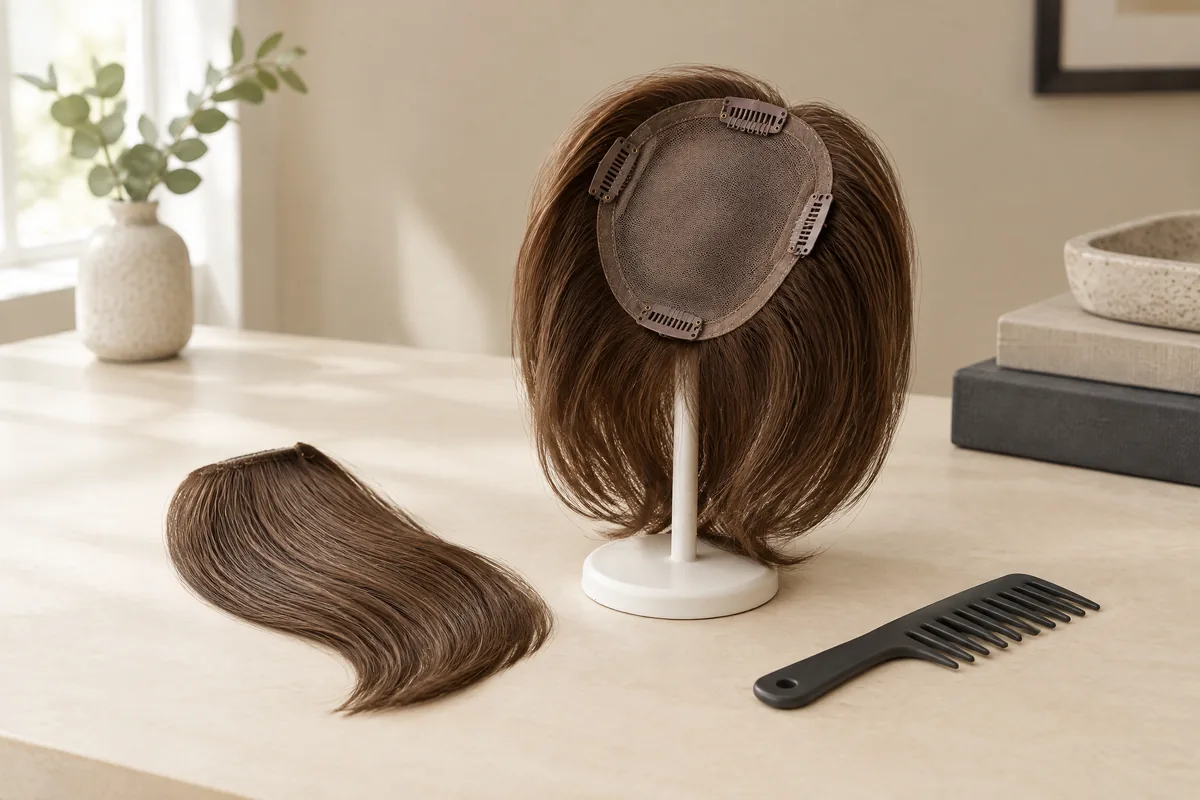
Separate base position, parting and haircut
An asymmetric part topper needs three decisions, not one instruction to ‘make it uneven’. The base footprint determines coverage and attachment. The part determines where the visible hair divides and falls. The haircut determines the finished outline. A left-side part can accompany equal side lengths; unequal side lengths can accompany a less pronounced part.
Visual balance does not mean matching both sides. CHI's hair-design education describes asymmetrical balance as uneven placement with balanced visual weight, including different lengths or volume on opposite sides. That gives you a useful distinction: ask for the intended overall shape, not automatic left–right equality.1
Position the base around the area it must cover, following the exact piece's fitting requirements. Do not twist it simply to move the part. Ask whether the proposed construction can place the visible part where you want it while keeping the perimeter and attachment appropriate. A correctly oriented base can still carry an intentionally asymmetric haircut.
Build a front card that cannot be read backwards
Use a straight-on photograph or a simple face outline, then label ‘wearer's left’ and ‘wearer's right’. A mirrored selfie can reverse those sides. If you bring one, label it explicitly rather than relying on what appears on the viewer's left. Keep the head upright so a tilt does not masquerade as a length difference.
Record where the part begins against a recognisable landmark, such as above the inner end of the left eyebrow. Then draw its direction towards the crown. ‘Left part’ alone does not describe whether it runs straight back or diagonally. Ask the stylist to translate your landmark into a feasible placement on the actual topper.
Describe endpoints, not just a style name
Write where the short side should finish and where the long side should finish when the hair hangs freely. ‘Left side near the jaw, right side towards the shoulder’ communicates more than ‘asymmetric bob’. Add whether the front point should be sharp or softened, and whether the shorter side normally sits behind the ear.
Keep preferred endpoints separate from the hair length supplied before cutting. The latter must leave enough material for the agreed outline. A catalogue's side-length measurement does not necessarily predict where the finished hair lands on you. Head shape, placement and how the hair travels from its base all matter to the cutting discussion.
| Front-card field | What to write or draw | What it prevents |
|---|---|---|
| Left and right | Wearer-relative labels | Reversing the intended long side |
| Part start and direction | Landmark plus an arrow towards the crown | Treating every side part as identical |
| Side endpoints | Separate short-side and long-side landmarks | Equalising an intentional length difference |
| Fringe and front edge | Sweep direction; own hair visible or covered | Cutting away hair needed at the front |
| Daily ear tuck | Which side, with glasses if worn | Judging only a posed, untucked photograph |
Give the back its own design instructions
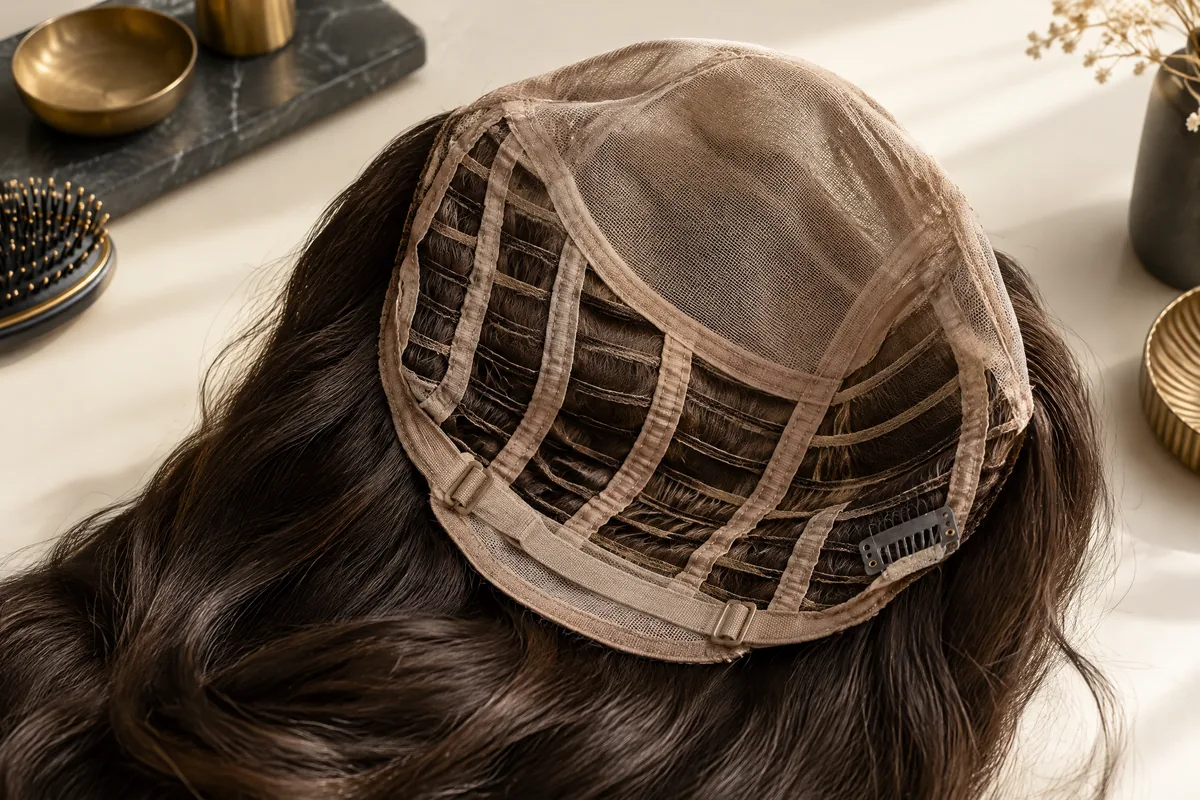
A front reference cannot settle the rear outline. Your long front side could connect to a level back, a gently diagonal back or a rounded shape. All can look similar from the front. Choose which rear shape you want before the first cut, rather than leaving the stylist to infer it from one angle.
Take a rear photograph with the head level and the shoulders visible. Mark the crown direction and the proposed end of the topper's coverage separately from the finished hair outline. Ask the fitter to help identify that coverage boundary; drawing it yourself is a discussion aid, not a base measurement or an instruction to manufacture it there.
Show the join, not only the longest strand
On the rear card, indicate where topper hair overlaps your own hair and where your own hair provides the final length. If the topper ends above a longer natural layer, mark the desired transition. A long strand reaching the shoulder does not prove that the shorter surrounding sections create a continuous outline.
Bring one extra view in your ordinary wearing position: hair down, or with the usual tuck. The cards should describe a routine you can actually repeat. Keep aspirational photographs separate and mark the feature you like in each. Otherwise, a glossy front image and a different rear haircut can accidentally become conflicting instructions.
- Label the wearer's sides on both cards.
- Draw the visible part independently of the base boundary.
- Mark each finished endpoint and the rear connecting line.
- Identify natural hair that should remain untouched.
- Note the normal tuck and whether glasses move the side hair.
Protect the boundary with your own hair
The blending boundary is where your topper meets visible natural hair, not merely where the base stops. Follow that transition around both temples and the back. On the short side, less hair may remain available to conceal an abrupt change. On the long side, a heavy overlap may create more bulk than the front photograph suggests.
Colour assessment belongs at that boundary. The American Cancer Society's wig-selection guidance recommends comparing hair and colour swatches in natural light. For a topper, compare the proposed shade with the hair that will actually remain visible at the sides and rear, rather than matching only a bright strand near the forehead.3
Among OWNSTRAND's hair toppers, the Amore Diamond Topper is a catalogue example listed as Remy human hair with a monofilament base, a 5-by-3-inch footprint, a 5-inch front and 12-inch sides. Those are starting specifications, not proof that it supports your intended deep part, finished outline or coverage. Supply requires a separate enquiry.
Draw a ‘do not cut’ boundary for natural hair you want to preserve, then discuss it in person. You may accept some trimming for a closer blend, or prefer a slightly less seamless join so your own haircut still works without the topper. That is a genuine trade-off; a good blend should not silently become permission to reshape everything.
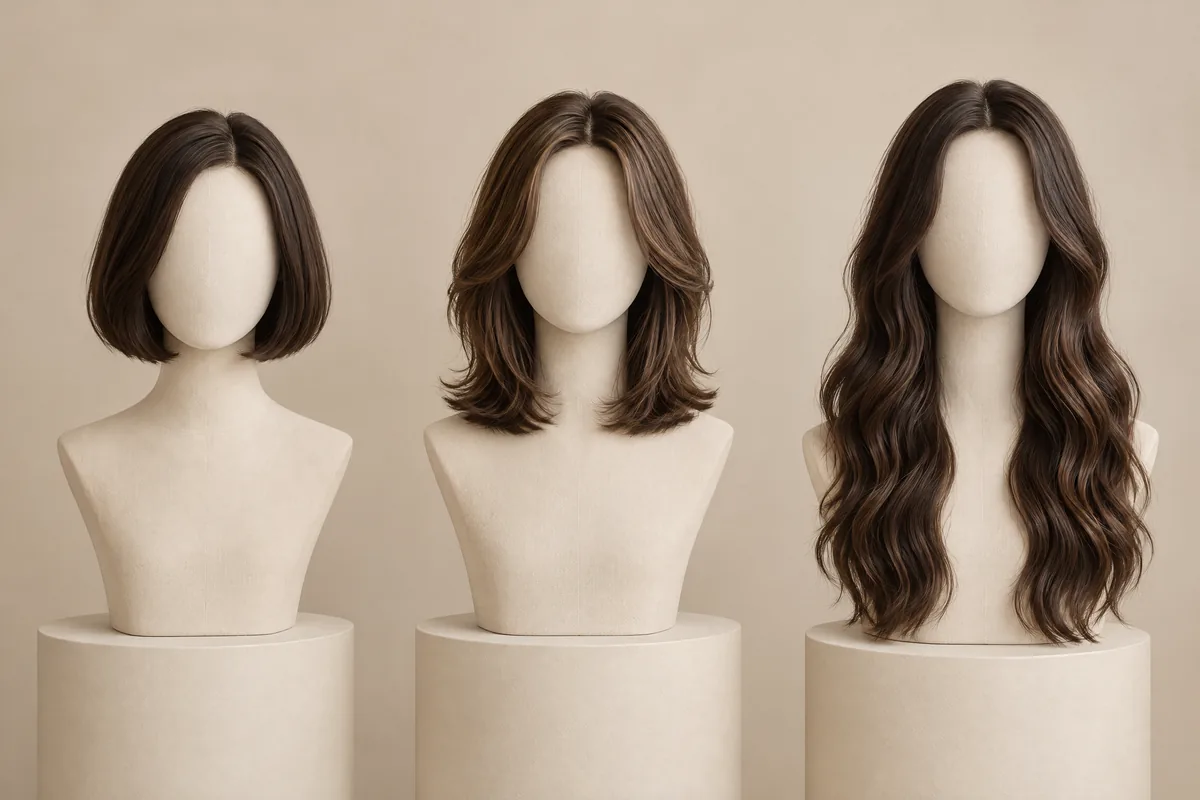
Fit first, then preserve the asymmetry through the cut
Agree the base position and test the desired part before reducing length. If the hair continually returns to a different direction, ask whether the proposed design or allowed styling can support your preference. Cutting the long side shorter will not solve a parting that the piece cannot hold, and may remove your room to adjust the outline.
OWNSTRAND's custom hair topper Hong Kong service describes bespoke human-hair discussion, sample viewing and measurements, followed by handmade production and a return fitting with wash, cut and blow-dry. Bring the cards to the design discussion and again to the cutting visit. Ask which details can be incorporated into your particular order.
At the fitting, ask to review the hair in its intended fall before the final outline is shortened. Sam Villa's professional cutting guide explains that cutting near natural fall can reduce bottom-edge inconsistencies, while over-direction affects length and weight distribution. The useful request is to assess the finished shape in position, not prescribe a salon technique yourself.2
Review each side against its own card endpoint. Cross-checking an asymmetric cut should preserve the intended difference, not make both ends meet. Ask to see the rear with a hand mirror before further shortening. If the outline is right but one side feels heavy, discuss weight separately; removing length and reducing bulk are not interchangeable decisions.
Compare matching and finishing work in the quotation
Two quotes can cover similar base dimensions yet different work. One may refer to the hairpiece alone; another may include a stated fitting and initial cut. For an asymmetric style, the cost comparison needs the same brief: chosen part, separate side endpoints, rear outline and the agreed boundary with natural hair. Otherwise, the lower amount may buy a different result.
The OWNSTRAND guide to hair topper prices distinguishes the exact piece and its specifications from fitting or customisation inclusions. It does not establish one universal topper price. Ask for written scope alongside the amount, especially where colour matching, an asymmetric cut or changes to your natural hair are part of the request.
| Quotation item | Request a clear description | Comparison decision |
|---|---|---|
| Piece and construction | Hair type, base dimensions and proposed parting capability | Are both quotes for comparable pieces? |
| Colour matching | Selected tone and any agreed grey blend | Is matching included or only a catalogue colour? |
| Initial fit | Placement check and stated fitting service | Is it product-only or fitted? |
| Asymmetric cut | Both side endpoints and rear connecting outline | Does the cut include your specific shape? |
| Natural-hair work | Areas to trim and areas to leave untouched | Will the blend alter your own haircut? |
| Finish and later changes | Initial styling; terms for any later adjustment | Which work is included, extra or unavailable? |
A written quotation need not price every snip separately. It should make inclusions clear enough that you can compare the totals honestly. If a matching request is not possible, ask what alternative is being quoted. A simpler colour choice may save work, but its visible join should be evaluated before you accept the saving.
Decide which kind of asymmetry you want to keep
Consider a hypothetical shoulder-length style with a strong left part, a shorter left side and a longer right front point. The wearer wants a level rear outline. A rear card makes that combination explicit. Without it, ‘longer on the right’ could be interpreted as a diagonal line continuing across the entire back, changing the shape more than intended.
In that situation, preserve enough topper length to connect the right front point to the chosen back. If the only option requires shortening the wearer's natural rear hair, decide whether that change is acceptable. Keeping the natural rear length may mean choosing a different piece or a gentler front difference rather than forcing the original photograph.
Now consider a wearer who wants a left part but alternates between tucking either side behind the ear. A strongly unequal cut can look intentional in one arrangement and unexpectedly sparse in the other. Review both tucks before final shortening. A softer length difference may offer greater everyday flexibility, even if it looks less dramatic in a still photograph.
The opposite choice is equally reasonable: keep the pronounced asymmetric outline and commit to one ordinary part and tuck. What matters is understanding the cost in flexibility. A bespoke request should define your priority clearly enough that the fitter can explain whether the proposed piece supports it, rather than promising every arrangement at once.
Collect the placement notes as well as the finished cut
Once the shape is agreed, take updated front and rear photographs in a normal, relaxed pose. Record the fitted base position and how the part was formed. The original cards describe the goal; these photographs describe the accepted result. Together they help distinguish a later placement error from a haircut that genuinely needs adjustment.
Ask for a home demonstration using tools permitted for the exact hairpiece. The American Cancer Society cautions against hairdryers and curling irons unless the wig is heat resistant. Do not transfer a temperature from another item, or assume a human-hair label approves every process. Follow the original manufacturer's instructions and the guidance for your specific construction.3
If the long side appears different after removal and refitting, restore the agreed placement and part before considering another trim. Do not solve every uneven appearance with scissors. Also avoid altering the base or moving attachment points yourself; a haircut reference card is not a construction-modification plan. Ask the fitter to assess any persistent discrepancy.
For an OWNSTRAND discussion, its only shop is Unit 2103, 利寶時中心, 50 Hoi Yuen Road, Kwun Tong. Arrange the visit before travelling. Bring both cards, your usual glasses and a short list of non-negotiable features. The most useful brief makes clear what may change and which asymmetry must remain.
Questions & answers
Should I send several hairstyle photographs before the consultation?
Send a small, labelled set with one preferred front and one preferred rear view. Mark the feature you want from each image. A large collection of unrelated styles can leave the intended combination unclear.
Can I request an asymmetric look without using scissors on my own hair?
You can make that a firm condition of the brief. Ask the fitter to assess what the topper alone can achieve. If the proposed join depends on natural-hair trimming, weigh a different piece or a softer outline instead.
Does a monofilament label guarantee my chosen part position?
No. The actual monofilament area, hair direction and surrounding construction matter. Ask to evaluate the proposed part on the exact piece; a general base label is not a promise of unrestricted parting.
Should my reference photographs show straight or wavy hair?
Show the texture you expect to wear most often, and label any alternative texture separately. An endpoint photographed with a curl is not the same instruction as that endpoint with the hair hanging straight.
What if I change my natural hair colour after ordering?
Tell the supplier before further matching or finishing work. A shade selected against your earlier hair may no longer blend. Discuss the possible options and costs rather than attempting to recolour the topper yourself.
Put the next step into practice
Build a clearer understanding of hair shape and everyday styling through learning at Canvas. Hair styling courses in Hong Kong。
Explore more practical styling and selection notes. Canvas hair and beauty journal。
Tell the team which hair styling techniques you would like to learn. Contact Canvas Academy。
Sources & further reading
- CHI Education — Understanding the Balance of Hair Design
Explains why visual balance can include different side lengths or volume, and how parting influences the overall design.
- Sam Villa — Best Hair Cutting Techniques: The Ultimate Guide
Professional cutting explanations clarify natural fall, distribution of weight and length, and purposeful cross-checking of the finished outline.
- American Cancer Society — Wigs for Hair Loss
Offers practical colour-reference and styling advice, including natural-light comparison and heat-resistance checks before using heated tools.