What do cap tabs actually change?
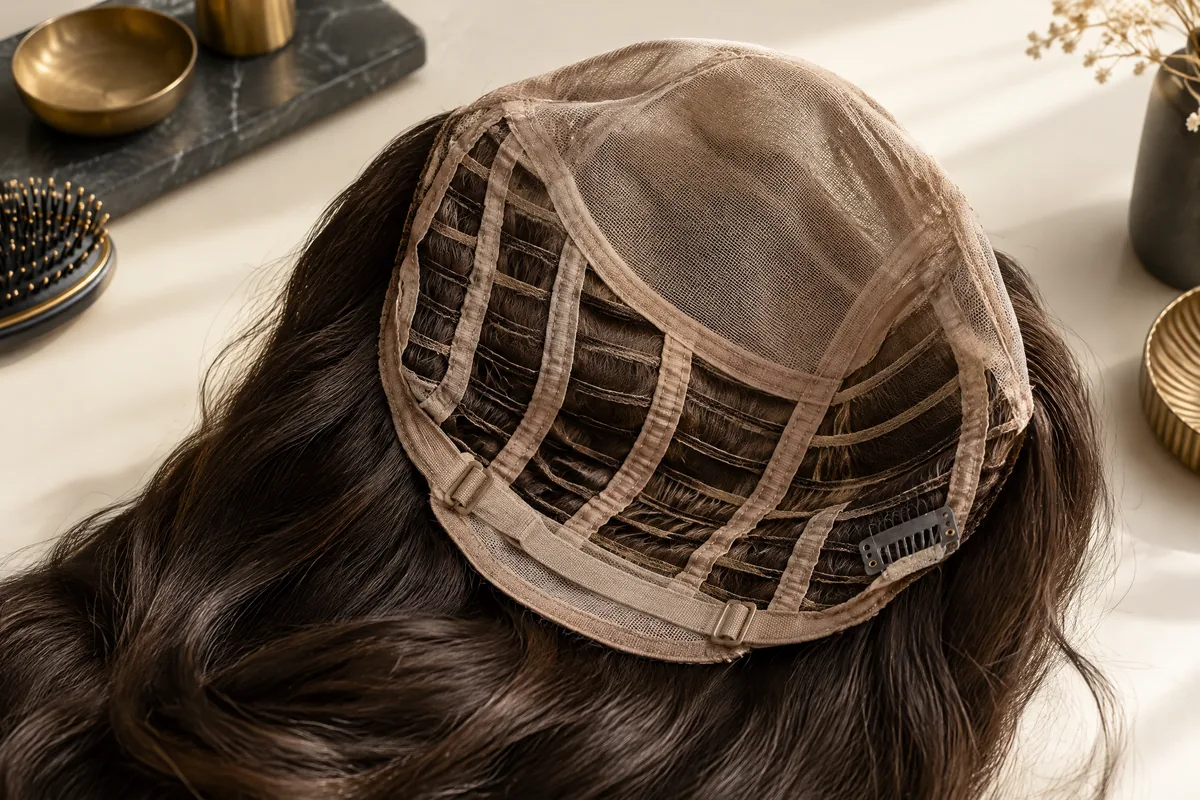
The adjustable fastenings inside a wig are not the same as its ear tabs. Ear tabs help you orient the sides; the adjustable straps or tabs commonly sit towards the nape. Cancer Hair Care describes right and left elasticated straps, sometimes secured with hooks or Velcro, that can be loosened or tightened to improve fit.2
Their useful job is to change how the lower perimeter sits. Cap volume is different: it is the space inside the shell, including the crown and back. Head shape describes how your own outline occupies that space. A comfortable perimeter can coexist with a pocket above the crown, while a roomy back can coexist with pressure at the temples.
This distinction explains why two wigs with the same broad size label can behave differently. The American Cancer Society recommends checking the particular brand’s chart and shows three measurement directions: circumference, front to back, and ear to ear. It also describes adjustable inside tabs as changing circumference. One measurement alone does not describe all those directions.1
Record the original fit before moving anything
Start with the wig positioned according to its own instructions, not pulled forward to hide a loose back. Prepare the hair underneath as you normally intend to wear it. Avoid changing a bun, liner and strap setting together: a different arrangement underneath can change what you feel, leaving you unable to tell which change helped.
Photograph the original fastenings while the wig is off your head. For hooks, note the occupied slot on each side; for sliding or hook-and-loop adjusters, record the visible position or overlap. Do not add permanent marks to the cap. A phone photograph and a written description are enough to let you return to the starting setting.
Then record where the problem is, rather than simply writing “too big”. A gap is an edge standing away from the head; a pocket is unfilled space inside the cap. A wrinkle is a fold in the cap fabric, not a wave in the hair. Lift the hair gently if needed, without stretching the base or pulling on delicate areas.
| Observation | Original setting | After one permitted small change | What to compare |
|---|---|---|---|
| Left and right adjusters | Photograph each fastening | Photograph both again | Did either fastening move unintentionally? |
| Hairline and side placement | Note their starting position | Check the same landmarks | Did the cap shift rather than fit better? |
| Nape edge gap | Describe where it stands away | Note smaller, unchanged or larger | Did the edge settle without digging in? |
| Crown or back pocket | Name the location | Check the same area | Is internal space still present? |
| Cap wrinkles | Note location and direction | Note new or deeper folds | Did tightening gather the base? |
| Comfort and ordinary movement | Note pressure and slipping | Repeat the same movement | Was security gained at a comfort cost? |
A useful note is specific: “Nape edge lifts when I look down; crown pocket remains while seated.” It need not contain a precise distance. Keep photographs in similar lighting and from the same angle. Small differences in how you hold the camera can make an unchanged edge look more open or flatter than it really is.

Make one reversible adjustment, then repeat the check
Use the wig’s allowed adjustment method
Check the instructions or ask the supplier which fastenings are adjustable and how to use them. For a wig you do not own, obtain permission before moving anything. Use a small available increment or a modest change within the stated range; there is no universal distance that every hook, slider or fabric fastening can safely accommodate.
Where the design calls for balanced left and right settings, preserve that balance. Do not tighten only one side to drag an uneven hairline into place. Avoid cutting straps, sewing folds, stretching the cap or using heat to force a fit during this comparison. Those actions change the item and can make a return or later fitting discussion more difficult.
Keep placement and movement consistent
Put the wig back on with the same preparation underneath. Recheck the hairline and ear-tab positions before judging security. The American Cancer Society advises following the supplied directions and positioning ear tabs evenly, rather than placing the wig over the ears. A strap change cannot be evaluated fairly if the second fitting starts in a different position.1
Compare comfortable, everyday movements while seated or standing safely: looking left and right, looking slightly down and speaking normally. You are checking whether the cap shifts during ordinary wear, not proving resistance to vigorous pulling or exercise. If it hurts, a fastening strains or an edge distorts, remove the wig and return to the previous setting. Use this sequence to keep the comparison readable:
- Record both original adjuster positions before changing them.
- Note the gap, pocket or wrinkle at a named location.
- Make only the small change allowed for that design.
- Restore the same hair preparation and cap placement.
- Repeat the same gentle movements and comfort check.
- Keep the setting only if it improves the problem without creating another.
Read what remains, not just what disappears
A smaller nape gap is not a complete success if the temples now feel squeezed. Equally, a little fabric movement is not automatically a failure if the cap stays comfortably in position and the base is not distorted. Judge the combination of placement, comfort and remaining space. The table below suggests next comparisons, not a diagnosis of your head shape.
| Result after the small change | What it may indicate | Practical next comparison |
|---|---|---|
| Less slipping; no new pressure or folds | The original setting may have been too loose | Repeat the improved setting before choosing another cap |
| Nape feels snug; crown pocket remains | Perimeter adjustment has not resolved internal space | Compare crown depth and another cap construction |
| New folds appear while the edge tightens | The base may be gathering rather than settling evenly | Restore the original setting and ask a fitter to assess it |
| Temples tighten while the back stays roomy | More than a simple circumference issue may be involved | Compare side comfort and back shape on another cap |
| Front rises or side tabs lose alignment | Placement or the cap’s overall dimensions need attention | Reposition once; if repeated, compare another model |
| Slipping remains at the permitted limit | There is no demonstrated comfortable tab solution | Check preparation and fastening condition, then discuss alternatives |
Tightness and looseness can exist at the same time. That is the important reason not to translate every wrinkle into “buy petite” or every lifting edge into “buy large”. The cap may have room in one direction and insufficient room in another. Trying a different model can be more informative than moving blindly between size labels.
Also separate empty cap space from a hairstyle that simply looks too full. If the base lies smoothly but the hair stands high, tab tightening is the wrong experiment. Ask whether the fibre and construction permit a styling refinement. A shorter cut or reduced hair fullness changes appearance; it does not reduce the shell’s depth or relocate its edges.
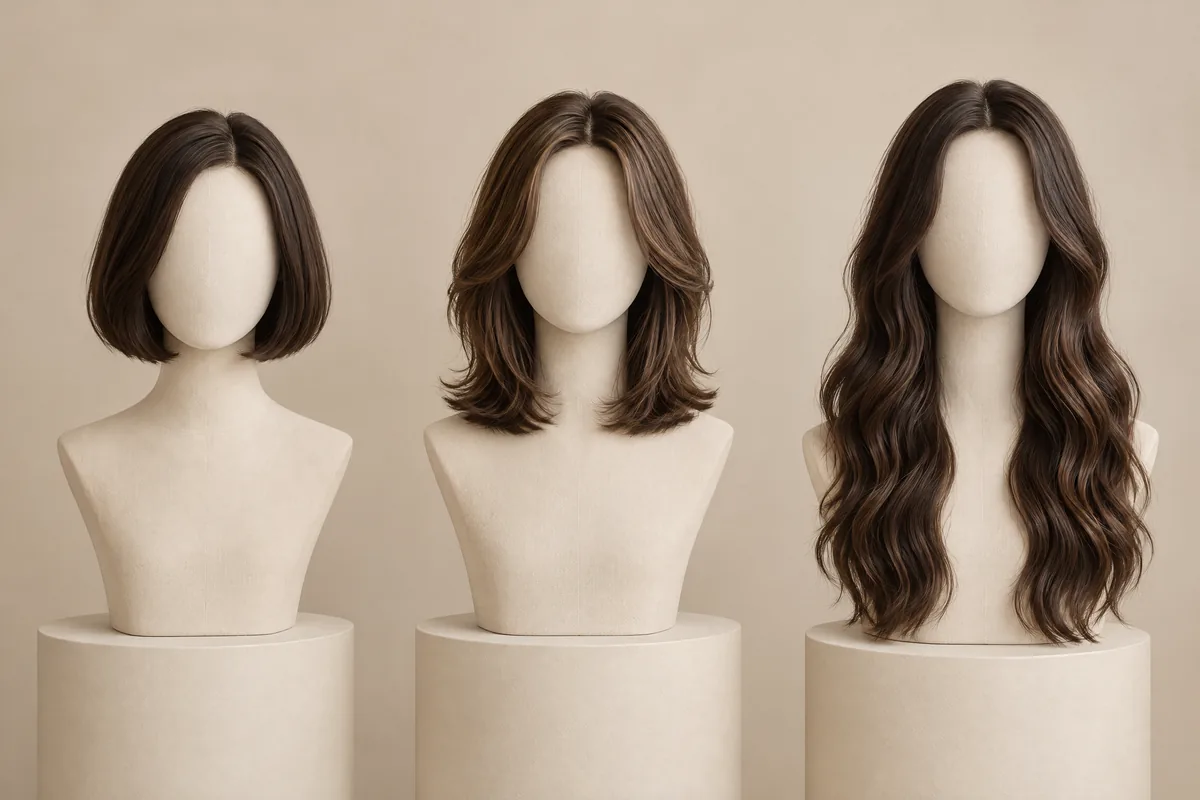
Three illustrative outcomes that lead to different decisions
Imagine a ready-made cap that sits correctly around the ears but moves slightly at the nape when the wearer looks down. After one permitted adjustment, the nape settles, the front stays in place and comfort is unchanged. That result supports retaining the adjusted setting and repeating the check. It does not establish that the same setting suits another wig.
In a second example, tightening reduces the edge gap but produces a horizontal fold near the back. The crown still feels unfilled. The useful finding is not “tighten again”: edge tension changed, while the pocket survived. Restore the baseline, show both photographs to the supplier and compare whether another ready-made shell has a more suitable depth or outline.
In a third example, both sides feel tight although the back remains roomy. The wearer also has thick hair bundled low underneath. Repeating the original setting with hair distributed more evenly may help reveal whether preparation contributes to the pattern. That is a separate comparison, not something to combine with another strap change and credit entirely to the cap.
These are hypothetical comparisons, not customer results or guaranteed explanations. Their value is the question each raises. The first asks whether a reversible setting is sufficient. The second asks about internal shape. The third asks whether the wearing conditions have been controlled well enough to judge the cap at all. None requires guessing a size from discomfort alone.
Compare ready-made and custom by the unresolved symptom
Ready-made remains a sensible option when a particular cap sits comfortably and your preferred style is already defined. If one model leaves a persistent pocket, another design might fit differently even within the same labelled size. The trade-off is that you are selecting an existing shell and style; its adjustment range cannot be treated as unlimited room to reshape it.
A custom discussion becomes more useful when the remaining concern can be described precisely: pressure at both sides with spare back space, an unresolved crown pocket, or repeated loss of correct edge placement. Bring that description into the measurement conversation. Custom work offers a different process, but it is not evidence that every base can solve every symptom.
OWNSTRAND’s guide to custom vs ready-made wigs describes existing designs versus choices developed through a measured custom process. For your own comparison, add a firmer question: which actual option addresses the problem left in your notes? An attractive style photograph cannot answer whether its shell resolves that particular gap or pressure pattern.
Cost, timing and daily care still matter after fit is discussed. Ready-made does not mean local stock or immediate supply, and custom does not mean unlimited alterations. Compare a quotation for the actual option, the arrangements for assessing it and the care it requires. A measured route is worthwhile only if its available choices address priorities you genuinely have.
Turn the notes into a focused fitting conversation
Ask the fitter to look at your baseline and adjusted observations together. “The back feels loose” invites several possible explanations; “the nape gap reduced, but a fold appeared and the crown pocket stayed” gives a much clearer starting point. Bring measurements if requested, but also describe hair underneath, liner use and where the cap sat during each comparison.
For a custom human hair wig Hong Kong enquiry, OWNSTRAND describes sample viewing, discussion of style and grey percentage, head measurement, then a return fitting with finishing work. Explain your unresolved cap concern before concentrating on colour or cut. Ask which dimensions and base choices can be discussed for the piece, rather than treating “custom” as a complete answer.
OWNSTRAND states approximately three to five working days for handmade production. That is the making period, not a promise covering the entire journey from first enquiry through appointments, fitting and collection. Its only confirmed location is Unit 2103, 利寶時中心, 50 Hoi Yuen Road, Kwun Tong, Hong Kong. Confirm arrangements before travelling; district information does not imply additional branches.
The service described at custom wig fitting Hong Kong is the return visit for a completed OWNSTRAND custom item. It includes assessing the fit and discussing possible adjustments, with washing, cutting and blow-drying in the completion route. It is not confirmation that a ready-made wig or one purchased elsewhere can receive the same service.
Before agreeing to work, distinguish a cap adjustment from a hairstyle change. Ask what can be changed, whether it is reversible and what happens if the same fit concern remains. Keep styling and heat decisions tied to the specific hair material and manufacturer’s care instructions. A finishing service should not be interpreted as permission to apply the same tools to every wig.
Test everyday accessories separately before settling on a fit
If you normally wear glasses, assess them after the basic cap comparison rather than changing their position during it. Cancer Hair Care discusses discomfort from the combined pressure of glasses and a wig. Record whether pressure appears only when the glasses are added; that gives the fitter a more useful distinction than another round of tightening.2
A liner should also be a separate test. Macmillan notes that a thin liner can improve comfort but may sometimes increase wig movement. Do not assume adding one always makes the cap more secure. Compare the same tab setting with your intended liner, then record the result before deciding whether that accessory belongs in your daily routine.3
Choose the arrangement that remains comfortable with your ordinary preparation and accessories, not the tightest available fastening. Retain the original and preferred-setting photographs for reference. If fit still depends on accepting a painful edge, distorted base or persistent movement, take the remaining symptom to a fitter or compare another cap instead of spending the adjustment range trying to hide it.
Questions & answers
Should the two adjusters always use identical positions?
Follow the design’s instructions. Matching positions can be a useful starting point, but fastenings and cap designs differ. If balanced placement remains difficult, ask the supplier to check the wig rather than deliberately offsetting one side to conceal the problem.
What if there are no adjustment tabs inside my wig?
Do not assume you can create an adjustment by folding or pinning the base. Ask how that particular cap is intended to fit and whether any approved adjustment exists. Some designs rely on a different fastening system or require a more suitable cap choice.
Is a wrinkle that appears only on the wig stand a fit problem?
Not necessarily. A stand’s shape differs from your head, so off-head folds do not establish an on-head mismatch. Assess the worn cap in its intended position and show the supplier any fold that remains during wear, especially if it accompanies pressure or movement.
Can I judge two different wigs using the same tab position?
No. A slot number or visible strap overlap belongs to that wig’s mechanism, not a shared sizing scale. Start a separate record for each item and compare comfort, edge placement and remaining space rather than trying to reproduce another cap’s setting.
What should I check before altering a newly bought cap?
Read the seller’s return and alteration terms first. Ask whether the proposed change is permitted during assessment and whether cutting, sewing or professional styling affects return eligibility. Keep the product labels and original condition intact while that decision is unresolved.
Put the next step into practice
Build a clearer understanding of hair shape and everyday styling through learning at Canvas. Hair styling courses in Hong Kong。
Explore more practical styling and selection notes. Canvas hair and beauty journal。
Tell the team which hair styling techniques you would like to learn. Contact Canvas Academy。
Sources & further reading
- American Cancer Society — Wigs for Hair Loss
Explains circumference, front-to-back and ear-to-ear measurements, brand-specific sizing and following the wig’s fitting directions.
- Cancer Hair Care — Getting a good fit
Describes nape adjustment straps and practical comfort considerations, including the extra pressure that glasses can create.
- Macmillan Cancer Support — Wigs for cancer treatment
Offers practical wearing guidance and explains that a liner may improve comfort yet sometimes make a wig move more.