Decide what the carer is helping you preserve
A familiar hairstyle can depend on surprisingly small details: a part just off-centre, one eyebrow left visible, or the ends tucked on only one side. A carer who remembers only ‘short brown bob’ may recreate the general cut but miss what makes it yours. Choose a few details that matter more than everything else, so assistance does not become an exhausting attempt at perfection.
Separate the job into what you want to do yourself, what someone may help with and what should be left alone. You might position the wig while a carer checks the back, or ask them to handle it while you direct from the mirror. Permission to help with putting it on does not automatically include permission to cut, restyle, photograph or share pictures.
For an appearance-focused discussion, OWNSTRAND's chemotherapy wigs service describes private consultation and handmade custom human-hair arrangements in Kwun Tong. Bring the details you want a carer to preserve, rather than asking for a generic ‘cancer hairstyle’. Sample viewing and measurements can inform the choice; the handling notes should ultimately describe the actual wig you receive.
A relative or friend can be useful at a fitting, but you do not have to make a choice immediately. Macmillan explicitly recognises both the value of bringing someone along and the freedom to wait until you feel ready. A handover should reduce the burden of explaining your preferences, not turn another person's opinion into a requirement.1
Label reference photos so nobody reverses the look
Use two distinct sets of references. An older photograph can explain the hairstyle you want; a photograph of the finished, arranged wig can show what to reproduce today. Label the first ‘style inspiration’ and the second ‘approved wearing reference’. Cancer Research UK suggests taking photographs of your hair before treatment to a fitting, but those pictures need not dictate your new look.2
With your permission, take a straight-on view, each relevant side and a crown view showing the part. Keep the camera position and lighting reasonably consistent. Avoid beauty filters and dramatic angles that conceal the fringe or hairline. For this task, a clear ordinary photograph is more useful than a flattering portrait that hides the feature the carer needs to check.
Every label should use your left and right. A carer facing you sees those sides reversed, and a mirrored selfie can add another reversal. Before saving the reference, point to your own left temple and confirm where it appears in the image. Put the label directly on the copy used for handover rather than relying on a message elsewhere.
| Reference label | What the photo should show | Short instruction beside it |
|---|---|---|
| A: front, approved look | Fringe edge and both sides of the face | ‘My left eyebrow stays visible’ |
| B: wearer's right side | Hair beside the ear and glasses arm | ‘This side remains outside the glasses arm’ |
| C: crown, approved part | Start and direction of the visible part | ‘Part begins on my left; fringe sweeps right’ |
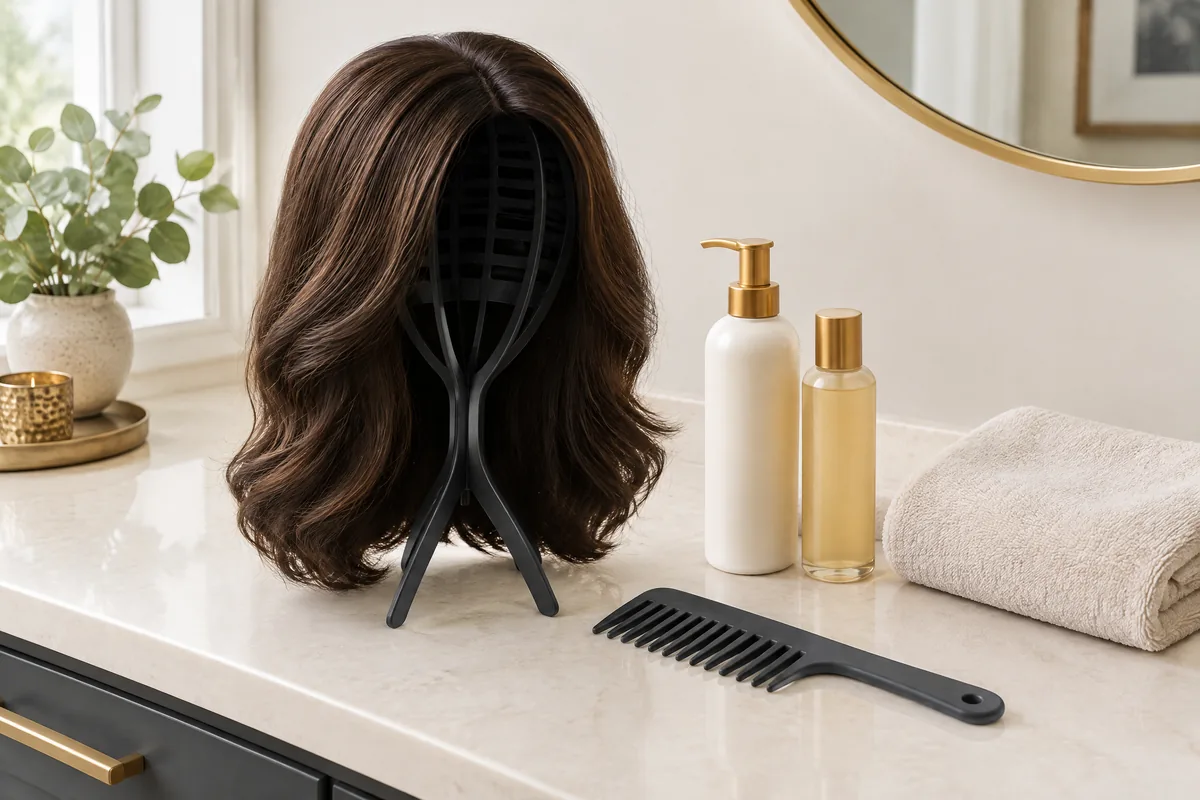
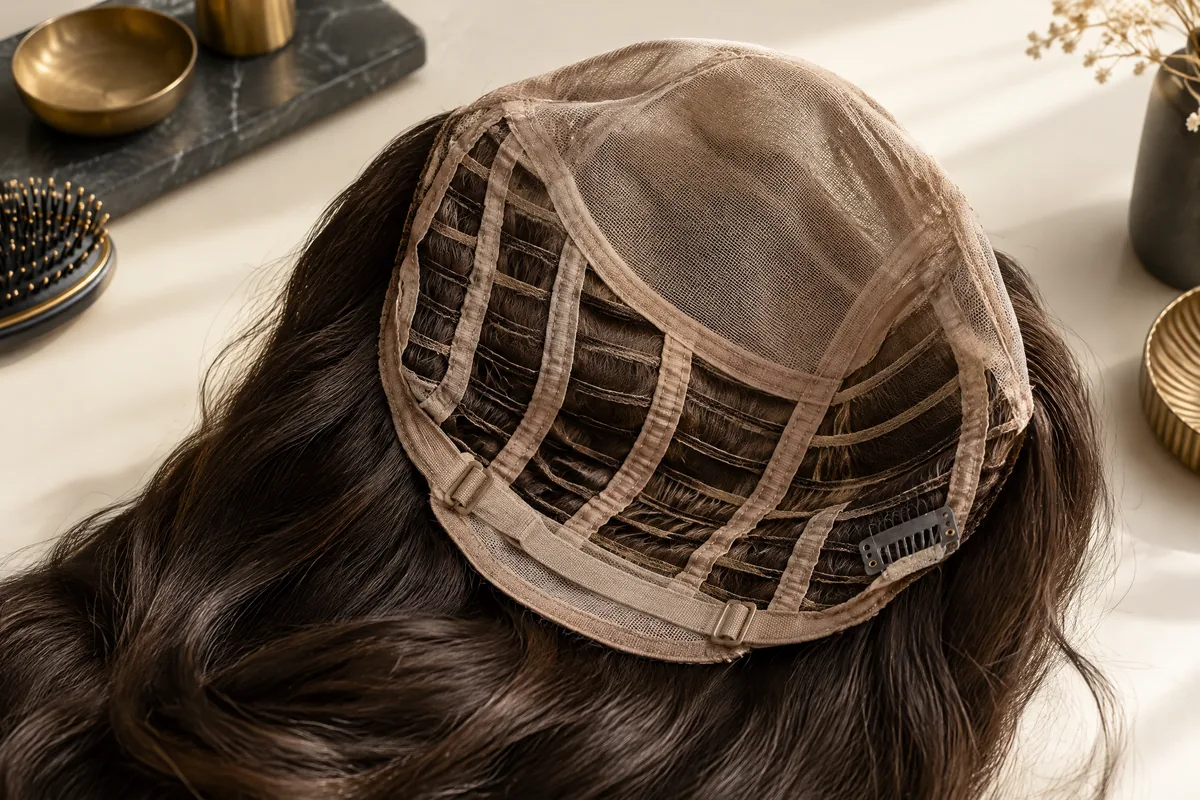
| D: off-head orientation | Front and back of this wig on its support | ‘Identify the front before lifting it’ |
The captions are examples, not positions everyone should adopt. Replace them with your own choices and avoid drawing a line across the photograph that could be mistaken for a cutting instruction. If a carer cannot identify front and back off the head, ask the supplier to demonstrate. Do not add pins, glue or permanent markings to the base just to create an orientation cue.
Describe the part and fringe in separate instructions
Make the part direction unambiguous
‘Left part’ can mean the part lies on your left or that the hair is brushed left. Write both facts: ‘Part starts on my left; front hair goes towards my right.’ Use the crown photograph to show where the visible line begins. If the wig has a fixed part, the task is to preserve that arrangement, not force a new line into it.
A centre-part reference also needs a practical check. Describe what should look balanced from the front, rather than asking a helper to measure your scalp with a ruler each morning. If the part seems wrong, check the wig's orientation and position before brushing repeatedly. An apparent parting problem may be a positioning problem, and rearranging more hair can make the look harder to recover.
Give the fringe a visible resting point
Replace ‘make the fringe natural’ with a detail someone can see: ‘The shorter edge sits above my eyebrow’ or ‘Keep the sweep away from my glasses.’ Include whether the ends stay loose or are tucked. Ask the carer to show you the result before a second adjustment. Your preference may be different from the tidiest or most symmetrical version.
When browsing women's wigs, compare the full-head silhouette and face-framing details as well as the colour. A shorter fringe may simplify arranging but change the familiar outline; a longer sweep offers a different look but may need more attention around glasses. Choose the compromise you want to maintain, not the one a helper finds easiest to impose.
Keep the handover card short enough to use
A one-page card should carry the essentials, with care instructions stored separately. Long explanations can obscure the stop signal or the right photo. Put the current approved references together and retire superseded copies from the everyday folder. You can keep old versions privately, but two competing ‘final’ photos leave the next helper guessing which one represents your preference.
Here is a compact example to adapt. It is an appearance handover, not a medical record. A carer should be able to read it back and explain what they will do without filling gaps from memory. Leave a blank where something has not been demonstrated; that is safer than adding a plausible-sounding method for an unfamiliar fastening.
- Chosen look: familiar bob, with the wearer's left eyebrow visible.
- Part and fringe: left-side part; fringe sweeps towards the wearer's right.
- Reference: approved photos A–D; no mirrored selfie as the direction guide.
- Help agreed: check the back and arrange loose front hair after permission.
- Do not change: cut, colour, heat-style or add a fastening without discussion.
- Stop signal: ‘Pause now’ or an agreed raised hand; stop adjusting immediately.
- Removal: use this wig's demonstrated release and lifting sequence, written below.
- Afterwards: place on its designated support; ask whether a different look is wanted next time.
Add the wig's style name or identifying label if there is more than one at home. Do not rely on colour alone to distinguish similar pieces. Keep supplier handling directions with that identity, so a carer does not apply instructions from a previous wig. The quick card says what matters today; the fuller instructions explain how this particular product should be handled.

Plan clothing and removal before arranging the hair
A carefully arranged fringe can be disturbed by a tight neckline immediately afterwards. Where practical, put on clothing that must go over your head before arranging the wig, and use a front-opening layer for later changes. Macmillan recommends clothing such as a shirt or cardigan when you may need to undress at an appointment, rather than pulling clothing over the wig.1
Do not ask a carer to learn removal at the end of a tiring outing. Have the supplier demonstrate the actual wig's fastenings and approved grip points while you can observe. Write down the release order in plain words. There is no universal ‘front first’ or ‘back first’ instruction that can safely replace the method for the wig and attachment you are using.
For a removable wig with no skin adhesive, your written removal sequence can use this framework. Fill in the handling details from the demonstration, and ask the carer to practise only with your agreement. The purpose is to prevent pulling on a fringe, lace edge or hair strands because somebody cannot see where to hold the base.
- Ask whether you want the wig removed, and have its support ready.
- Move glasses or loose accessories out of the way with permission.
- Release the actual fastenings in the supplier's demonstrated order; do not tug through resistance.
- Hold the approved parts of the base and lift it off in the demonstrated direction, without pulling the hair.
- Put it on the designated support and ask what you want next: rest, chosen headwear or no covering.
If tape or a skin adhesive is involved, do not improvise by pulling or applying a household solvent. Macmillan notes that treatment can make skin sensitive and advises asking a doctor or nurse which tape can be used and how best to remove it. Keep clinical advice about skin contact separate from the supplier's explanation of the wig's construction.1
Agree a stop signal that ends the adjustment
Choose a phrase such as ‘Pause now’ and, if helpful, a gesture such as an open raised hand. Agree the response before starting: hands stop moving, no further brushing, and the carer asks whether you want to leave the wig alone or have help removing it. Stopping adjustments is not automatic permission to lift the wig off.
The signal can mean tiredness, discomfort or simply ‘I have had enough arranging’. You should not have to justify it or wait until a helper finishes one last section. Macmillan includes taking a wig off when possible among its suggestions for keeping cool. It does not turn that advice into a fixed wearing schedule for every person.1
For example, imagine the part is aligned but the fringe still covers more eyebrow than you wanted. You signal a pause before a carer makes another adjustment. The useful response is to accept the unfinished detail and ask what you want next, not to explain that correcting it will ‘only take a moment’. Preserving control matters more than finishing a photograph-perfect style.
Questions about soreness, skin changes or treatment belong with your clinical team, not in a home experiment to find your maximum wearing time. A carer can record what you reported and help pass it on, without diagnosing the cause or tightening the wig to solve it. A request to stop is enough to stop the appearance routine.
Record preferences without turning them into tolerance targets
Keep notes that make the next attempt simpler: which reference you chose, what help you accepted and what you wanted changed. Write your words where possible. ‘Please leave the right side loose’ is actionable. ‘Tolerated well’ is less useful if it hides that you wanted to stop but did not want to disappoint the person helping you.
Avoid a box labelled ‘safe wear time’ or a goal to extend yesterday's duration. Even an accurately recorded period does not establish what will feel right tomorrow. Instead, capture the situation and your decision. A note can explain why you switched to headwear without creating a rule that every outing must follow the same sequence or length.
| What happened | Useful preference note | Do not convert it into |
|---|---|---|
| Fringe interrupted reading | ‘Next time keep the sweep away from my glasses’ | A reason to trim it without permission |
| You asked to pause | ‘Stopped arranging when requested; wearer chose rest’ | A failed practice session |
| You chose a scarf for the journey home | ‘Bring the chosen scarf as an optional alternative’ | A mandatory change after a set time |
| You reported an uncomfortable area | ‘Record the wearer's words; raise the concern with the clinical team’ | A diagnosis or instruction to add padding |
Care tasks also need an honest handover. Comparing human hair wigs means considering the upkeep of the exact piece, not just its movement or colour. Styling flexibility may appeal, but it also creates work someone must undertake. Agree who handles washing, drying and arranging, and keep any heat settings or permitted products tied to the manufacturer's instructions.
Cancer Research UK describes many synthetic wigs as ready to wear and notes that some human-hair wigs need professional styling. Those differences can influence how much help you want. A simpler routine is a legitimate priority, not a lesser choice. Neither a material label nor a higher price gives a carer permission to use tools or products outside the particular wig's care directions.2
Rehearse the handover without making it a test
Use a calm rehearsal to see whether the notes are clear. Ask the carer to identify the wearer's left in the photograph, read the fringe instruction and explain the removal steps before handling anything. Then let them assist with the part you have agreed. Correct one unclear instruction on the card rather than expecting them to remember a series of verbal corrections.
For an OWNSTRAND custom enquiry, ask whether your chosen carer can attend the relevant consultation or return fitting and receive a handling demonstration. The stated service includes a completed custom wig fitting with washing, cutting and blow-drying. Confirm the arrangements for your enquiry. The location is Unit 2103, 利寶時中心, 50 Hoi Yuen Road, Kwun Tong; district information is not a separate branch.
End with a decision you can change: ‘This is the look I want help with today.’ Keep optional headwear available if you want it, and let a day without the wig be an ordinary choice. The best handover does not make the carer responsible for keeping you looking the same. It gives them a clear way to help you choose your appearance.
Questions & answers
Can I keep the reference photos private from other relatives?
Yes. Choose who may access them and where they are kept. A printed card in a private drawer may suit you better than a family chat. Agree separately whether a carer may photograph you; accepting practical help does not mean agreeing to share images.
What if two carers disagree about which hairstyle looks better?
Your preference decides. Ask each helper to follow the same approved reference rather than negotiate a compromise between their tastes. If you want their opinions, invite them for a particular decision; you can still choose something different.
How can I direct a carer if I do not want to look in a mirror?
You can describe the few details you want preserved and nominate an approved photograph. Ask the helper to describe changes before making them. You may also request help only with positioning and leave styling for another occasion; mirror checks are optional.
Should every wig in my collection have the same handover card?
Use a separate handling section for each wig. You may share appearance preferences, but fastenings, parting options and care rules can differ. Identify the piece clearly so a helper does not follow one wig's removal or styling instructions on another.
Does choosing a wig help treat chemotherapy-related hair loss?
No. This handover concerns appearance and practical assistance, not treatment or hair regrowth. Ask your healthcare team about treatment-related hair or scalp concerns. A wig supplier can discuss the product, styling and fitting arrangements, but cannot replace clinical advice.
Put the next step into practice
Build a clearer understanding of hair shape and everyday styling through learning at Canvas. Hair styling courses in Hong Kong。
Explore more practical styling and selection notes. Canvas hair and beauty journal。
Tell the team which hair styling techniques you would like to learn. Contact Canvas Academy。
Sources & further reading
- Macmillan Cancer Support — Wigs for cancer treatment
Practical guidance on choosing and wearing a wig, involving a friend or relative, clothing changes and asking the clinical team about tape on sensitive skin.
- Cancer Research UK — Wigs, hats and scarves
Explains reference photos, fitting support, material and care differences, and the option to choose other headwear or not wear a wig all the time.