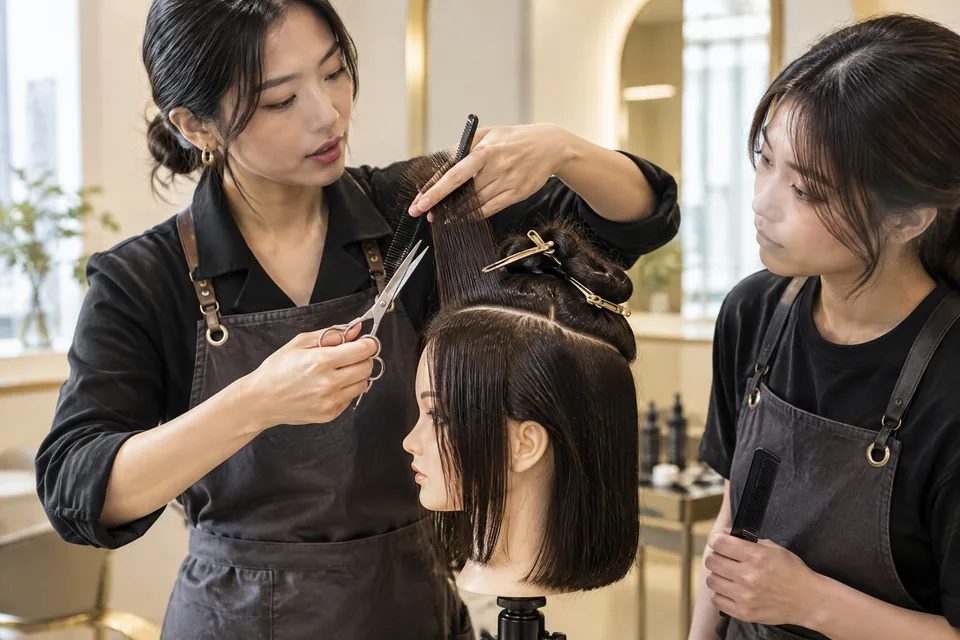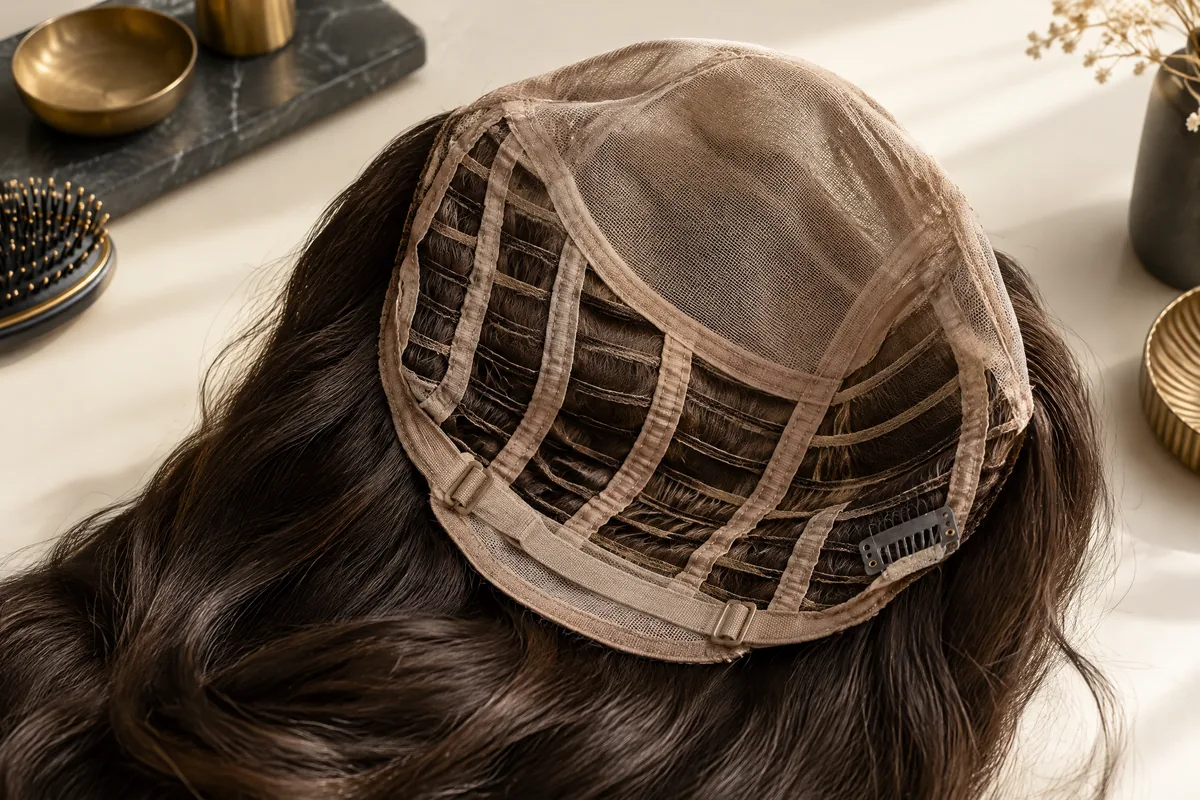
First identify what actually needs to move
A fringe can look wrong for several different reasons. Its ends may point into your eyes, its parting may sit too centrally, or the whole front may appear too rounded. These are not interchangeable problems. Moving the ends away from your forehead is a different request from lifting the roots or reducing the amount of hair across the brow.
Before planning a shape change, put the wig on according to its fitting directions and check the cap position. Look straight ahead, then turn slightly to each side. Note whether the fringe bothers you while wearing glasses or looking down. A bend that looks attractive on a stand may not solve the particular point of contact on your face.
OWNSTRAND’s synthetic wigs catalogue provides starting shapes to compare. For example, Amore Bay is described as straight, while Braylen is described as wavy or curly. Neither description establishes heat permission. Compare the actual front length and supplied silhouette, then enquire about the exact option’s quotation and availability rather than treating a style image as an in-stock promise.
Compare the two looks in three decision columns
Treat the supplied fringe as one candidate and your proposed bend as another. Do not award the new look extra points simply because it is customisable. A preset shape can be the better choice when it gives the outline you want with less work. Conversely, a carefully defined change may solve a specific problem that the supplied shape does not.
| Candidate | Maker instructions | Shape memory | Reversibility |
|---|---|---|---|
| Keep the supplied fringe | Follow its normal care and handling directions; no new heat method is needed. | Establish how that fibre’s supplied texture behaves after its prescribed wash and dry routine. | You retain the starting shape, provided care and storage follow the maker’s directions. |
| Add one bend to an explicitly heat-permitted fibre | The exact tool, method and stated limits must cover the proposed change. | Find out whether the reset shape remains after washing and how cooling sets it. | A return may need another permitted styling session, not just shampoo. |
| Add a bend when heat permission is missing | Do not proceed with heat, even if the change seems small. | Unknown behaviour is not a reason to experiment. | There is no dependable undo plan; choose a nearer preset shape or seek clarification. |
HairUWear’s instructions illustrate why the middle column matters. They say Tru2Life retains its new heat-styled texture even after washing. The same official guide prohibits thermal tools for Flexlite and Vibralite fibres. Thus, two synthetic wigs can require opposite decisions, and washing a permitted heat reset is not necessarily a route back to the original fringe. 2
The table also separates two meanings of reversible. A hairstyle may be changeable through another authorised process, yet not return automatically through routine care. Ask yourself whether you would still want the new bend if restoring the old look required another appointment or styling session. If not, the supplied shape has a practical advantage.

Describe one bend without asking for a whole new fringe
A single bend is one broad curve within the section, not a ringlet or a series of waves. For planning purposes, separate where it starts from where the tips finish. A soft inward curve near the ends may shorten the fringe’s visible drop. An outward curve may reveal more forehead but place the tips closer to a spectacle frame.
Specify the start, direction and landing point
Give a stylist a reference photo, but add words that describe your own fringe. Say whether the bend begins near the middle or only towards the tips. State whether it turns inward, outward or towards one side. Finally, identify the resting point: just above the eyebrow, beside the temple, or clear of the upper edge of your glasses.
These are visual instructions, not measurements for operating an iron. Asking for a broad curve does not establish a tool, temperature or contact time. The maker’s directions still govern the process. Your description helps distinguish the result you want from a tight curl, increased root volume or a different haircut, which could otherwise be bundled into the same request.
| Vague request | More useful description | What it keeps separate |
|---|---|---|
| “Make it less flat.” | “Keep the roots as supplied; add one shallow curve only near the ends.” | End movement versus root lift. |
| “Move it off my face.” | “Let the tips rest towards my right temple, without a curled-under finish.” | Side direction versus inward curl. |
| “Make it softer.” | “Use a broad bend rather than a ringlet, and keep the current length.” | Curve size versus cutting. |
| “I want a curtain fringe.” | “I want two separated sides; please assess the parting and front length first.” | A new fringe arrangement versus one bend. |
State what must stay unchanged
A useful boundary sounds like this: “Keep the parting, root height and length; I only want the lowest part of the fringe to turn slightly away from my glasses.” That tells the stylist which features you already like. It also makes it easier to reject a proposal that would achieve clearance by cutting the fringe shorter instead.
For an illustrative comparison, imagine a straight fringe that reaches the upper rim of your glasses. A curled-under finish might look tidy from the side yet make the fringe appear shorter. If your priority is maintaining brow coverage, ask whether a shallow side-directed bend can meet that aim. If not, a longer preset front may be the better starting point.
Read heat permission as a complete method
Permission has to belong to the fibre and model you own. HairUWear’s contrasting fibre instructions show why “synthetic” alone is inadequate. A recommendation for one named fibre does not authorise the same process on a different one. Likewise, a general description of heat tolerance is not a complete explanation of how to reshape the fringe. 2
Before choosing from heat-friendly synthetic wigs, ask for the exact style’s care sheet and compare it with your one-bend description. OWNSTRAND’s guide invites enquiries about styles, quotations and ordering arrangements; it does not give every model one shared method. Buying flexibility only makes sense if the permitted process covers the change you actually want.
Keep these details together when discussing the plan:
- The maker, model and exact fibre name.
- Whether heat is expressly permitted, and which tool is covered.
- The required hair condition, permitted products and stated limits.
- Any restrictions near the base or hairline.
- How the section must cool and how the finished shape is maintained.
Jon Renau’s HD instructions include digitally controlled tools and different handling for curling and straightening. Their curl procedure requires complete cooling before release, while straightened hair is left hanging naturally to cool. That is evidence that finishing position matters, not permission to copy the HD procedure onto another fibre or use a general low setting. 1
If the care sheet says no heat, the decision is finished for a heated bend. If the sheet is missing or only says “heat-friendly” without explaining the intended method, pause the change until the maker clarifies it. Do not resolve the gap with a concealed-section trial, steam, hot water or someone else’s temperature recommendation.
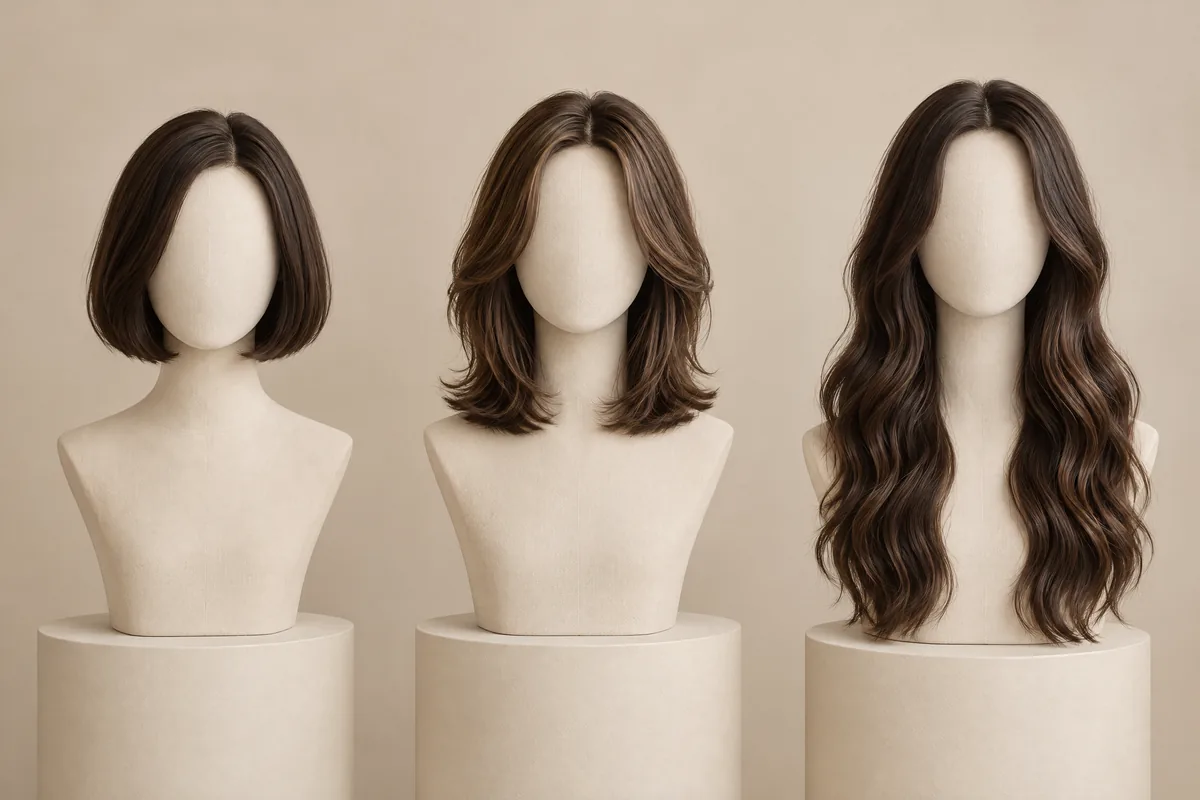
Decide how much lasting change you want
Shape memory is useful shorthand for a fibre’s tendency to retain a set texture. It should not be read as a guarantee that every wig restores its factory silhouette after washing. Tru2Life’s published wash-resistant heat reset is a particularly clear example: a successful new bend may become the texture you subsequently maintain, rather than a one-evening variation. 2
This changes the buying question. If you want the fringe curved every weekday but straight on occasional evenings, ask what switching requires for that exact fibre. A look that can be reset is not necessarily convenient to alternate frequently. Include the cooling, maintenance and return process in your decision, rather than counting only the time spent with a tool.
Cooling also changes when you should judge the result. Jon Renau’s HD curling directions call for the formed curl to cool completely before the clip is removed and the hair is blended. For an authorised styling session, assess the finished resting shape after the required cooling stage, not while it is still supported in a curl. 1
Preserving the supplied fringe has its own care obligations. HairUWear advises appropriate stand storage to avoid unwanted kinks or crimps in its fibres. Follow your model’s storage directions rather than leaving the front folded under another item. Retaining a preset shape is a deliberate choice, not a promise that handling and storage cease to matter. 2
Work through a realistic stop-or-go example
Consider a bob whose preset fringe already frames your face well, but whose tips brush your glasses when you look down. You want one shallow bend away from the frame, not additional volume. First rule out cap placement as the cause. Then compare a compatible preset silhouette with the proposed change using the three columns, including the effort needed to undo it.
If that bob’s named fibre has instructions that expressly prohibit heat, choose the preset option or another model with a better front shape. A tiny change does not create an exception. You can discuss handling allowed by the care sheet, but do not promise that finger-positioning will produce a lasting bend or treat it as equivalent to a heat reset.
Now imagine a different model with explicit instructions for the intended heat method. You like the proposed bend enough to keep it between washes, and a stylist can explain the permitted return process. That is a reasonable candidate for assessment. It still deserves a restrained brief: change the specified end section, preserve the roots and parting, then judge the fully finished shape.
A third situation calls for delay even with permission: you need the original fringe for an event tomorrow and have no confirmed way to restore it. Keeping the supplied look is the stronger decision because reversibility fails your timetable. Permission tells you what is allowed; it does not tell you whether the change is worth making today.
When a different starting wig is the better purchase
Repeatedly redesigning a fringe can signal that its starting cut is wrong for your preference. If you want a daily side sweep but the model’s front arrangement resists it, compare shapes designed closer to that look. Length, parting and amount of front hair all affect the result. One end bend cannot substitute for every change to those features.
Comparing human hair wigs may be worthwhile when changing your fringe is a regular priority. OWNSTRAND lists options such as Amore Brielle and Ellen Wille Appeal, with quotation and availability to confirm. Compare their exact front shape and care requirements, rather than buying human hair solely on the assumption that every styling process will be permitted.
Human hair also does not remove the need for limits. HairUWear’s human-hair guidance requires dry hair before curling or flat irons and warns that excessive heat can scorch it. Its instructions assign cutting and chemical processes to a professional stylist. Styling flexibility therefore remains a product-and-care decision, not an assurance that a bend is risk-free or effortlessly reversible. 2
Take a clear fringe brief to your next enquiry
Bring a front view and a side view of the wig as it currently sits, plus a reference showing the intended curve. Include the maker’s label and care sheet. Ask whether the proposed change is permitted, what the finished resting point should be, and what returning to the supplied look would involve. Keep cutting out of the agreement unless you want it.
Choose the preset fringe when it already solves the visible problem or when the return plan is weak. Choose a permitted single bend when it solves a defined issue and you are comfortable maintaining that result. For help discussing the look, contact Canvas on WhatsApp at +852 5443 7168 and describe the bend, not just the tool you had in mind.
Questions & answers
Does a longer fringe always give a softer bend?
No. Length gives more room for a curve, but the starting cut and amount of front hair also matter. Ask to compare the intended resting shape from the front and side; a longer fringe can still finish too bulky or reach your spectacle frame.
Can I use heat-protectant spray to make an ordinary synthetic fringe heat-friendly?
No. A spray used within a maker’s authorised method does not change a no-heat fibre into a heat-permitted one. Identify the exact fibre first, and do not apply a tool when its instructions prohibit heat or leave permission unresolved.
Should the same bend be added to both sides?
Not automatically. A side-swept fringe may need different visual treatment on each side. Describe where each side should rest and which areas must stay unchanged, then ask whether the model’s front arrangement can produce that balance without cutting or changing the parting.
Does permission for a curling iron also cover a heated brush?
Do not infer that it does. A heated brush has a different contact and handling method. Ask for guidance covering that device on the exact model; the instructions for an authorised iron are not blanket approval for every heated styling tool.
Can I return a wig after changing its fringe?
Check the seller’s terms before any alteration. Do not treat a styling reset as commercially reversible just because the shape might be changed again. Get clear answers about heat styling, cutting and return eligibility for your purchase before authorising work.
Put the next step into practice
Build a clearer understanding of hair shape and everyday styling through learning at Canvas. Hair styling courses in Hong Kong。
Explore more practical styling and selection notes. Canvas hair and beauty journal。
Tell the team which hair styling techniques you would like to learn. Contact Canvas Academy。
Sources & further reading
- Care and Tips for HD Fiber — Jon Renau
The maker’s HD guidance explains complete cooling for curls, natural hanging while straightened hair cools, and controlled-tool requirements for its own fibre.
- Hair Care & Styling — HairUWear
Separate fibre sections distinguish Tru2Life’s wash-resistant heat reset from no-heat synthetic fibres and explain relevant storage and human-hair styling precautions.