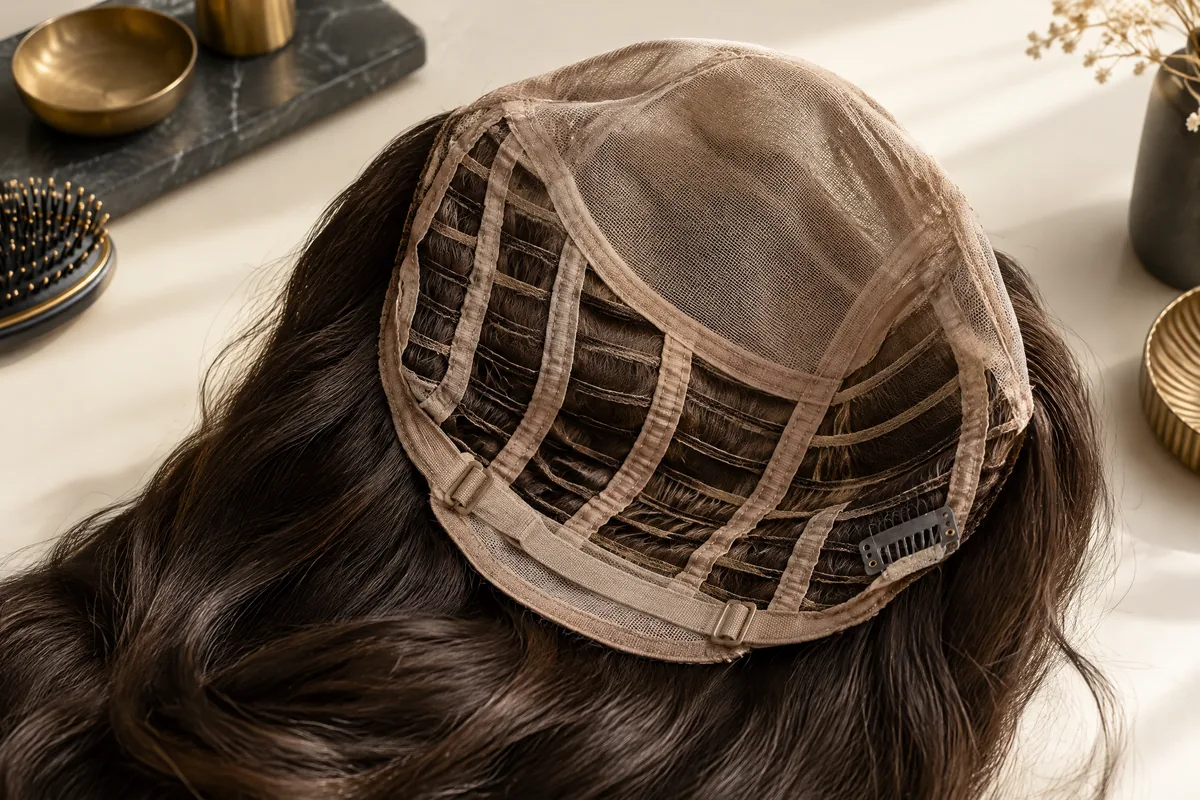
Start with the cap and glasses as separate fits
Wear your everyday glasses without the wig first. Notice where each arm rests above the ear and whether either side already presses, slips or sits higher. That is your starting point. A wig should not become the tool that forces an uncomfortable frame into place, and a frame should not become an improvised clamp for the wig.
Cap sizing also needs more than a circumference label. The American Cancer Society describes circumference, front-to-back and side-to-side measurements, and notes that sizing can vary between brands. A cap can feel snug around the head yet have an unsuitable distance between the hairline and ears. Use the maker's measurement method rather than tightening until the perimeter feels secure. 1
The surrounding construction matters when choosing a lace front wig. OWNSTRAND's catalogue lists Amore Arden with a lace front, monofilament and wefted/basic construction, while Amore Brielle is listed with a lace front, monofilament and 100% hand-tied construction. Both require a quotation and availability enquiry. These descriptions establish different cap layouts, not which one will accommodate your glasses better.
Map three contact zones, not just the hairline
An ear tab is the small shaped section near the ear used to help position the wig's side. Some have a mouldable stay; others have an open design or different padding. The American Cancer Society advises that ear tabs should be even and slightly in front of the ears. They should not cover the ears simply to make the front look flatter. 1
With the wig off your head, support it gently and identify the tabs, front edge and panels immediately above and behind each ear. Find any seams or adjustment points near the route of the glasses. Do not stretch the cap to inspect it. The purpose is to know which material the frame will meet, rather than treating every visible mesh section as interchangeable.
Use a mirror to compare the following zones after putting the wig on. Keep hair loosely away from the contact area so it does not hide a folded edge. A phone photograph can help record the starting position, but use the same angle and lighting for later comparisons; otherwise, shadows can look like a change in fit.
| Contact zone | What to observe with glasses on | What the observation suggests |
|---|---|---|
| Ear tab above the ear | The arm sits freely, or pushes the tab upwards | Upward movement points to a clearance problem, not automatically weak grip |
| Temple end of front lace | The edge rises only when the frame is inserted | Frame contact or transferred side tension deserves attention first |
| Side panel behind the tab | Material lies smoothly, folds or drags with the arm | A fold may be local interference; movement beyond it may involve cap positioning |
| Nape and opposite tab | They stay aligned, or move together during a turn | Several zones moving together suggests broader cap movement |

Run a controlled glasses-on comparison
Establish the fit before inserting the frame
Prepare your own hair and any intended liner the same way you would for an ordinary day. Remove your glasses while putting on the wig, then set the cap using its instructions. The American Cancer Society also recommends removing glasses during fitting. Hold appropriate cap sections rather than tugging delicate front lace to bring the sides into alignment. 1
Before replacing your glasses, look straight ahead, turn gently to each side and lower your chin as though reading a message. Notice whether both tabs remain aligned and whether the front already lifts. If the problem exists at this stage, record it as a cap-only issue. Otherwise, it is easy to blame the frame for movement it did not create.
Now insert the glasses slowly, using your usual route above the ears. Do not push through resistance. Simply Wigs describes wearing frames either above or beneath ear tabs, and notes that an oversized cap can bring tabs too low. Its guidance supports trying alternative positions, but there is no single arrangement that suits every cap and frame. 2
Change one contact at a time
Keep the cap adjustment unchanged while comparing an allowed alternative frame position. Observe the left and right sides separately. When you remove the glasses, check whether a lifted corner settles again. That reversal is a useful clue: the frame may be loading the edge, although it does not prove that the cap size or construction is otherwise right.
For each trial, repeat the same ordinary movements rather than pulling hard on the wig to test it. Put the glasses on and take them off once, turn towards an imaginary colleague, then look down at a phone. These are fitting observations, not a guarantee for wind, sport or a whole working day. Stop if pressure or rubbing develops.
- Keep hair preparation, liner and strap setting unchanged between frame-position trials.
- Compare front-edge lift separately from side-panel movement.
- Note which contact changes first, rather than only the final appearance.
- Remove the glasses to see whether the change reverses.
- If you change a cap setting, restart the comparison from the glasses-off position.
Distinguish front lift from a side-support problem
Front lift means the edge separates visibly from the forehead or temple. Side support concerns how the tab and neighbouring panel sit against the head and retain their position. Friction concerns rubbing during movement. They can occur together, but they are not equivalent: a front can look flat while the glasses press painfully at the sides.
If one temple corner rises as its frame arm slides underneath a tab, investigate that local contact first. If the whole front moves when you lower your chin, with or without glasses, review the cap's positioning and dimensions. Tightening the back may change both observations, so it should not be your first simultaneous change in a glasses-position comparison.
A useful decision is whether the frame has enough space without displacing material. If it does not, extra holding force elsewhere may merely keep the wig still while preserving the pressure point. Conversely, if the frame sits freely but the cap shifts as a whole, a permitted adjustment or securing feature may be relevant. The visible symptom should determine the next step.
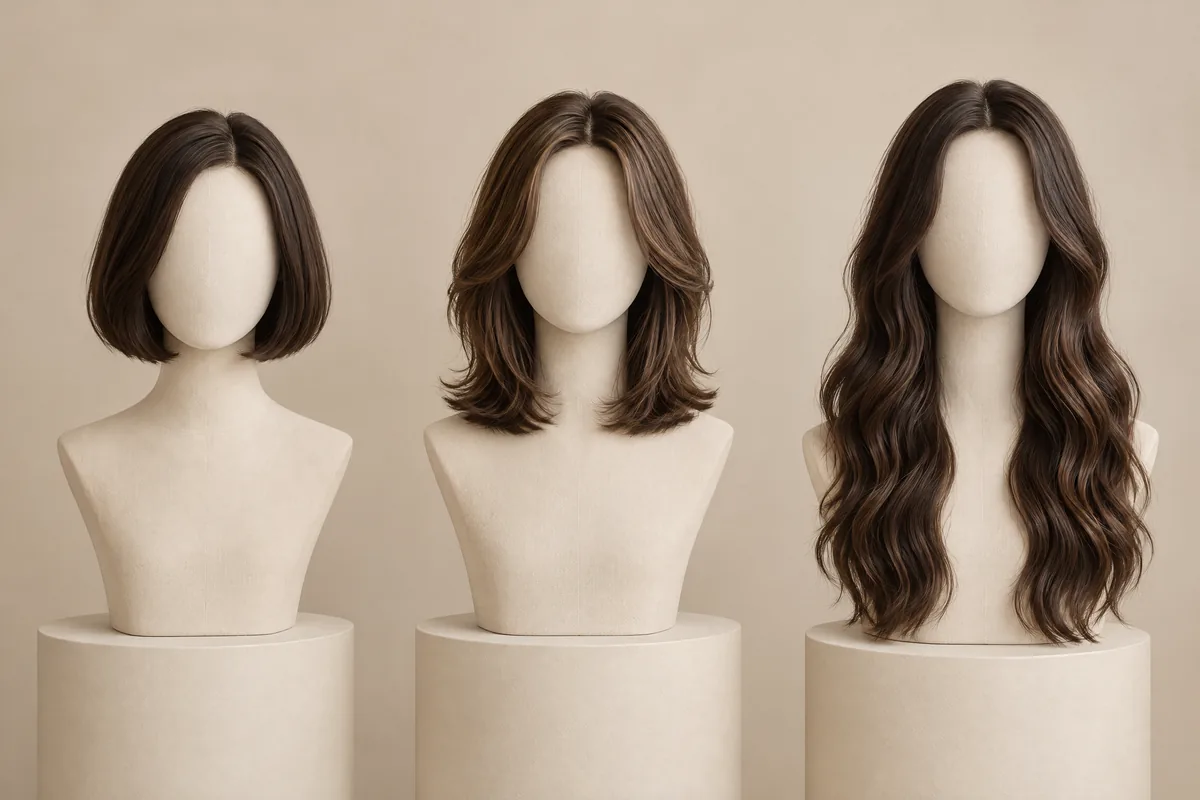
Evaluate hand-tied side panels by their layout
Hand-tying describes how hair is attached, not how firmly a side panel supports the frame route. The American Cancer Society describes individual strands or fibres tied to the cap. That attachment method does not tell you the location of reinforcement, an ear opening or a fastening feature. Separate hair movement and appearance from the structural questions around your ears. 1
When considering a hand tied wig, trace where the hand-tied area ends and the ear-tab construction begins. OWNSTRAND's guide explains that hand-tying may cover stated sections rather than the entire cap. Ask for an inside view showing the sides, perimeter and seams; a photograph of a natural-looking part cannot answer how a frame arm will pass beside the ear.
For a cap with hand-tied side panels, observe whether the glasses drag the panel when removed. Lift the frame away from contact before sliding it forward, rather than using the fabric as a guide rail. Do not pierce mesh with an arm or treat a small gap between knots as a designed opening. The useful opening is one the construction deliberately provides.
More substantial padding can offer a different contact surface, but it also occupies space beside a thick frame arm. Less bulky material may leave more room, yet still fold or catch at a seam. Neither trade-off makes one construction universally better. Compare the actual panel in your intended hairstyle, especially if you tuck the sides behind your ears.
Compare built-in support before buying extra grip
A glueless wig is intended for an adhesive-free wearing approach; it can still use securing or adjustment features. OWNSTRAND's guide makes this distinction and does not promise universal stability. Identify what the individual cap provides before adding a band, clip or adhesive. The question is what addresses your observed movement without creating a new contact problem.
Use the comparison below to separate the job of each feature from its limitations. These are possible design elements, not a list included in every wig. A component that adjusts circumference should not be expected to create an ear opening. Likewise, an ear tab that lies neatly against the head does not establish resistance to every activity.
| Feature or change | Problem it may address | Trade-off to check |
|---|---|---|
| Cap's rear adjusters | Circumference fit within its intended range | More tension may alter the front and sides without improving ear clearance |
| Adjustable ear-tab stay, if supplied | Local tab contour | Use only the intended adjustment; repeated bending is not a size correction |
| Designed open ear tab | A permitted route for a frame arm | The opening must accommodate the arm without stretching or forcing |
| Supplied elastic support | The cap's intended holding arrangement | Check its position and whether it changes side pressure |
| Compatible grip band | Additional hold when the cap otherwise fits | Added material may change the available room around the ears |
| Compatible clip or comb | Attachment to suitable natural hair | Requires an appropriate anchor and a location clear of the frame |
Simply Wigs notes that some open ear tabs allow glasses through an opening, but warns against forcing them. If yours lacks that design, do not create a hole or cut around the ear yourself. An optician can also assess frame fit with the wig present. That is more useful than bending the glasses at home to compensate for unknown cap pressure. 2
A comfort liner is not automatically a grip solution. Macmillan notes that a liner can sometimes make a wig move more, and that clips may be usable when there is natural hair to attach to. If you add an approved accessory, repeat the same glasses-on comparison; do not judge it only by how secure it feels before the frame goes back on. 3
Read the result in everyday situations
Thick frame arms lift one temple corner
Imagine a bob that sits evenly until a wide acetate arm passes beneath the right tab. The right temple edge rises, but the nape remains in place. Removing the frame lets the corner settle. The first useful comparison is an allowed above-tab route or another frame you already wear, not adding stronger grip around the whole head.
If that route keeps the edge flatter but presses the glasses into your ear, the result is still a poor compromise. Ask about another tab layout or have the frame fit assessed. A less exposed hairline under a fringe may change how noticeable the edge is; it does not remove the pressure that caused the problem.
Reading glasses repeatedly catch the side
Picture someone who removes reading glasses throughout the working day. The cap stays aligned during head turns, but one side panel follows the arm during removal. Compare lifting the arm clear before drawing it forward. Also separate loose hair from the frame hinge. Repeated catching points to handling or local clearance, not necessarily a need for more perimeter tension.
If rubbing continues, inspect the area off the head for a folded seam, trapped strands or damage, without pulling the knots. Macmillan warns that repeated friction from items worn over a wig can shorten its life. Avoid relying on a headband laid over the troublesome area to hide movement; it adds another contact surface rather than resolving the frame route. 3
Make the fitting routine repeatable
Once you find a workable combination, record the cap setting, frame route and hair preparation together. A photograph of the tabs with hair held loosely aside is more useful than a front-only selfie. Recheck after changing glasses or adding a liner. Clean the frame arms and care for the wig according to their respective instructions; do not use heat to reshape the cap or ear area.
For an OWNSTRAND enquiry, name the style and describe the contact result: for example, “the right frame arm lifts the tab but the nape stays aligned”. The brand offers private sample viewing in Kwun Tong and handmade custom human-hair options with head measurement and a later fitting that can include washing, cutting and blow-drying. Those services do not make every catalogue item custom-made.
OWNSTRAND's only showroom is Room 2103, 利寶時中心, 50 Hoi Yuen Road, Kwun Tong; district information does not mean additional branches. Ask about the style, quotation and visit arrangements before travelling. For a Canvas discussion, WhatsApp 85254437168 with your usual frame type and the area that moves. A clear contact description is more useful than asking for the tightest possible fit.
Questions & answers
Should I bring prescription sunglasses as well as my everyday glasses?
Yes, if you regularly alternate between them. Different arm widths and curves can meet the same ear tab differently. Compare each pair independently rather than choosing a wig setting that works only with your lightest frame.
Can I keep my glasses on top of the wig when I am not using them?
A case is preferable during a fitting comparison. Parking glasses on the head introduces contact with hair and the cap, and may obscure what caused later movement. Follow your frame maker's advice rather than stretching the arms around extra volume.
Must both ear tabs have exactly the same bend?
Not necessarily: your ears and frame fit may differ between sides. Start with an evenly positioned cap, then use only adjustments the maker permits. A visibly uneven cap should not be disguised by bending one tab more aggressively.
Can I put longer hair behind my ears without changing the fit?
Test the hairstyle you plan to wear. A gathered section beside the frame can add bulk or catch at a hinge. Move the hair gently without pulling the panel, and compare tucked and untucked positions before arranging the sides permanently.
What should I ask before a stylist trims hair near the glasses?
Explain whether the problem is strands catching or cap material pressing. A haircut can reduce hair bulk but cannot relocate an ear tab. Wear your usual frames for the discussion and confirm the proposed change before any irreversible cutting.
Put the next step into practice
Build a clearer understanding of hair shape and everyday styling through learning at Canvas. Hair styling courses in Hong Kong。
Explore more practical styling and selection notes. Canvas hair and beauty journal。
Tell the team which hair styling techniques you would like to learn. Contact Canvas Academy。
Sources & further reading
- Wigs for Hair Loss — American Cancer Society
Explains wig construction, three head measurements, brand-dependent sizing and basic ear-tab positioning.
- How to Wear Wigs with Glasses: A Complete Guide for Comfort & Style — Simply Wigs
Specialist retail advice on above- and below-tab frame positions, designed openings and glasses adjustments.
- Wigs for cancer treatment — Macmillan Cancer Support
Includes practical guidance on securing wigs, liners that may increase movement and avoiding repeated friction.