Start with the change you actually want
A reference photograph often contains three separate decisions: movement through the top, a narrower outline at the sides, and a haircut connecting them. Asking only for a men's perm leaves those decisions bundled together. Before comparing prices, describe which part of your present shape you dislike and which parts you would happily keep.
Top movement means a visible bend or wave through the retained top and fringe. Side control means discussing hair that projects outward near the temples or above the ears. Cutting changes length, weight and coverage. A tidy silhouette may involve one of these decisions or several; the photograph alone does not reveal the work behind it.
For a local service discussion, Vit So's down perm sheung wan explanation separates closer sides from added curls or crown height. That distinction matters when you like your existing top but dislike the width above your ears. Describe the side sections rather than asking for an entire reference hairstyle under one service name.
Write one priority sentence before collecting quotes: 'Keep my straight top and covered temples, but reduce the outward shape above my ears.' Alternatively: 'Create a visible wave through my fringe and top; I am comfortable with shorter sides.' These briefs ask for different work. Neither is automatically the cheaper or more useful choice for your hair.
- Top: what movement should be visible, and where?
- Sides: what width should change, and what coverage must stay?
- Cut: which lengths and connections need redesigning?
Read the outline from more than one angle
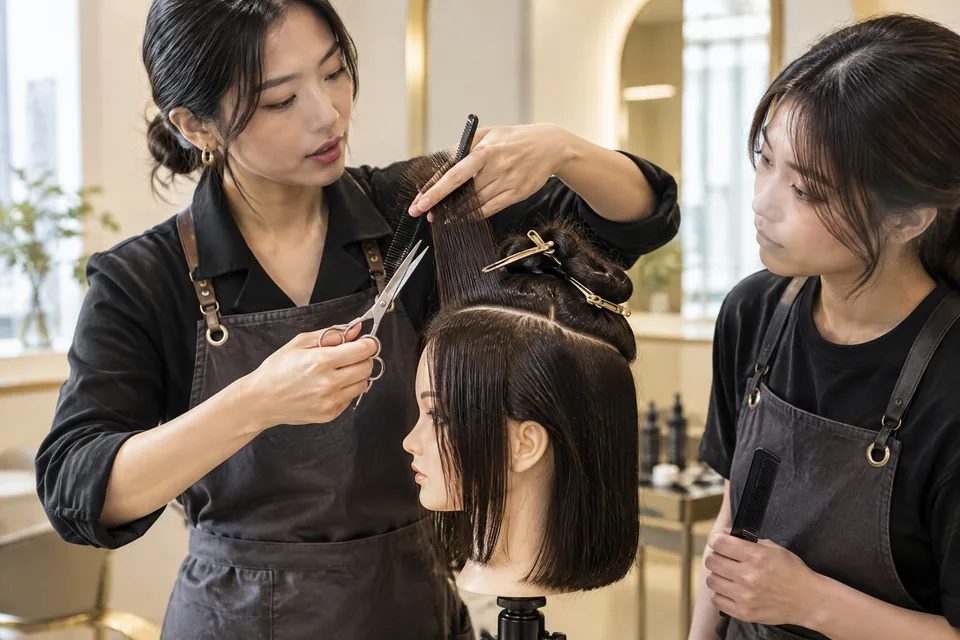
Compare your hair after your normal wash and drying routine, with no deliberate attempt to force it into the reference shape. A front view shows overall width, but it can hide a projecting section behind the ear. Take both side views and a back view. Keep your usual parting and fringe position for each photograph.
Separate excess weight from projecting direction
Look at where the widest point sits. Is it a thick band where the longer top meets the sides, or individual lengths standing away just above the ear? Ask the stylist to explain whether removing weight, changing length or controlling retained hair addresses that particular area. This is a design discussion, not something a photograph can conclusively assess.
Cutting shorter can reduce coverage as well as width. Local side control is a different discussion if you want to keep the temples covered. If you already prefer exposed ears and a close outline, start with the cutting plan. Paying for chemical work on lengths you intend to remove may not serve your priority.
Check the connection to the top
A fuller top beside closer sides creates contrast, but contrast is not the same as new curl. Identify whether you want the top itself changed or simply made more prominent by narrowing the sides. Show the reference from the side if possible. Ask how the transition should look, rather than judging only the fringe in the front photograph.
Bring your usual glasses to the consultation. The arms sit exactly where many people notice side width, and covered ears look different from exposed ones. Also explain whether you normally wear your fringe forward or sweep it back. A cut should be discussed in the position you wear, not only in a temporary salon finish.
Build a treatment-area quote worksheet
Use the same rows for every proposed plan. Record 'not requested', 'included' or 'separately quoted', rather than leaving a blank beside top movement or side control. A blank is easy to misread as an inclusion later. Keep the salon's own service name beside your plain-English description so the scope and the menu entry remain connected.
| Worksheet row | Record in the quote | Question that resolves a mismatch |
|---|---|---|
| Top movement | Fringe, top or broader coverage; intended bend | Which retained sections will change? |
| Side control | Exact side boundaries and areas left alone | Is this included or a separate service? |
| Cutting | Length retained, ear coverage and top-side connection | Is wash, cut and blow-dry included? |
| Care | Named pre-service or other care component | Is this included, necessary or optional? |
| Total | Applicable amount and separately charged work | What changes would require a revised quote? |
The published down perm price at Vit So, checked on 6 November 2026, is HK$700 for the standalone entry. The men's wash, cut and blow-dry plus Down Perm package is HK$780–880. The range does not identify your applicable amount, and the standalone service name does not establish cutting inclusions. Keep these as different worksheet options.
Do not turn a treatment-area description into an invented price category. 'Only the right side' does not establish a half-price service, and 'just the fringe' does not automatically match a particular partial-perm entry. Ask which listed entry corresponds to the assessed work. Leave an unconfirmed charge visibly pending rather than estimating it from the size of the section.
The Hong Kong Consumer Council advises checking less prominent surcharges and particular requirements before a service, and retaining a receipt listing the work provided. Apply that advice by keeping the agreed quote with your worksheet. An itemised scope is useful even when the total is a package price rather than a sum of separate charges.2
Compare packages only after matching their contents
For a haircut and perm package, Vit So lists men's wash, cut and blow-dry with a full-head perm and pre-service hair protection at HK$1,680, checked on 6 November 2026. That is a different listed combination from cutting with Down Perm. Down Perm is not explicitly named in the full-head combination, so do not treat additional side control as an automatic inclusion.
If you need both top movement and closer sides, place both requirements in the brief and request a quote for that combined design. The resulting plan may not map neatly to either package alone. Conversely, if your top is already the way you like it, a broader perm can represent more change than you actually want, regardless of the package's apparent value.
Care inclusions also affect the comparison. A full-head combination with named pre-service protection and a side-control combination without that named component do not have identical contents. Ask what any recommended extra care involves and why it is being proposed. A menu's separate care entry is not evidence that it must be added to every perm.
Compare value against the same intended result, not the number of items in the bundle. If one proposal creates waves and the other leaves the top straight, their price difference is partly a difference in design. First decide whether you want those waves. Only then can you judge whether the additional work earns its place in your budget.
Before choosing a package, mark every desired change as included, separately quoted or not part of the plan.

Test the choices with two hypothetical designs
Consider a hypothetical man who likes his straight, side-parted top but dislikes hair projecting above both ears. He wants covered temples and does not want visible skin higher up the sides. A haircut assessment with local side control is a relevant discussion. A full-head perm would introduce a different design aim unless he also wants movement.
His useful comparison is between a cut that changes the side weight while retaining the desired coverage, and a cut with an assessed local treatment. Ask how each option would look after ordinary drying. If the cutting proposal needs much shorter sides, it sacrifices something he values. If local treatment is unsuitable for his hair, retaining more width may be the better compromise.
Now consider a second hypothetical man whose priority is a wave through a longer fringe and top. He is happy with close sides and wants the ears visible. Compare a cutting-and-movement plan against a cutting-only alternative that leaves the top's natural texture unchanged. Local side control alone would not address his main request, however attractive its headline price looks.
If he also dislikes outward side hair, add that concern as another row rather than renaming the whole design 'a perm'. Ask whether the proposed cut removes the relevant side lengths or retains them. A quote for top movement plus retained-side control should explain both areas; a quote covering only the top is not an equivalent offer.
- State the feature that makes the design worthwhile.
- Identify the length or coverage you refuse to lose.
- Compare alternatives that respect both decisions.
- Treat a different finish as a different option, not a bargain version of the same result.
Let hair history change the plan, not just the bill
Map previous bleach, colour, straightening and perms onto the sections you intend to retain. A short haircut does not prove that every treated length has gone. Say where the earlier work was applied, approximately when it happened, and whether it was done at home or in a salon. Unknown product details should remain unknown rather than guessed.
The Canadian Dermatology Association states that colouring, perming and relaxing chemicals weaken hair and make it more prone to breakage. Its guidance advises against applying them to already damaged hair. Existing roughness or breakage therefore belongs in the initial consultation, not only in a discussion about buying a care add-on after choosing the chemical plan.1
If a proposal depends on processing fragile lengths, ask whether a different cut, temporary styling or postponing chemical work better fits the goal. Extra-care spending is not a reason to push ahead with an unsuitable service. Hair treatments are cosmetic care, not a promise to restore every damaged strand or make further processing harmless.
A useful history note contains:
- The treated areas and any lengths still present.
- Approximate treatment dates and available product details.
- Changes noticed during ordinary washing or combing.
- Any previous reaction near the hairline, ears or scalp.
Budget for later visits separately from today's design
The lowest appointment total is not necessarily the lowest practical commitment. Compare later cutting, any reassessment of retained treated hair, and the routine you can manage at home. Keep future costs separate from the present quote: they may not be fixed yet, and a possible repeat chemical service should not be recorded as an inevitable appointment.
| Budget stage | What to record | What not to assume |
|---|---|---|
| First appointment | Agreed service total and essential extras | That every reference feature is included |
| Optional care | Procedure, purpose and separate charge | That a recommendation is compulsory |
| Home routine | Products you need and ones you already own | That an entire new product set is necessary |
| Later haircut | Outline changes that would prompt a trim | That trimming means redoing every treatment |
| Later chemical work | Reassessment needed and how a new quote is obtained | A fixed repeat interval or identical cost |
For the combined top-and-sides option, ask how a later cut can preserve the movement you value while tidying the outline. For local side control, ask whether the next visit might be cutting alone. These are planning questions, not promises about durability. Avoid comparing cost per month using a lifespan that has not been established for your hair and design.
Choose practical review triggers instead of a universal schedule. You might notice ear coverage changing, side width returning, or the fringe no longer sitting as intended after normal drying. Take comparable photographs when that happens. They help explain what changed and support a fresh cutting discussion without automatically requesting more chemical work.
Leave with a routine you can actually follow
Ask the stylist to demonstrate the finish with the parting and tools you normally use. Explain if you do not want to use a round brush or spend time reshaping the fringe each morning. A reference that needs a more involved routine is still an option, but its daily effort belongs alongside the salon price in your decision.
For gentle general handling, the American Academy of Dermatology recommends conditioner after shampooing, absorbing water with a towel instead of rubbing, and using the lowest heat setting. Ask how to adapt those habits to your retained top and side lengths. More heat is not a substitute for a shape that suits your everyday routine.3
Get washing and styling instructions for the actual service performed, including when to resume washing and how to handle each treated area. Do not borrow a fixed delay from another perm type. Keep any follow-up instructions with the agreed design details, so a later question can distinguish ordinary maintenance from a concern about the original result.
Before agreeing to the appointment, have these four things ready:
- Front, both side and back photographs of your usual dry hair.
- One reference with the desired top and side features marked separately.
- A treatment-history note and your normal styling routine.
- A completed worksheet showing the chosen scope, applicable total and unresolved extras.
Questions & answers
Should I request separate quotes for the left and right sides?
Show both sides if their shapes differ, but do not presume separate charging or identical treatment. Ask for the proposed boundaries on each side and one applicable total. The aim is a balanced outline that respects your retained length, not necessarily matching treatment areas.
Can I keep the top untouched and decide on waves later?
You can make leaving the top unchanged part of your brief. Ask how the proposed cut preserves length for a possible later design. Future movement still needs a new assessment and quote; dividing the changes over visits does not establish that every later service will be suitable.
Is a partial perm automatically a cheaper way to get closer sides?
A partial-perm label and a side-control request describe different things. Partial coverage does not by itself explain the intended effect or method. Compare the assessed treatment area and finish, then ask which menu entry applies. A smaller section is not enough to establish either a lower charge or the right service.
What if I cannot remember my previous treatment details?
Give the approximate date, areas treated and result you remember. Bring available appointment records or product photographs, but say clearly what is uncertain. The stylist may need further assessment or suggest cutting and temporary styling instead. Guessing a product name can make the history less useful.
How should I discuss a hard spending limit?
State your maximum appointment budget before agreeing to the work. Ask for a plan that prioritises the feature you value most and separates essential charges from optional extras. If no suitable plan fits, reducing the design ambition or postponing a chemical change is preferable to an unclear final bill.
Put the next step into practice
Develop your understanding of shape, cutting and styling with structured learning at Canvas. Hair styling courses in Hong Kong。
Explore practical guides for a clearer plan before your next style change. Canvas hair and beauty journal。
Tell the team which cutting or styling skills you would like to learn. Contact Canvas Academy。
Sources & further reading
- Hair Care — Canadian Dermatology Association
Explains that colouring, perming and relaxing chemicals weaken hair and increase breakage susceptibility, and advises against applying them to already damaged hair.
- Consumers' Woes against Hair Salons Many and Varied — Hong Kong Consumer Council
Recommends clarifying surcharges and special requirements before salon services, checking package restrictions, and retaining a receipt listing the work provided.
- How to stop damaging your hair — American Academy of Dermatology
Offers practical care habits including conditioner after shampooing, towel absorption instead of rubbing, and lower-heat drying to reduce avoidable damage.