Map the tie, base edge and loose hair separately
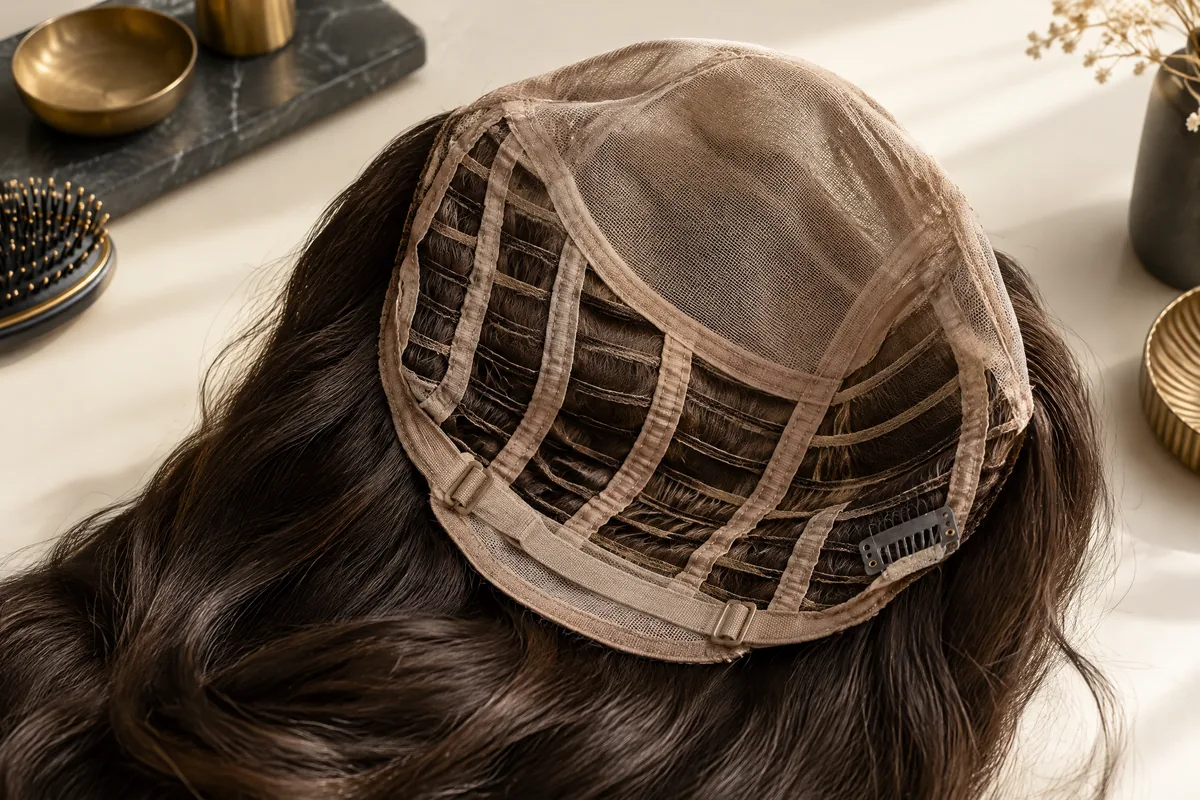
Before lifting any hair, find the rear and side edges of your topper in its normal wearing position. Use a second mirror or ask someone to look from behind. Identify the attachment points using the maker's diagram. Do not slide a pointed comb underneath the base to find them; an uncertain boundary is a reason to pause the styling attempt.
Now separate three things: the edge of the base against your head, the hair falling over that edge, and the place where the gathered bundle would be tied. These may overlap in a finished hairstyle, but they should not be treated as one structure. A tie can look neatly hidden while still pressing against a rear clip or bending the perimeter.
For this exercise, clearance means the tie does not press on the base or attachments, the base remains flat, and loose hair still covers the transition. There is no universal finger-width gap. A tie well below the edge can still pull it through a taut bundle; a smaller visual gap may be workable when the hair hangs freely. Judge the whole arrangement.
Give the loose covering hair a role before gathering anything. Leave a layer down around each side and behind the base. Avoid borrowing that entire layer to make the tied section look fuller. The half-up effect comes from moving selected hair, not from lifting every strand that currently keeps the topper's perimeter discreet.
Choose a modest half-up shape, not a tight crown ponytail
The starting shape is two small side sections meeting gently towards the back, with the lower lengths left down. Keep the gathering point low enough that the hair does not need to be pulled sharply upwards. A high crown ponytail asks more of the attachment and exposes different areas. It is a separate styling decision, not simply the same arrangement tied higher.
Repeated pulling from tight hairstyles can damage natural hair. The American Academy of Dermatology advises loosening styles so they do not pull and says that a painful hairstyle is too tight. That is a useful boundary here: extra tension is not a sensible way to make a loose topper arrangement look more secure. 1
This trial is for a removable topper whose instructions permit the proposed handling. With a clip-in design, distinguish the fastening clips under the base from a styling accessory on the hair. The latter should hold the chosen bundle, not act as another anchor for the topper. Do not add pins through the base or improvise attachments to rescue the shape.
Have the normal removal instructions nearby, along with a mirror and a lightweight, smooth accessory suitable for the hair. Choose something you can open or unwind rather than drag down the lengths. Set aside a large claw clip if its jaws would close across the base. A smaller accessory is not automatically better if it grips too tightly.
Build the arrangement in a reversible sequence
Hold the bundle before adding the tie
Begin with the topper secured as directed and the hair falling in its ordinary style. Gently separate a small section on each side while leaving the covering layer in place. Bring the sections towards your proposed meeting point with your hand. If short layers only reach when stretched, let them fall and choose a smaller or lower arrangement.
Keep holding the bundle without fastening it. Look at both side edges and the rear perimeter. Release your hand and compare the hair-down view with the gathered view. A line that appears only when you gather tells you that the movement removes coverage or changes the base position. This is more useful than immediately hiding that line with another accessory.
Reduce one variable at a time. First try less hair; then try a lower meeting point. Keep the original coverage position of the topper. Do not move the whole piece backwards simply to clear a tie if doing so leaves the intended parting or crown area uncovered. When neither adjustment works, the loose version is the better result for that piece.
Fasten lightly and check the layers again
If the hand-held version remains flat and covered, fasten the selected hair without cinching it against your head. Check that the tie captures hair only. The base edge, fastening clips and covering layer should not be trapped inside the accessory. Resist pulling the two sides of the tail apart to tighten it, as you might with an ordinary ponytail.
Let the bundle settle, then turn your head normally and look down as you would when reading a menu. Check the rear with the second mirror. You are looking for a change in coverage or attachment position, not testing how much force the piece can withstand. If movement reveals a problem, undo the accessory and return to the previous loose arrangement.
Read the result instead of tightening the tie
A useful half-up result need not be symmetrical to the last strand. One side may need a slightly smaller section to preserve coverage. What matters is whether the arrangement stays comfortable and the base transition remains discreet during ordinary movement. Use the observations below to choose a specific change rather than repeatedly adding more grip.
| What you notice | What the arrangement may be doing | Try next |
|---|---|---|
| Rear edge appears only when gathered | The covering layer is being lifted | Leave that layer down and gather less |
| Base rises towards the tie | The bundle is drawing the piece backwards or upwards | Release it; retry lower only if the base stays flat |
| Accessory sits against a fastening clip | Tie and attachment occupy the same space | Choose another meeting point or leave hair loose |
| Short strands need stretching to join | The chosen section does not reach freely | Exclude those strands or use a smaller side sweep |
| One clip area feels uncomfortable | The gathering may be loading that attachment | Undo the style; reassess the fit before another attempt |
Pain or stinging is a stop signal, even when the style looks attractive. The AAD recommends changing a hairstyle immediately when these occur. Do not wait for visible redness or try to tolerate discomfort through a weekend outing. Remove the styling tension, and address persistent discomfort rather than treating it as the normal price of wearing a hairpiece. 1
For example, imagine a shoulder-length topper worn with shorter natural layers near the ears. A large side sweep may pull those layers out of the edge-covering position. Gathering only the longer upper strands might leave the sides covered, but produce a smaller tail. That is a clear trade-off: keep a modest half-up effect or choose a different piece, rather than force a fuller tail.
Compare toppers and full wigs by the edge your style reveals
A topper leaves surrounding natural hair in the finished look, while a full wig supplies whole-head coverage. Half-up styling changes which transitions you see. With a topper, examine the partial base perimeter and its blend into your hair. With a full wig, examine the front, sides and nape that the sweep exposes. Neither category makes every updo possible.
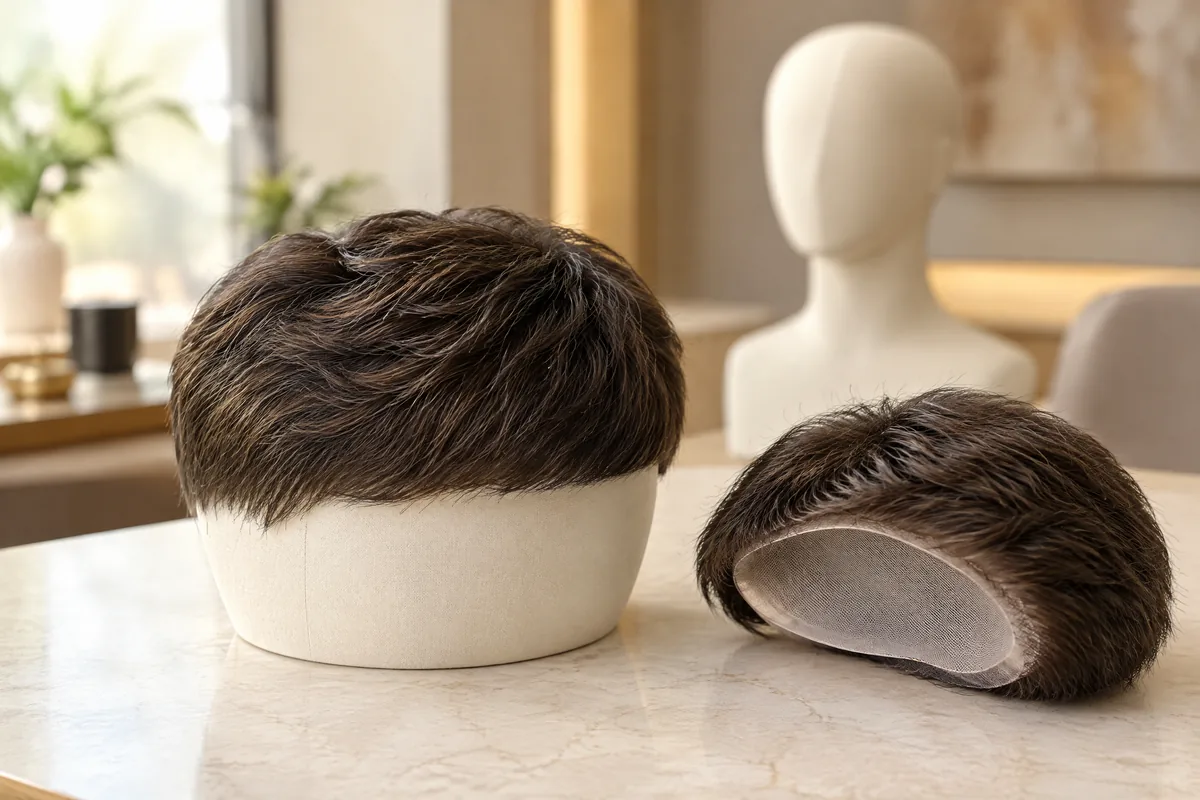
OWNSTRAND's hair toppers catalogue illustrates why base size and hair length must be considered separately. Amore Diamond Topper is listed with a 5-by-3-inch monofilament base, a 5-inch front length and 12-inch side length. Long Mono TP is listed with a 5.25-by-5.75-inch base and 18-inch hair. These figures describe different footprints and lengths, not permission to tie either model up.
A larger base may provide the coverage you want but occupy the area where you hoped to place a tie. Longer hair may reach the meeting point more easily, yet still lift the covering layer when gathered. Do not choose the smallest base solely to accommodate the hairstyle: the uncovered area does not become less important because the tail looks better.
| Desired look | Topper question | Full-wig question | Likely compromise |
|---|---|---|---|
| Small, low half-up bundle | Can loose hair cover the side and rear base edges? | Do the swept sections reveal cap edges? | Use a smaller bundle |
| Both sides swept away from the face | Is the front transition meant to be exposed? | Does this exact front construction support that look? | Keep face-framing strands down |
| Higher half-up ponytail | Does lifting uncover the rear footprint or pull clips? | What happens at the sides and nape? | Lower the tie or change the design |
| Very little blending with natural hair | Can the partial piece achieve the desired transition? | Is whole-head fit comfortable in the intended shape? | Compare full coverage rather than enlarging the gathered section |
When exploring women's wigs at OWNSTRAND, ask to compare the exact swept-back shape rather than only a hair-down photograph. A full wig removes the partial topper-to-natural-hair blend across the crown, but it has its own perimeter. A lace-front description concerns the front; it does not establish that the sides or nape can be exposed in a high tied style.
Keep material care separate from base clearance
Heat is not a solution to a tie pressing against the base. Macmillan notes that wigs come with care instructions and that blended hair can need special care because synthetic fibres may stretch or frizz under hairdryers or straighteners. Follow the exact piece's directions instead of using heat to flatten a raised edge or force short layers into the bundle. 2
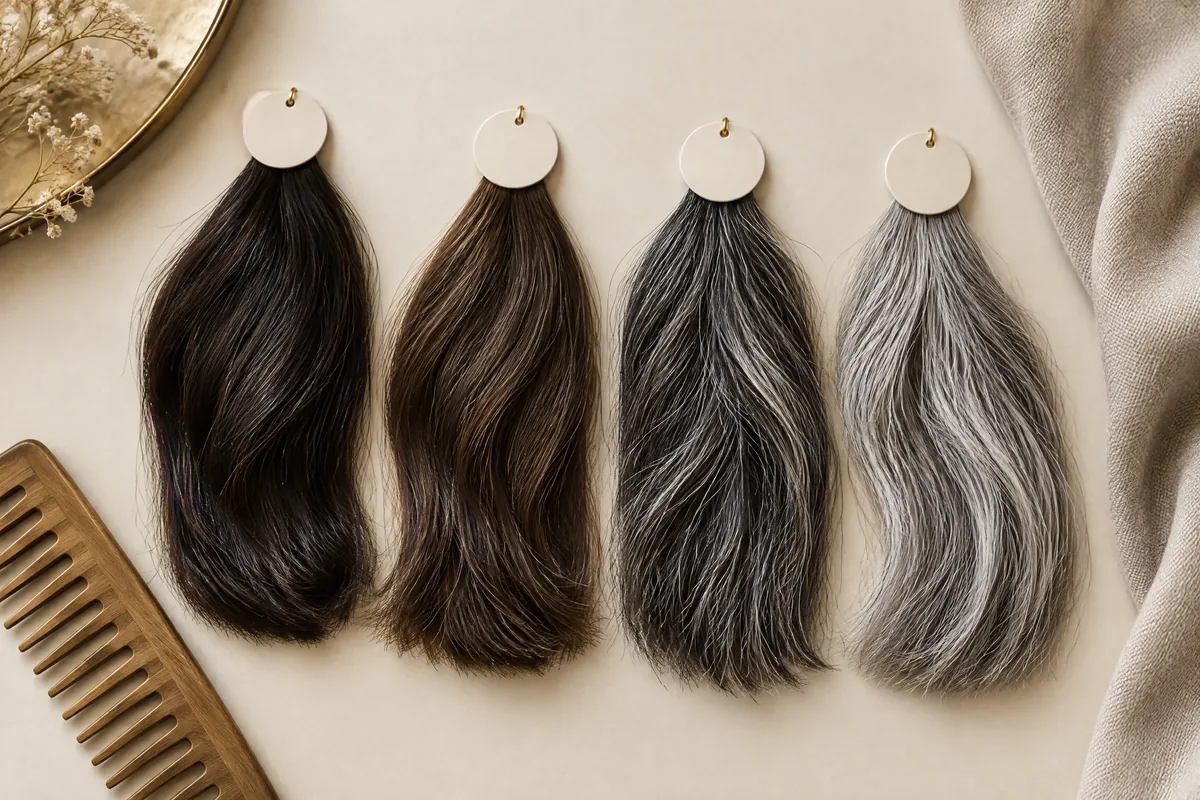
If you are considering a human hair topper, ask about its fibre, attachment and permitted styling separately. The category does not establish Remy status or automatic colouring and heat permission. OWNSTRAND's guidance makes those distinctions explicit. Human hair may be relevant to your preferred texture, but it cannot compensate for a base that conflicts with the gathering point.
Keep the first trial free of heat, cutting and heavy product. This preserves the option to let everything fall back into its original shape. If the loose half-up version works but the ends need a different finish, discuss that finish under the maker's care directions afterwards. Solve the arrangement before making changes that are harder to reverse.
Plan the release before leaving home
For a compatible removable clip-in topper, the principle is to release the hairstyle before releasing the attachment. A tied bundle can hide a clip and keep strands under tension as you try to open it. Give yourself enough light and a mirror for removal. Do not start by lifting the whole topper away from your head while the hair is still gathered.
- Support the gathered hair with one hand so it does not hang against the attachment.
- Open or unwind the styling accessory; do not slide a tight elastic down the bundle.
- Let the gathered sections fall and gently free any crossed or caught strands.
- Locate the topper's fastening clips and open them in the exact model's instructed sequence.
- Confirm every attachment is released before lifting the piece away, following its removal directions.
There is no universal front-first or back-first clip rule for every model. If a strand catches, stop lifting and find the catch; do not pull the piece to free it. Bonded or other attachment systems require their own removal method. The half-up release exercise is not a reason to experiment with an unfamiliar fastening system.
Take one workable version into the weekend
For a lunch outing followed by shopping, try the final arrangement with the bag and outerwear you intend to use. Check whether a shoulder strap brushes the loose lengths or a collar nudges the accessory upwards. If you expect to change clothes, a front-opening layer avoids dragging a neckline over the finished hair. Practical contact matters as much as the mirror view.
Record the useful details in plain language: which side sections were gathered, which layers stayed down, where the tie sat, and what you undid first. Add a rear-view photograph for your own reference if helpful. Keep the hair-down version available as the fallback. A style that you can comfortably release is more useful than one that requires constant tightening.
For an OWNSTRAND enquiry, bring the intended half-up shape and your observations, not just a request for a longer piece. Ask about that model's base, attachment and styling directions, as well as quotation and supply. Its sole location is Unit 2103, 利寶時中心, 50 Hoi Yuen Road, Kwun Tong. District guides do not represent other branches; agree any visit arrangements directly.
Questions & answers
Can I add a ribbon bow to the half-up bundle?
A lightweight bow may be an option if the attachment can be opened easily and stays on the hair rather than pressing against the base. Check the fastening beneath the decoration: an attractive ribbon can conceal a bulky or tight clip.
Should I leave the half-up arrangement tied during storage?
Undo the styling accessory and store the piece according to its maker's directions. Keeping the arrangement tied makes it harder to see caught strands or attachment problems before the next wear. Do not rely on a stored ponytail to reproduce the fit.
Would cutting the natural side layers improve the blend?
Not necessarily. Those layers may provide the coverage you need around the base. Discuss the proposed half-up and hair-down looks together before cutting; a length that suits one arrangement may leave an edge exposed in the other.
Is a monofilament base automatically suitable for tying up?
No. That construction description does not specify the tie position, perimeter coverage, attachment or length. Swiss mesh should not be treated as an interchangeable name for monofilament or lace either. Evaluate the exact design in the intended shape.
Can I practise the hand-held gathering on a topper I have not bought?
Ask the seller what handling or demonstration is available for that exact piece before touching or fastening it. A catalogue photograph is not permission to style a sample, and a viewing arrangement does not imply a free trial or confirmed supply.
Put the next step into practice
Build a clearer understanding of hair shape and everyday styling through learning at Canvas. Hair styling courses in Hong Kong。
Explore more practical styling and selection notes. Canvas hair and beauty journal。
Tell the team which hair styling techniques you would like to learn. Contact Canvas Academy。
Sources & further reading
- American Academy of Dermatology — Hairstyles that pull can lead to hair loss
Explains why repeated tight styling can damage hair, recommends loosening pulling styles, and identifies pain and scalp stinging as reasons to change the hairstyle.
- Macmillan Cancer Support — Wigs for cancer treatment
Offers general guidance on wig fibres and care, including following the supplied instructions and recognising heat-related care limits for synthetic and blended hair.