A sample is a starting point, not the finished specification
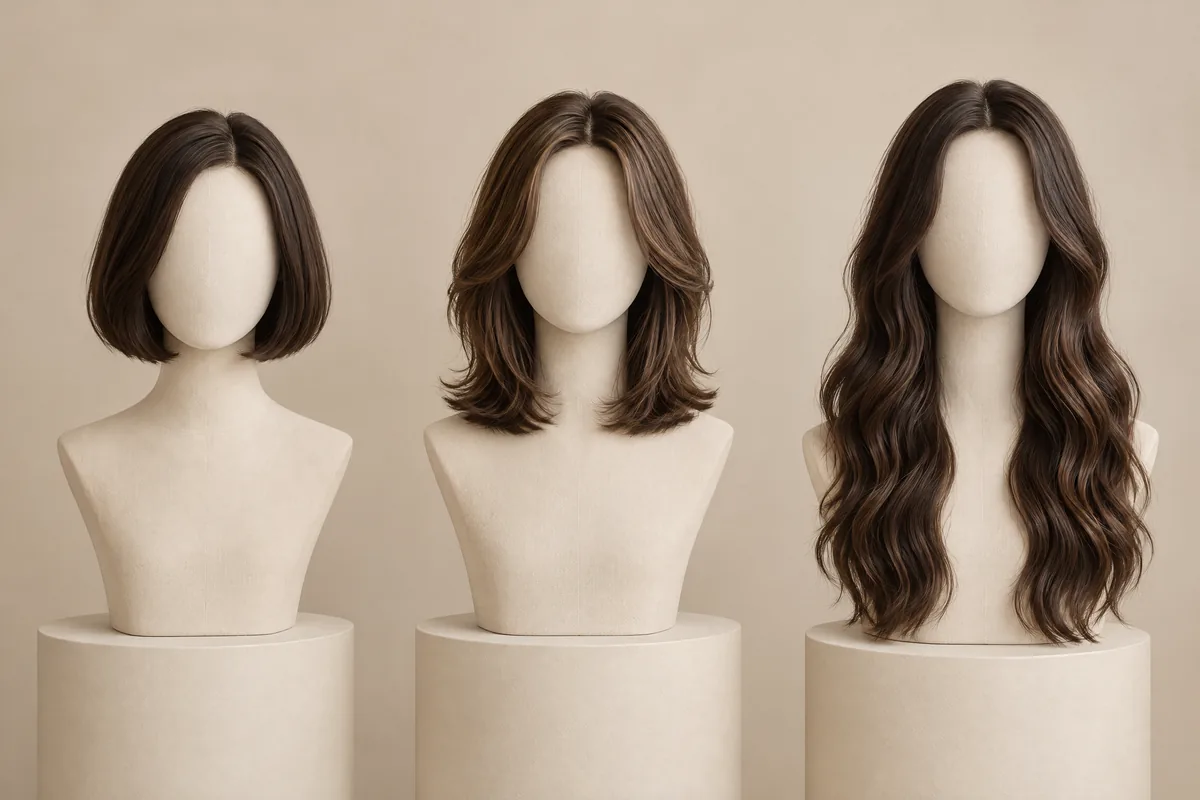
A showroom wig can look convincing because its fringe, parting and volume are already arranged. Your order may use a different colour, a measured base or a shorter finish. Those decisions change what you should expect at collection. A useful comparison asks whether the agreed details have been delivered, not whether every strand falls like the display piece.
When exploring wigs Hong Kong, save the model name and colour option separately from the image. OWNSTRAND's catalogue includes different fibres and constructions, with quotations and availability handled by enquiry. A catalogue model and a handmade custom human-hair order need different descriptions: one identifies a manufacturer's item; the other needs its agreed design written down.
Distinguish a feature you want to keep from one you want changed. You might like the sample's soft side outline but want a longer fringe and less crown lift. Writing only “same as sample, more natural” leaves these intentions unresolved. Write the retained features first, then the changes. This gives the fitting conversation a stable starting point.
Build the card while the sample is still in front of you
OWNSTRAND's wig shop Kwun Tong information describes sample viewing, head measurements for handmade human-hair work and a return fitting with washing, cutting and blow-drying. Its only salon is Unit 2103, 50 Hoi Yuen Road, Kwun Tong, Hong Kong (利寶時中心). Contact the salon before travelling to arrange your visit.
Use a phone note or a paper card that you can show without searching through a long message thread. The table below is a suggested personal record, not a form supplied by the shop. Fill it in during the discussion while the sample and colour reference are available, then ask the person handling your order to check the wording.
| Card field | What to record | Why it belongs on the card |
|---|---|---|
| Sample reference | Model or sample identifier; photo only with permission | Keeps the starting shape identifiable |
| Actual order | Catalogue brand/model or agreed custom design; fibre and base | Separates the display piece from what is being made or supplied |
| Chosen colour | Full colour name/code, or agreed custom tone and grey proportion | Avoids using “brown” for several different options |
| Keep unchanged | Parting direction, side outline or other retained features | Protects the details that attracted you |
| Proposed alterations | Area, desired result and whether cutting is authorised | Turns a vague preference into a specific action |
| Service scope | Included fitting/styling steps, charges and follow-up terms discussed | Keeps service expectations beside the design |
| Revision status | Requested, agreed, completed or still unresolved | Shows which version everyone is using |
Treat unfinished decisions honestly. “Colour to be selected” is better than a guessed code; “fringe length to be judged when worn” is better than premature cutting permission. Before leaving, make sure the card identifies the order clearly enough that someone could understand it without remembering the entire appointment. It need not contain every detail of the conversation.
Give each alteration the right category
Use three simple labels: L for fibre length, F for cap fit and S for styling. The labels describe the action, not just the complaint. “The fringe touches my glasses” is an observation. Moving the cap into its intended position is F; trimming the fringe is L; redirecting it to the side is S. These are not interchangeable remedies.
Cap fit comes before the haircut
Ask the fitter to establish the intended front position, side alignment and fastening arrangement before assessing the hair. Record the wearing setup, including any liner or other accessory actually used. The American Cancer Society notes that wig sizing can vary between brands and recommends checking the relevant size chart; a familiar size label alone is not a complete fit check.1
If the front is sitting too low, the fringe may appear longer than intended. Cutting it immediately can hide that positioning problem until the next wear. First ask the fitter to assess placement and fit, then look again. Likewise, a cap that shifts when you turn your head should be discussed as a fit concern before changing the side length.
Separate cutting from an arranged finish
A fringe can look shorter when swept sideways, and crown hair can look fuller after styling. Those observations do not necessarily mean the fibres changed length or density. Ask what action is proposed and what it will leave behind. Record “side-sweep demonstrated” as S and “fringe shortened at centre” as L rather than writing both as “fringe fixed”.
The distinction matters after washing. Macmillan explains that conventional synthetic wigs have their style heat-sealed into the hair, while human-hair wigs may need regular cleaning and styling. It also notes that wigs can be cut and styled by a hairdresser or wig consultant.2 For the particular piece, ask what finish you can reproduce with its prescribed care routine.
Keep colour and construction outside the haircut discussion
The L/F/S labels do not cover every possible discrepancy. If the colour or base differs from the order, record that separately as a specification issue. Do not allow “styling adjustment” to become a catch-all answer. A different parting appearance may concern construction; a darker shade may concern colour. Neither should be resolved by cutting merely because scissors are available.
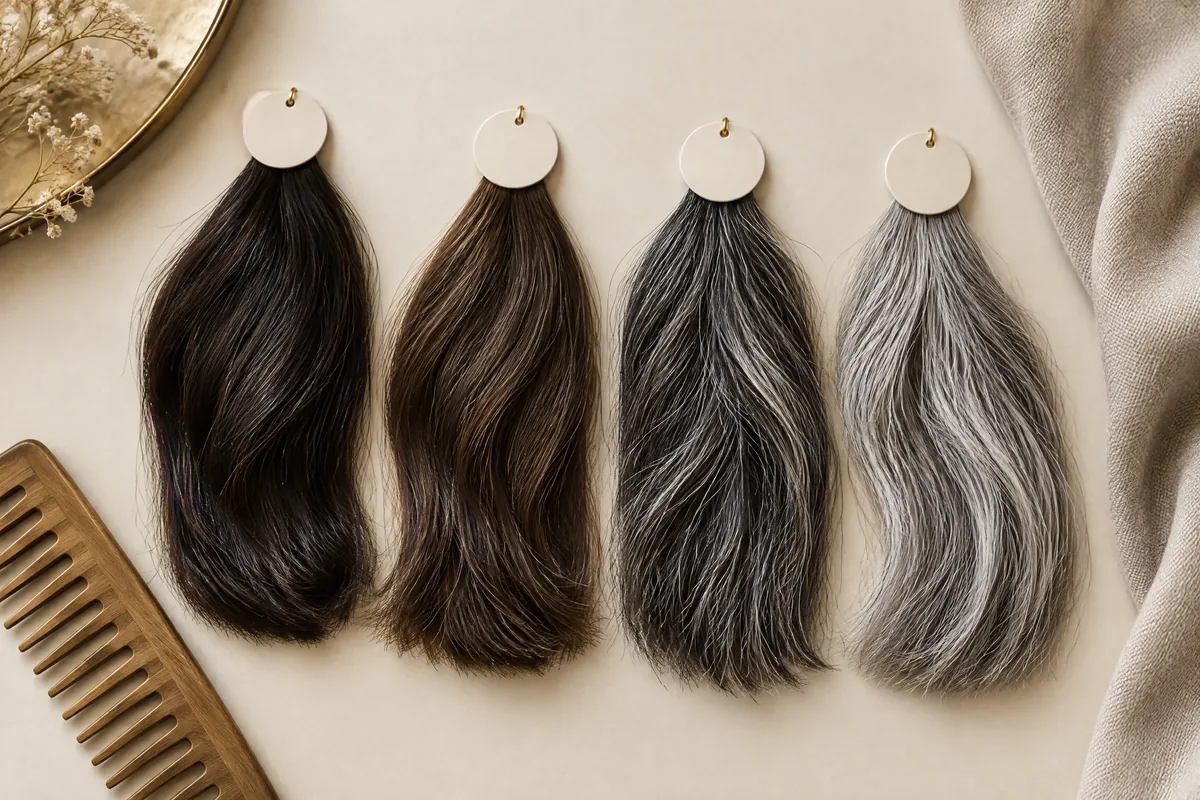
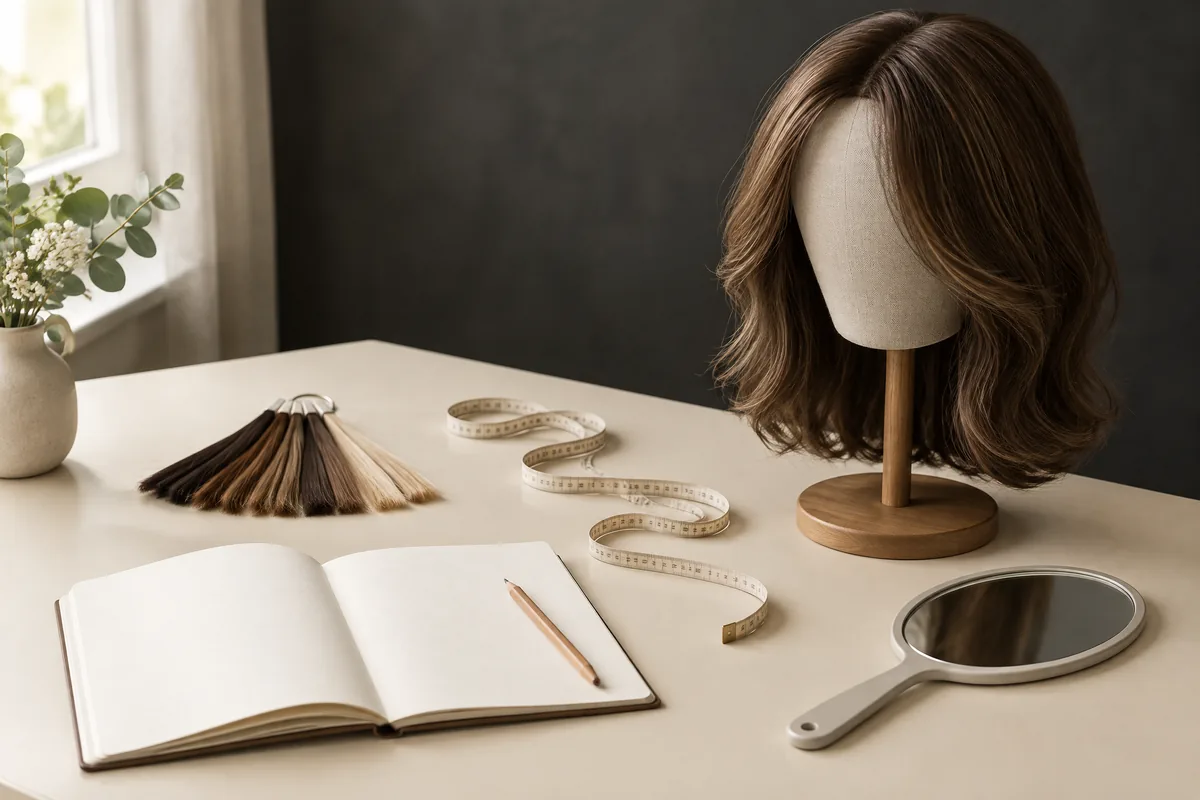
For colour, keep the selected code or physical reference as the main comparison. The American Cancer Society recommends comparing hair and wig swatches in natural light.1 A phone picture helps identify which reference was discussed, but do not use an uncalibrated screen as the sole shade standard. Ask to compare the actual piece with the chosen reference where practicable.
If you agreed a grey proportion, note the overall intention and any placement discussion, not only the percentage. “Retain visible grey near the front” communicates something that a number alone may miss. Ask how that request will be represented in the finished piece. A sample chosen for its shape is not automatically the reference for its colour or grey distribution.
Write the agreed base name without translating it into another construction. For example, OWNSTRAND's local 瑞士網 description should not be relabelled as lace-front or monofilament on your card. For a manufacturer's model, retain its stated construction. Consistent naming makes it easier to spot an actual change instead of creating a disagreement through different labels for the order.
Check the piece in an order that avoids unnecessary cutting
Bring the card, your usual glasses and any wearing accessory agreed for the fitting. Ask to compare the piece before additional cutting where practical. If washing or styling is part of the appointment, distinguish the initial assessment from the finished assessment. “Before styling” and “after styling” notes prevent one impression from replacing the other without explanation.
Work through this sequence rather than starting with the most eye-catching strand:
- Identify the order and compare its colour and stated construction with the card.
- Ask the fitter to establish placement, fit and the intended wearing setup.
- View the front, sides and back with your head in a normal position.
- Check the agreed length and outline before approving another trim.
- Assess the styled finish and ask for a repeatable routine.
- Mark completed changes and leave unresolved points visible.
| Collection observation | First question to resolve | Card entry after assessment |
|---|---|---|
| Fringe touches glasses | Is the cap in its intended position? | F if placement changed; L only if a trim was agreed |
| Crown appears too high | Is this styling lift or a different density/shape? | S for arranging it flatter; separate any proposed thinning |
| One side seems longer | Are placement, parting and head position consistent? | Record the cause before authorising L |
| Colour looks unlike the reference | Is this the agreed code or custom tone? | Specification issue, not an L/F/S shortcut |
| Piece shifts during a normal head turn | Is the fitting or fastening setup appropriate? | F, with the adjustment and outcome described |
| Finish looks right only after blow-drying | What routine and tools reproduce it? | S, with instructions for this fibre |
Compare in ordinary movements as well as a still mirror view. Turn your head, put your glasses on and look down naturally, with the fitter's guidance. These checks are useful observations, not guarantees of all-day comfort. Record an unresolved feeling precisely: “pressure at right side while wearing glasses” gives a better next discussion than “it feels wrong”.
Authorise changes one step at a time
Before any trim, ask the stylist to show the proposed boundary on the worn piece. Agree the area and intended result, not merely a quantity to remove. “Keep the side long enough to tuck behind my ear” is a functional requirement; “take a little off” is not. If that function conflicts with the desired shape, choose which matters more before cutting.
Where you are uncertain, agree a conservative first stage and reassess. Leaving more length preserves choices but may leave extra bulk or a less tidy outline for now. A shorter finish can simplify the look but gives fewer styling options. Cutting removes fibre that cannot grow back; ask about alternatives before treating a temporary styling preference as a permanent length decision.
Keep thinning separate within the length/shape notes because it removes hair rather than just redirecting it. Ask where thinning is proposed, how it supports the agreed outline and whether styling alone could address the concern. Once the action is completed, replace “less bulky” with a factual entry describing what was changed and whether the result now meets your preference.
Use a short read-back before moving to the next area: “The front position is settled; the fringe is still longer than agreed; I want the centre trimmed, with the sides retained.” That sentence separates the cause from the permission. If you change your mind about the original specification, mark it as a new request rather than a correction owed automatically.
Two everyday situations show why the categories matter
Consider a hypothetical wearer who chose a bob sample for its jaw-level outline but requested longer sides for ear-tucking. At collection, the piece is not identical to the sample, yet that difference may fulfil the order. If the card says “retain ear-tucking length”, compare against that requirement. Copying the sample's shorter side could remove the very feature requested.
Suppose one side looks too long only after the hair is swept across from the opposite side. First restore the agreed parting and check the fit. If the outline then matches the card, the issue was arrangement rather than excess fibre. If it remains longer than agreed, ask the stylist to show a proposed trim and record the decision as L.
Now consider a hypothetical wearer who wants a neat fringe with glasses and little morning styling. The collection finish looks suitable after a pronounced side-sweep, but the wearer normally lets the fringe fall forward. Ask to view that everyday arrangement before approving the result. The choice may be between retaining length for sweeping and shortening it for the usual routine.
Neither preference is inherently better. Longer fibres offer options; a more fixed outline can reduce the need to arrange them. Ask for the practical trade-off on the exact piece. If maintaining the desired finish requires tools you will not use, discuss a different finish before collection rather than approving a salon-only look and hoping it remains unchanged at home.
Leave with a usable final record, not just a photograph
The service information for wig shop Hong Kong describes an enquiry-led process, including quotations and supply checks. Use your card to record which fitting and finishing steps apply to your particular order. Ask separately about further adjustments, their charges and any return terms; your personal card documents the conversation but does not create a shop policy.
At handover, keep the original specification visible and add the finished version below it. Note the final parting, wearing position and completed L/F/S changes. If a point needs another discussion, record who you should contact and the next action agreed. A final photograph can support these notes with permission, but it should not replace the written colour and construction details.
Ask for the care instructions for the exact fibre and product. The American Cancer Society warns against using a dryer or curling iron unless a wig is heat-resistant.1 Do not infer safe temperatures from the display finish, a generic “human hair” description or another model. Follow the manufacturer's instructions and ask which tools, products and techniques are suitable for yours.
Before leaving, explain the wearing steps back to the fitter and ask for another demonstration if a step remains unclear. Store the card with the care instructions and order record. That way, a future question can start with a specific change and its outcome, rather than trying to reconstruct what the showroom sample looked like weeks earlier.
Questions & answers
Can I make a change card if the showroom sample has no model number?
Ask for whatever identifier the salon uses. With permission, pair a sample photograph with a written description of its shape, fibre and base. Do not invent a model number or substitute a similar catalogue item.
Should I ask to take a colour swatch home?
Ask whether one is available and whether it can be borrowed or purchased; access is not guaranteed. If it stays at the salon, retain the exact colour reference and ask how it can be compared at collection.
What if a family member prefers a different final cut?
Their opinion can help, but separate it from your own wearing priorities. Do not authorise a new cut simply to resolve competing opinions. Decide whether the suggestion fits your daily routine before revising the agreed design.
Can I add a new request after the order has started?
Contact the salon promptly with the exact request. Ask whether it remains possible and affects cost or timing. Keep the existing specification until the revised version is agreed; a sent message alone does not confirm the change.
Is it better to save fitting notes on paper or on my phone?
Choose whichever you can retrieve and share easily. Keep one clearly marked latest version. If you use both, update them together so an older paper note does not conflict with a newer phone instruction.
Put the next step into practice
Build a clearer understanding of hair shape and everyday styling through learning at Canvas. Hair styling courses in Hong Kong。
Explore more practical styling and selection notes. Canvas hair and beauty journal。
Tell the team which hair styling techniques you would like to learn. Contact Canvas Academy。
Sources & further reading
- American Cancer Society: Wigs for Hair Loss
Practical guidance on comparing colour in natural light, checking brand-specific sizing, professional trimming and heat precautions.
- Macmillan Cancer Support: Wigs for cancer treatment
Explains differences in synthetic and human-hair styling and care, including how a hairdresser or wig consultant can adjust a wig's finish.