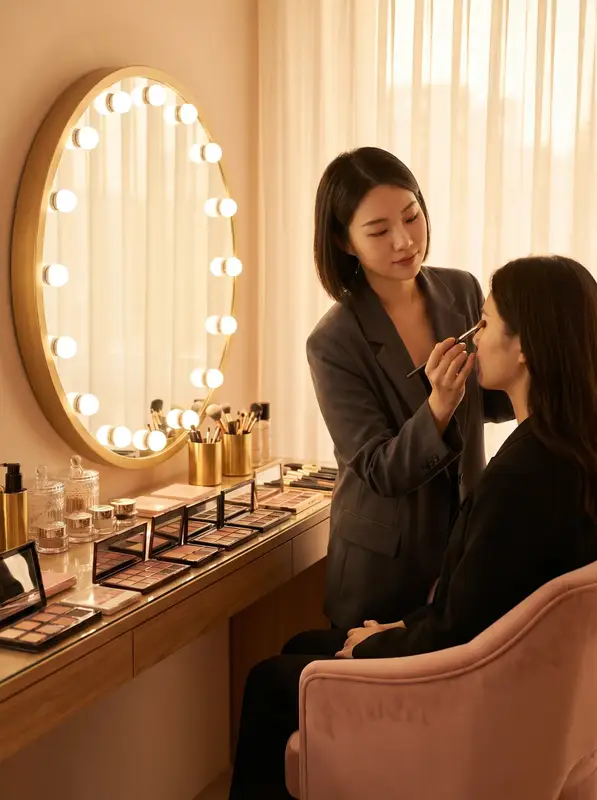
Make one outcome do the organising work
"A group does not need to agree on a complete beauty routine. It needs one shared result that can be recognised at the end. Describe a skill, not a vague feeling: ‘Everyone can create a five-minute polished base for a video call’ is workable. ‘We want to feel more confident’ is a welcome reason to meet, but gives a tutor little help in choosing techniques or pace.
"Write the outcome in one sentence and add a boundary: ‘Participants will practise a simple daytime base, brows and lip colour; this is not an advanced eye-look class.’ A boundary protects practice time while allowing different faces, preferences and starting points.
Choose the outcome from the occasion. Friends before dinner might prioritise a day-to-evening adjustment. A team preparing for staff portraits may need camera-aware base placement. A workplace session can offer optional, practical self-presentation skills. Never assume every colleague wants the same degree of participation.
If you are comparing possible group formats after defining that one outcome, the makeup workshop Hong Kong guide describes the practical distinction between a demonstration, hands-on stations and guided practice. Treat it as a prompt for questions, rather than assuming a particular format, duration, kit or venue is included.
Profile the room, not just the headcount
"A number alone does not tell a facilitator how to teach. Ten beginners with mirrors and a shared objective are a different session from ten people with widely different routines. Give a range if attendance may move: ‘12 confirmed, up to 16’ is more useful than a fixed guess. Name the person who can decide on the day.
"Ask three short questions: how often do they wear makeup; what technique do they want to practise; and is there a product, ingredient, access need or skin concern to pass on privately? These answers do not diagnose anyone or promise custom products. They show where pace and optional variations matter.
"Keep personal information proportionate. A facilitator may need to know about a known allergy or a seated, step-free position, not a detailed medical history. Invite private, optional replies and aggregate them for the brief. At work, avoid attaching names to cosmetic preferences without a clear operational reason.
A simple way to describe mixed ability
Use bands rather than labels such as ‘good’ or ‘bad’ at makeup. For example, say that eight people are new to base makeup, four are comfortable with it but want help with brows, and two plan to observe. This gives the instructor a logical core demonstration and tells the host where optional extension tasks may be needed. It also makes observers legitimate participants rather than late additions to the plan.
Choose the format by practice, not by aspiration
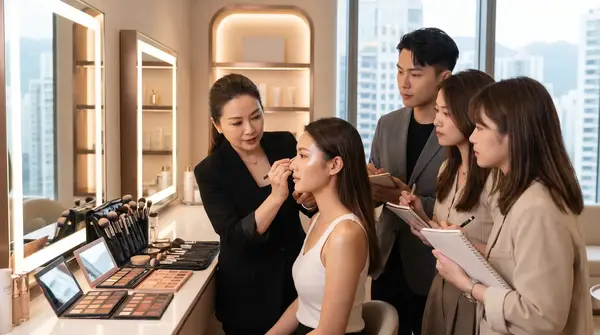
"There are three honest choices. A demonstration with questions can suit a large room or short staff event, but does not prove each person can reproduce a technique. A hands-on session provides feedback during application but needs mirrors, surfaces, cleaning and time. A hybrid starts with a shared demonstration and reserves a defined practice block.
"The trade-off is clear: more individual correction requires fewer people, more equipment or more time. Do not call a watch-only session hands-on. State the desired split, such as ‘one third demonstration and two thirds practice’. It is a request to check, not a schedule promised before confirmation.
For an employer, a short voluntary session can work when the objective is narrow and inclusive. A corporate beauty workshop may be planned around a lunch-hour demonstration or a longer practical format after headcount, language and venue details are confirmed in writing. The host should ask whether time for set-up and clean-down sits inside the staff-facing session or outside it.
Example: a three-part practical session
This is an illustrative plan, not a provider timetable. In a 120-minute small-group session, allow 15 minutes for arrival and hygiene set-up, 25 for a core demonstration, 55 for guided practice, 15 for troubleshooting and 10 for cleaning and packing. For a second look, cut the technique list or add a session; do not take practice minutes away.
Inspect the venue before it becomes a problem
"A beautiful event room can still be a poor practice room. Check it in person or through current photographs and venue staff. Record the room, access time, tables, chairs, plugs, mirrors, hand-washing access, loading restrictions and room contact. ‘Central office’ or ‘studio preferred’ is not enough.
"Describe whether there is window light, overhead light only, or space for safe portable lights. Ask whether blinds can be adjusted and whether the lighting distorts complexion matching. The goal is enough even light to see blending and colour while practising.
Add the room’s ventilation to the check. The US CDC explains that ventilation brings in outdoor air, moves and dilutes indoor air, and can include filtration; increasing clean air can reduce exposure to airborne hazards in indoor spaces. See its concise guidance on ventilation and respiratory viruses. For a workshop, this means asking the venue how fresh air is provided, whether windows can open where appropriate, and how a crowded room will be kept comfortable. It is a sensible venue question, not a promise that ventilation alone removes all risk.
| Venue question | What the host should record | Why it changes the plan |
|---|---|---|
| Arrival and access | Earliest entry, lift, loading rule and room contact | Determines realistic set-up time and equipment route |
| Work surfaces | Number, size and layout of tables and chairs | Decides whether each participant can practise safely and comfortably |
| Mirrors and light | Quantity of mirrors; window, overhead and portable-light conditions | Affects station count and ability to judge application |
| Water, power and waste | Hand-washing point, sockets, bins and cleaning access | Supports hygiene, lighting and clean-down arrangements |
| Air and comfort | Ventilation method, temperature control and room capacity | Helps avoid an unnecessarily cramped, uncomfortable session |
Agree a product and hygiene plan early
"Decide which products participants bring, what the facilitator may supply and what is single-use. Personal foundation or concealer can be practical because its shade is familiar. Ask for a kit list, but do not promise brands, shades or supply until confirmed.
"Hygiene needs a visible routine: a hand-cleaning point, clean surfaces, separate personal items, disposable applicators for sampling, and no double-dipping into shared cream or liquid. Set aside a labelled waste container and clean-down time. These choices do not replace following product labels.
The US Food and Drug Administration advises users to wash hands before using cosmetics, not share makeup, keep containers clean and closed, and stop using a product after an unexpected reaction. Its cosmetics safety guidance also advises following the label and its warnings. Put that into the host note: participants should flag known sensitivities early, may bring suitable personal products, and should not be pressed to trial something that makes them uneasy. If redness, burning or another unexpected reaction occurs, stop using that product and follow appropriate professional health advice.
"Do not treat ‘natural’ or ‘hypoallergenic’ as a guarantee. Ask whether someone knows a product suits them and can follow its label. For younger participants, eye-area activities or special-effects materials, use age- and product-appropriate guidance rather than transferring an adult plan unchanged.
Turn constraints into a timed run sheet
"A host can collect the first brief in 30 minutes: ten minutes for outcome and format, ten for people and venue facts, and ten to identify unknowns and send the enquiry. Mark dates, costs, language and product supply ‘to confirm’ if not agreed. That is better than filling a form with assumptions.
Use this order when speaking to a facilitator or venue:
- State the occasion, one learning outcome and whether participation is optional.
- Give the confirmed and maximum headcount, ability bands, age range where relevant, and language preference.
- Name the preferred date options, start and finish window, location and access time.
- Specify demonstration, hands-on or hybrid format and the approximate practice share.
- Provide the venue facts: tables, chairs, mirrors, light, water, power, ventilation and access restrictions.
- Explain the product plan, any privately collected sensitivities and the hygiene approach.
- List questions requiring written confirmation, including scope, staffing, materials, pricing, cancellation terms and exact venue.
A formal enquiry should distinguish a preference from a commitment. The makeup class booking page similarly asks hosts to identify the audience, desired outcome, group size, preferred times and venue district, with final arrangements confirmed in writing. That is a useful final discipline for any provider: do not tell participants details are settled until the written arrangement says so.
Copy this 30-minute host questionnaire
Paste the following into an email or shared planning note. The bracketed answers are examples only; replace them with your own facts.
- Occasion and outcome: [Friends’ evening; practise a simple day-to-evening adjustment.]
- Participation: [Optional; observers welcome.]
- People: [12 confirmed, maximum 15; nine beginners, three occasional users; adult group.]
- Timing: [Two preferred weekday evenings; room access from 18:00; participant session 18:30–20:30.]
- Format: [Hybrid; short demo then most time practising.]
- Language: [English preferred; please confirm whether this is available.]
- Venue: [Meeting room in Kowloon; 15 chairs, six tables, three wall mirrors, windows, nearby washroom, four sockets; lift booking required.]
- Products and access: [Participants bring personal base products; ask for any shared-kit and disposable-item plan; host will privately pass on declared sensitivities and access needs.]
- Need confirmed in writing: [Facilitator, scope, set-up/clean-down, materials, fee, cancellation terms, final venue and attendance limits.]
"This brief lets a provider say yes, no or ‘we need to adjust the format’ quickly. A clear no before booking is safer and less frustrating than a yes that cannot be delivered in the actual room or time.
Questions & answers
Do I need every attendee’s exact skill level before asking for a proposal?
No. A useful estimate is enough at enquiry stage. Give ability bands and say what is uncertain. The facilitator can then suggest whether a core beginner routine, optional extensions or a demonstration-first format is more realistic. Update the count before the written arrangement is final.
What is the smallest useful brief for a workplace lunch hour?
Provide the staff-facing outcome, voluntary-participation approach, headcount range, exact room and time window, preferred language, and whether the group expects a demonstration or practice. A narrow skill is usually more credible than trying to cover a complete routine in a short period.
Can friends share a palette or mascara to make the workshop simpler?
Do not assume this is suitable. The FDA advises not sharing makeup. Ask the facilitator for the agreed hygiene method, use participants’ personal items where suitable, and use single-use applicators or separated portions for any shared product plan.
What if the venue has few mirrors or no sink in the room?
Report that early rather than improvising on arrival. Fewer mirrors may require stations, pairs, a smaller active group or a demonstration-led format. No sink may change the hand-cleaning and clean-down plan. The provider or venue should confirm what is workable.
When should the host confirm the session with participants?
After receiving the written arrangement that settles the essential facts: format, date, time, location, participant limit, materials, payment or cancellation terms and any preparations. Before that, invite interest and communicate that the plan remains provisional.
Put the next step into practice
For the learning options at Canvas, explore makeup course Hong Kong。
For another practical reference, see freelance makeup artist training。
To plan a next step that fits your needs, read makeup course Hong Kong。
Sources & further reading
- Using Cosmetics Safely
FDA consumer guidance supporting the article’s hand-washing, non-sharing, label-reading and stop-use advice.
- Ventilation and Respiratory Viruses
CDC/NIOSH explanation of outdoor air, air movement, dilution and filtration used for venue-planning context.