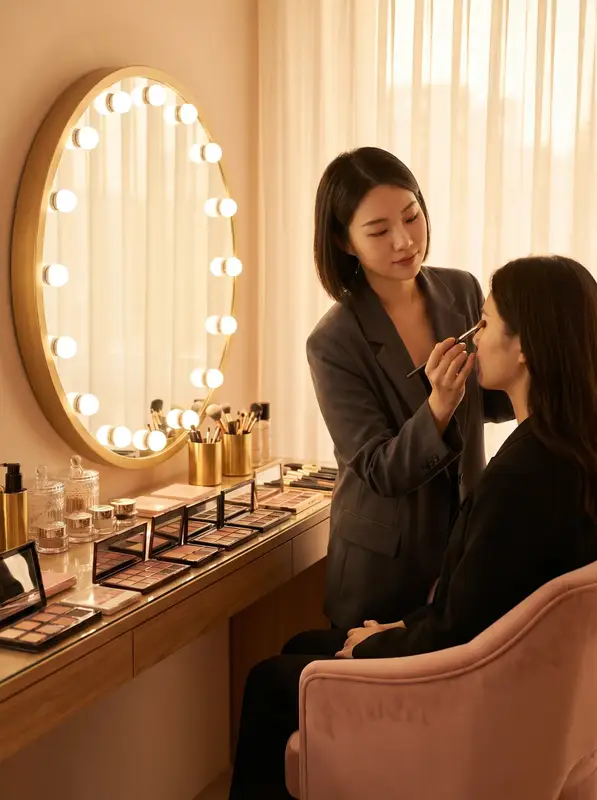
Start with what is missing, not what is trending
Advanced study earns its place when it closes a visible client gap. A striking technique is not automatically your next need. If your grid already proves polished soft-glam complexions but never shows a secure veil or a finished back view, more base-makeup study may be less useful than bridal hair structure.
Review your strongest 12 to 18 images without captions. Can a bride, planner or photographer tell the occasion, finish and your role? Then ask what would make that person hesitate. A portfolio gap is an important outcome that is absent, inconsistent, slow, or unconvincing for the work you want to take.
Define the clients you want to serve
Write three realistic enquiries you would like to receive over the next year: a bride wanting a refined low bun and understated complexion; a bride changing from ceremony veil to evening accessory; or a fashion team needing clean beauty images for a product campaign. Use briefs you could plausibly accept now.
Turn each enquiry into visible deliverables
List outcomes, not course labels. A bridal brief may demand colour matching, correction, a photographic skin finish, a low-bun structure and accessory placement. A fashion brief may need a mood board, a face that reads in a particular light and continuity between images.
This separates makeup detail, hair engineering and image direction; they are not substitutes.
Separate confidence from evidence
For every deliverable, mark it proved, practised but not photographed, slow, or not yet learned. “I think I can do it” is not proof. Move a skill into proved only after an appropriate model, clear photographs from useful angles and a repeatable process within a sensible time limit.
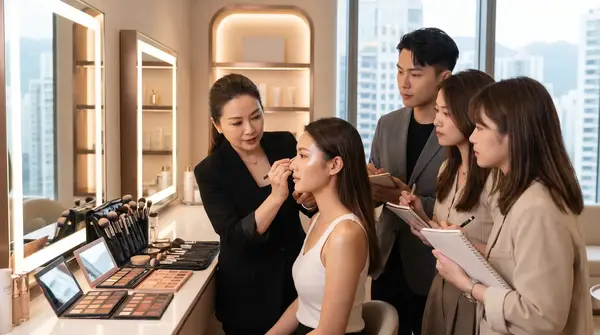
Audit your portfolio with a scorecard
Score each row from 0 to 3: 0 means absent and 3 means consistently clear. Consider repeatability beside visibility. One result is not enough for a wedding-day service.
| Portfolio signal | What a client needs to see | Common hidden weakness | First response |
|---|---|---|---|
| Complexion and feature work | Balanced skin, correction, brows and eyes in close-up | It works only in one light or takes too long | Practise a controlled base-and-feature sequence |
| Finished hair structure | A stable silhouette from front, side and back | Pins or sections show; the shape collapses | Drill sectioning, anchors and finishing |
| Veil or accessory change | Styling remains intact as an item is fitted or removed | The item disrupts hair because it was added too late | Build placement into every practice set |
| Camera and brief literacy | Makeup reads for the intended image | Lighting changes the finish or the look lacks purpose | Run photographed tests against a simple brief |
Do not simply choose the lowest number. Weight the gaps by your intended clients. A makeup artist offering complete bridal services should give hair structure extra weight. An artist joining commercial shoots may gain more from camera awareness and brief interpretation.
Choose focused bridal makeup when face work is the bottleneck
Deeper makeup study fits uneven foundations, uncertain correction, unbalanced close-up features, or trials that cannot become repeatable services. Assess skin and undertone, decide what needs correction, layer deliberately, check the face at normal distance and in photographs, then record the adjustment.
Published information for the bridal makeup advanced course distinguishes concentrated bridal detail work from broader makeup-and-hair coordination, and lists bridal base, correction, brow and eye work within its stated scope. Use this to prompt precise questions about current practice, models, kit requirements and timetable.
If airbrush is decisive, get an answer in writing. Airbrush is not listed in that page’s published inclusions. Clarify whether you need supervised application, equipment handling, cleaning, troubleshooting or only an introduction. Do not make an enrolment decision—or a promise to clients—on an unconfirmed technique.
Choose hair technique when the full bridal look is incomplete
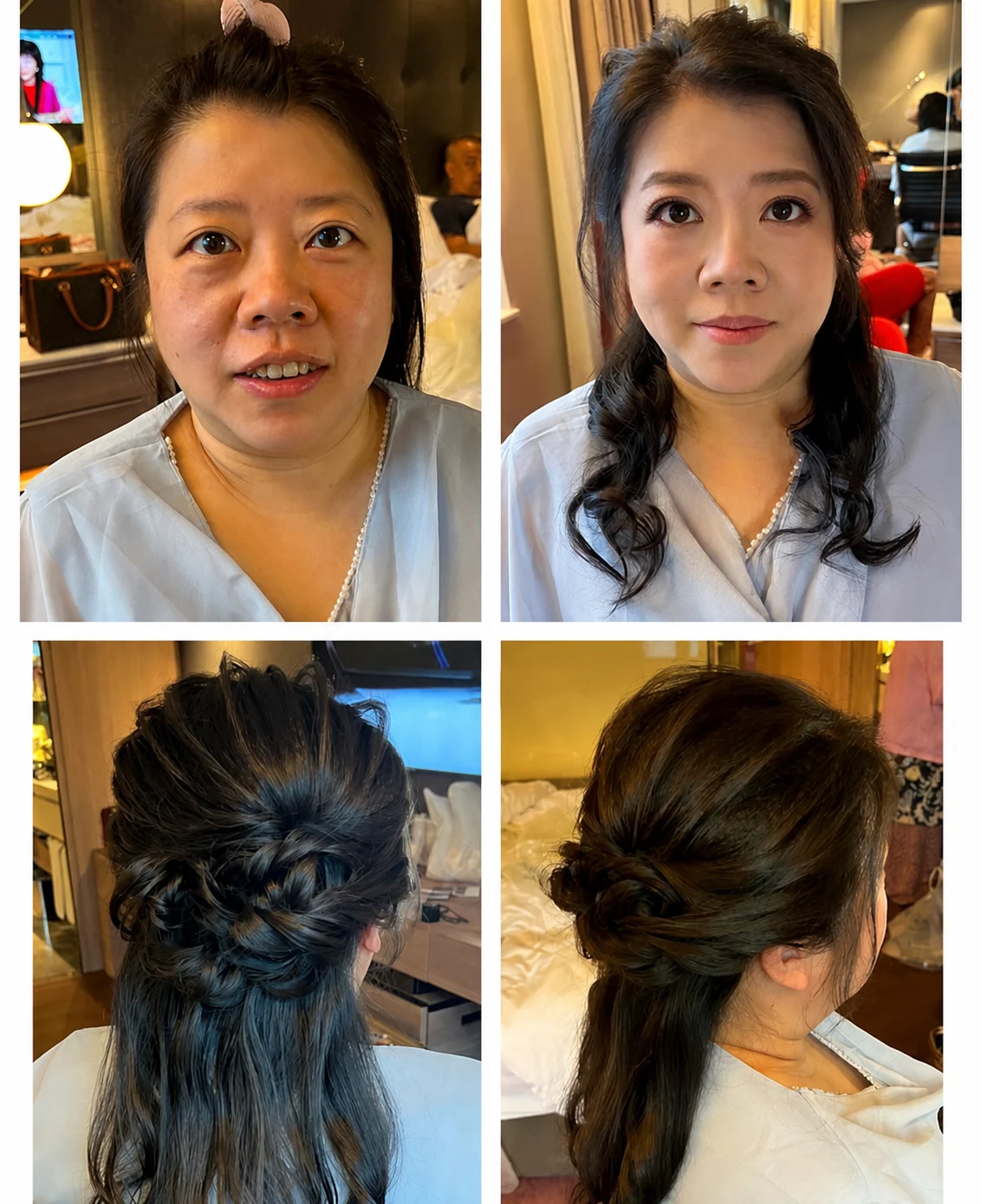
Hair is often the clearest gap for an artist who already creates good faces. A client may like your eye work yet see no evidence that you can produce a balanced rear view, place a veil, or keep an upstyle controlled through movement. One close-up braid is not complete-service evidence.
Prioritise a sequence from sectioning and curl preparation to internal volume, anchors and finishing. A braid may be visible, but its stability depends on what sits beneath it. Photograph the front, both profiles, rear, accessory point and a movement check; those views expose structural weakness.
The published bridal braiding course names sectioning, curling, padding, fixation, updos, braiding, veils and accessories. Bring the finished hairstyles you need and confirm tools, models and practical setup before enrolling.
Example practice plan: use three sessions for one low-bun brief. First make only the internal base and photograph the rear. Next repeat it with the visible surface and accessory. Finally work from a timed reference, remove and refit the accessory, then compare images. This reveals the step needing more practice.
Choose editorial or commercial study for an image-direction gap
Technically tidy application can still look interchangeable, poorly lit or disconnected from wardrobe and purpose. That image-direction gap matters for fashion collaboration and deliberate bridal presentation.
Editorial learning develops concept through colour, texture, silhouette and story. Commercial learning develops legible, repeatable makeup that supports a product or brand brief under camera. Neither is automatically more advanced. Editorial asks what the image should communicate; commercial asks what must stay clear and consistent.
The published comparison for the editorial versus commercial makeup course makes the same contrast between concept, texture and narrative, and clarity, reproducibility and camera briefing. It also says models and photography are not automatic. If camera response is your gap, plan how you will test the work and retain usable images, not merely how you will attend a class.
Match the route to practice capacity
A course supplies a framework; protected practice produces evidence. Count the hours you can reserve in the following six weeks, including models, setup, photographs, cleaning, review and a re-do. A broad programme may be wrong if each technique gets one attempt.
| Practice capacity after learning | Sensible focus | Portfolio output | Trade-off |
|---|---|---|---|
| About 2–3 hours weekly | One finish or one hair foundation | Two documented iterations of one brief | Less variety, stronger process evidence |
| About 4–6 hours weekly | One makeup outcome plus one hair structure | A small paired bridal set | Decline extra trend experiments |
| One half-day most weeks | Coordinated bridal work or camera testing | Three contrasting documented looks | Plan models and photography carefully |
Keep a one-page log: reference, model considerations, products and tools, time, photographs, what failed and one change for the next run. This turns before-and-after images into evidence of judgement.
Build proof after the classroom
Before adding a result to the portfolio, repeat it without prompting, adapt it to a second suitable model or hair density, photograph it cleanly, and write a two-sentence service note. For bridal hair, include a full silhouette and rear view. For makeup, use a neutral-light and, where available, flash or studio-style check. This tests how work reads; it does not guarantee wear.
Ask a narrow question: “Does the bun look stable from the back?” This is more useful than a general request for approval.
Keep client safety inside the practice workflow
Begin with clean hands and prepared surfaces, organise products to avoid cross-contact, use suitable single-use applicators where appropriate around eyes and lips, and never share used tools without proper cleaning and sanitation. The American Academy of Dermatology’s brush guidance notes that brushes can collect residue, dirt, oil and bacteria and should not be shared. Its 7-to-10-day washing suggestion is personal-use guidance, not a substitute for a multi-client kit protocol.
Use equally careful language about products. The FDA’s cosmetics safety overview notes, in its US regulatory context, that cosmetics may be contaminated in insanitary conditions. Check labels, note disclosed sensitivities and stop using a product if there is a concerning reaction. Do not diagnose skin conditions or position cosmetic work as treatment.
Make the choice with a one-page brief
Before enquiring, write: (1) the client type and service you want to deliver; (2) three reference images and the elements you can already execute; (3) one visible technical gap and one workflow gap; (4) protected practice time and model access; and (5) the portfolio evidence you will make within six weeks. Then ask what the current syllabus, equipment, model, photography and scheduling arrangements include.
A useful choice can be narrow
Choose bridal makeup detail when the face is the weak link. Choose hair technique when the completed look lacks structure or versatility. Choose editorial or commercial study when application is competent but the work lacks a clear image purpose. Postpone other routes until the capability is repeatable evidence, not one fashionable post.
Questions & answers
Should I take both bridal makeup and hair training at once?
Only if your current work, intended service and practice capacity all require coordinated delivery. If one side is already strong, a focused course may create clearer improvement and leave enough time to repeat the new technique.
How many photographs do I need before calling a skill portfolio-ready?
There is no fixed number. Aim for enough images to show the complete outcome, relevant angles and more than one successful application. More important than volume is whether the work is repeatable across suitable models and clearly connected to the work you want to book.
Is a trend-led bridal look a good reason to take an advanced class?
It can be a useful reference, but it is not sufficient on its own. Translate the look into underlying skills—skin finish, proportion, hair structure, accessory placement or camera response—and check whether those skills fill a real gap in your portfolio.
What should I ask before a course booking?
Ask for the current practical scope, level expected, lesson format, model and equipment arrangements, materials, timetable and any portfolio or photography components. If a specific technique matters, such as airbrush work or veil transitions, ask for that point to be confirmed clearly.
When should I choose editorial or commercial study instead of another bridal class?
Choose it when your main weakness is not bridal application itself but how your work responds to camera, lighting and a visual brief. It can strengthen the way you plan, communicate and photograph your existing skills; it does not replace hands-on bridal structure practice when that is the missing evidence.
Put the next step into practice
For the learning options at Canvas, explore makeup course Hong Kong。
For another practical reference, see freelance makeup artist training。
To plan a next step that fits your needs, read makeup course Hong Kong。
Sources & further reading
- How to clean your makeup brushes — American Academy of Dermatology
Supports the hygiene note that used brushes can accumulate residue, dirt, oil and bacteria, and should not be shared; its 7–10 day interval is identified as personal-use guidance.
- FDA Authority Over Cosmetics: How Cosmetics Are Not FDA-Approved, but Are FDA-Regulated
Supports the limited US-context statement on cosmetic contamination and insanitary conditions; it is not presented as Hong Kong legal advice.